Most Traders Are Solving the Wrong Problem
 Chakit Vaish7 min read·Just now
--
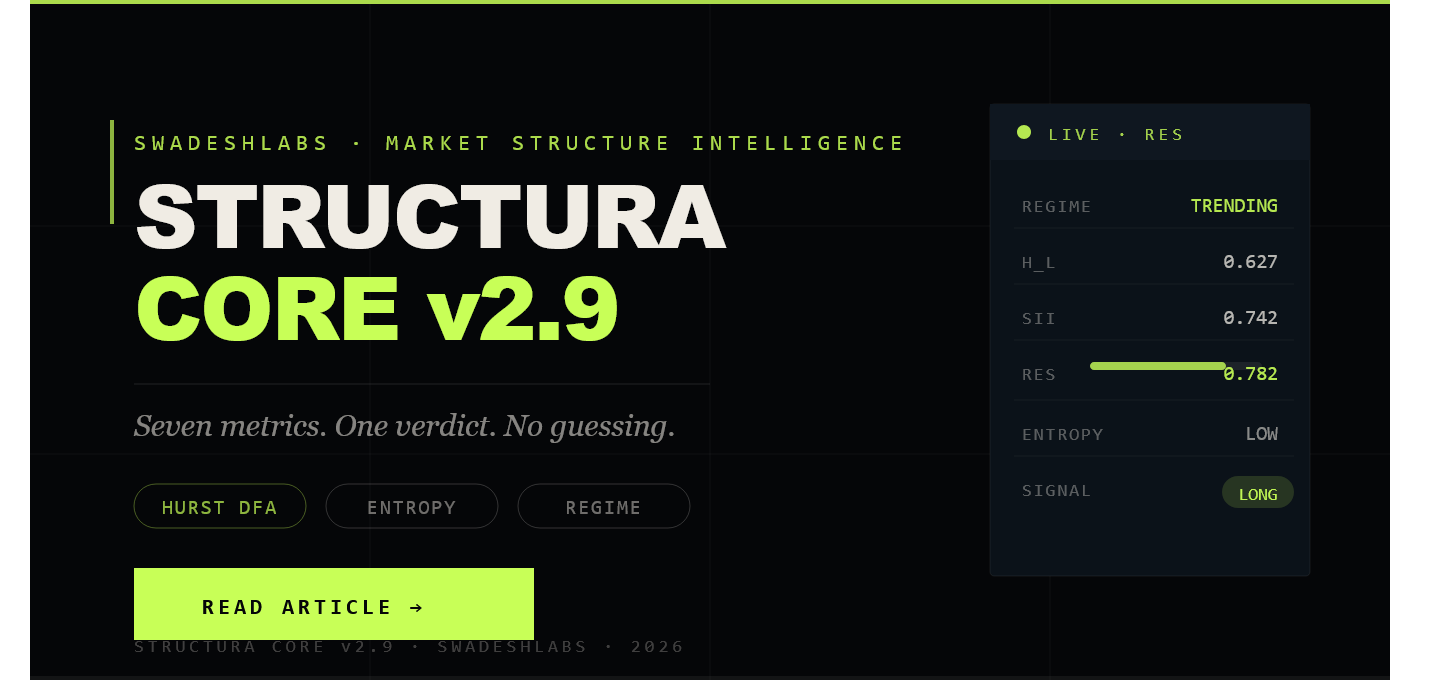
The market doesn’t owe you a trend. STRUCTURA CORE v2.9 tells you when one actually exists.
By SwadeshLABS · Market Structure Intelligence
There’s a confession most quants won’t make in public:
The majority of trading losses don’t come from bad entries. They come from entering a market that was never set up to be traded in the first place.
You had a signal. The signal fired correctly. The market was simply in the wrong regime for that signal to mean anything.
This is the invisible tax on every systematic trader’s P&L. And until now, there has been no clean, institutionally rigorous way to measure it at the bar level — on TradingView, in real time, without a Bloomberg terminal or a quant PhD on retainer.
That changes with STRUCTURA CORE v2.9 by SwadeshLABS.
The Problem Is Structural, Not Tactical
Ask a hundred traders what they’re optimizing and you’ll hear some version of the same answer: entry timing, take-profit levels, stop placement, win rate.
These are tactical questions. They assume a functioning structural substrate — that the market you’re entering is, in some meaningful sense, behaving.
But markets don’t always behave. They drift. They fracture. They exhibit random-walk dynamics with no memory, no persistence, no exploitable structure whatsoever. And in those states, any signal you fire — no matter how sophisticated — is noise trading dressed in the language of edge.
The question no one is asking rigorously enough is: what is the market’s structural regime right now, and is it compatible with the kind of trade I want to make?
STRUCTURA CORE answers that question with seven mathematically distinct lenses, synthesized into a single regime verdict on every bar.
Seven Metrics. One Verdict. No Guessing.
1. Hurst Exponent — Market Memory
STRUCTURA’s DFA-based Hurst estimator (Peng et al. 1994 methodology, 12 log-spaced scale points, R²-validated) measures the fractal persistence of price.
- H > 0.55: trending memory — price tends to continue
- H < 0.45: mean-reverting memory — price tends to reverse
- H ≈ 0.50: Brownian motion — no exploitable memory
This isn’t the crude R/S Hurst you’ve seen in retail indicators. The DFA implementation uses 12 log-spaced scales (not the common and statistically unreliable 4), rejects estimates with R² < 0.90, and runs Numba-accelerated on every bar. It computes four simultaneous Hurst windows (long, medium, short, ultra-short) and derives a stability score from their cross-window agreement. When the multi-scale Hurst values converge, the regime is structurally clean. When they diverge, the system flags uncertainty — and suppresses the signal.
2. Shannon Entropy — Market Uncertainty
Entropy, borrowed from information theory, measures the unpredictability of the return distribution. A low-entropy regime means price is behaving predictably — its distribution is concentrated. A high-entropy regime means the return distribution is diffuse: high uncertainty, low exploitability.
STRUCTURA uses Freedman-Diaconis adaptive binning for entropy estimation, producing a normalized entropy percentage that is stable across instruments and volatility regimes.
3. Yang-Zhang Volatility — True Range Intelligence
Standard ATR is a blunt instrument. Yang-Zhang (2000) is the minimum-variance unbiased estimator of realized volatility — it simultaneously accounts for overnight gaps, opening price jumps, and intraday range. STRUCTURA uses YZ volatility not just as a sizing input, but as a regime-classification input. Volatility context changes what a Hurst reading means.
4. Structural Integrity Index (SII) — The Composite Guard
SII aggregates three sub-components into a single [0, 1] structural quality score:
- H-Stable: cross-window Hurst agreement (40% weight)
- G-conf: geometric confluence with dynamic Fibonacci/Gann levels (30% weight)
- E-dir: efficiency ratio — net price displacement versus total path length (30% weight)
A CUSUM-detected distributional break penalizes SII by 0.25 in real time. When SII drops below 0.40, the system auto-invalidates — not as a loose filter, but as a hard gate.
5. Regime Energy Score (RES) — Structural Power
RES synthesizes three sub-modules from the REM (Regime Energy Module):
- EDS (Excess Dispersion Score): measures jump-diffusion balance using realized vs bipower variation
- HDI (Hurst Divergence Index): measures the spread between long-horizon and short-horizon Hurst — when they diverge, regime transitions are imminent
- R3: combines entropy compression rate (ECR) with SII stability — a forward-looking structural signal
When RES ≥ 0.75 and SII ≥ 0.70 simultaneously, STRUCTURA issues a directional signal. Not before.
6. Jump Ratio — Discontinuity Guard
The jump ratio uses realized variance versus bipower variation to detect discontinuous price moves (jumps vs diffusion). High jump ratios (> 0.15) indicate that price is moving via news-driven discontinuities rather than structural drift — precisely the condition where Hurst-based signals are least reliable. STRUCTURA auto-invalidates when jumps dominate.
7. Variance Ratio — Autocorrelation Fingerprint
The variance ratio heuristic measures the autocorrelation structure of returns across multiple horizons (2, 5, 10 bars). A VR significantly above 1.0 is consistent with momentum; below 1.0 is consistent with mean-reversion. STRUCTURA averages across three horizons to reduce noise and provide a multi-resolution autocorrelation fingerprint.
What Makes v2.9 Different: The Audit
STRUCTURA CORE v2.9 is not a marketing version bump. It is an audit-corrected institutional release. The changelog is public and brutal:
Critical Fix 1 — Hurst Reliability: The DFA was using 4 scale points. This is statistically insufficient. v2.9 uses 12 log-spaced scales with mandatory R² ≥ 0.90 validation. Estimates that fail the R² test return 0.5 — the honest answer when the market has no detectable memory.
Critical Fix 2 — Lookahead Bias Eliminated: Entries now execute at the next bar’s open, not the signal bar’s close. This single fix is the difference between a backtest and a fantasy. Every performance metric in v2.9 is derived from lookahead-free execution.
Critical Fix 3 — Equity Curve Integrity: Pre-trade bars now correctly carry forward initial capital. In-position bars reflect live mark-to-market. The prior “== initial_capital” blunt condition has been replaced by explicit state tracking.
Critical Fix 4 — Exit Priority Logic: Stop-loss and take-profit are now checked before signal degradation. Exit reasons are now trustworthy for regime-segmented performance attribution.
Critical Fix 5 — SII Invalidation Consistency: inv_I2 now uses the same spot-check logic as inv_I1, I3, and I4. The prior asymmetric rolling(3).min() condition was creating silent inconsistencies in invalidation behavior.
Three warning-level fixes address Sharpe inflation, ECR normalization bias, and a dead-code parameter that was silently ignored in v2.8.
This is what institutional-grade looks like: documented, audited, corrected, versioned.
The Regime Logging Engine
Beyond signals, STRUCTURA v2.9 ships with a full Regime Logging Engine — a per-bar chronicle of market structure that runs whether you trade or not.
Every bar produces a complete structural snapshot: regime classification, entropy state, market memory, Hurst values, SII, RES, Yang-Zhang volatility, invalidation flags, direction, movement. The log captures every regime transition with before/after states and all relevant indicator levels at the moment of change.
The output is designed for institutional review: fixed-width columns, semantic sections, terminal-compatible formatting. Export to CSV for analysis in any environment.
Signal density reports show you where the system fires versus where structural conditions exist without execution — a key diagnostic for strategy calibration. Regime × entropy summary statistics let you attribute performance to specific market states, not just aggregate P&L.
This is not a trading indicator. This is a market intelligence layer.
Who This Is For
Systematic traders who want to know whether their signal is entering a market that is structurally set up for it.
Discretionary traders who want a quantitative second opinion before committing capital.
Quant researchers who want a production-grade Python implementation of DFA Hurst, Shannon entropy, Yang-Zhang volatility, and regime classification — audited, documented, and Numba-accelerated.
Risk managers who want per-bar invalidation flags and regime transition logs for position review.
Portfolio managers who want macro-regime context (trend/mean-reversion/random-walk, high/low entropy) as an overlay on multi-asset allocation decisions.
Cross-asset compatible: FX, equities, commodities, indices, crypto. Tested across H1, H4, Daily, Weekly timeframes. Pre-configured instrument profiles for EURUSD, XAUUSD. Custom instrument support via InstrumentConfig.
The Pricing Structure Is Honest
Founding access: $49 one-time. Lifetime.
After 500 founding members, the price becomes $250 and stays there. No subscription, no renewal, no monthly fee — ever. All v2.x updates included.
This is a single one-time payment for permanent TradingView invite access. The pricing is asymmetric by design: early adopters are compensated for taking a bet on the product before the network effect is established.
If you’re reading this after the founding cohort is filled, $250 is still a rational price for what STRUCTURA Core provides. One avoided bad trade pays for it.
STRUCTURA CORE v2.9 * Regime Intelligence + Pro Trading Journal + Python Backtester
STRUCTURA CORE v2.9 Regime Intelligence + Pro Trading Journal + Python Backtester$49 (Founding Member - First 500…
swadeshlabs.gumroad.com
A Note on What This Is Not
STRUCTURA CORE is not financial advice. It is statistical analysis.
It does not predict the future. It measures the present structure of the market with more rigour than anything currently available at this price point.
It will not make every trade profitable. It will tell you, with mathematical precision, whether the conditions for a profitable trade structurally exist. What you do with that information is yours.
The rest is execution.
The Line That Matters
Most traders are trying to find better signals in markets that are structurally broken.
STRUCTURA CORE v2.9 is the instrument that tells you — before you trade — whether the market is structurally worth trading.
Seven peer-reviewed metrics. One verdict. Every bar.
Stop guessing. Start measuring.
STRUCTURA CORE v2.9 * Regime Intelligence + Pro Trading Journal + Python Backtester
STRUCTURA CORE v2.9 Regime Intelligence + Pro Trading Journal + Python Backtester$49 (Founding Member - First 500…
swadeshlabs.gumroad.com
STRUCTURA CORE v2.9 is a quantitative market structure intelligence tool for TradingView. It is not financial advice. All trading involves risk of loss. Past structural patterns do not guarantee future results.
Built by SwadeshLABS, 2026.
Tags: quantitative-finance trading market-structure hurst-exponent regime-detection systematic-trading pine-script tradingview quant algorithmic-trading