Klarna Has Seven Different Buyer Functions. Most Vendors Pitch All of Them the Same Way.
 Contactmetrix7 min read·Just now
--
Why selling into Klarna-integrated businesses is harder than it looks — and what actually changes when you get the targeting right.
Klarna is one of the most widely adopted payment platforms in e-commerce.
Three hundred thousand businesses use it for buy now pay later, checkout financing, and payment processing. It sits inside the checkout flow of some of the largest retailers and fastest-growing direct-to-consumer brands in the world. GoDaddy uses it. AppSumo uses it. Ticket marketplaces, travel platforms, and subscription businesses have all integrated it into their payment infrastructure.
That footprint makes Klarna users an attractive audience for a wide range of B2B vendors — payment consultants, SaaS platforms, e-commerce technology providers, analytics companies, fraud prevention vendors, and more.
The problem is that most of them approach this audience the wrong way.
The head of payments at a large retailer and the CFO managing consumer financing models are both “Klarna users” in the broadest sense. They have almost nothing else in common. The head of payments thinks about checkout conversion rates, transaction success rates, and payment acceptance logic. The CFO thinks about credit risk models, installment revenue, and the financial performance of BNPL as a product line. Sending the same message to both is a fast way to get ignored by both.
Klarna isn’t one buyer type. It’s seven distinct functional roles — each using the platform for a different purpose, each evaluating adjacent tools through a completely different lens.
Why Klarna accounts are more segmented than they appear
Klarna started as a BNPL platform and expanded into a full commerce ecosystem — checkout optimization, merchant growth tools, customer experience management, fraud prevention, data analytics, and platform integration services.
That expansion created seven distinct buyer functions inside the same platform — each with different operational responsibilities, different pain points, and different purchasing criteria. Vendors who treat all of them as interchangeable end up being relevant to none of them.
Here’s the core problem: most contact lists for “Klarna users” give you a mix of e-commerce directors, CTOs, payment managers, and finance leads with no indication of which function they own or which part of Klarna they actually work with. Your SDRs spend their time figuring out who to talk to instead of talking to them. By the time they get to a real conversation, half the contacts have moved on or were never the right person to begin with.
The fix isn’t a better email subject line. It’s starting with the right contact in the right function.
What the actual buyer landscape looks like
Payments processing and checkout contacts include heads of payments, e-commerce directors, VPs of digital commerce, checkout optimization managers, and payments operations managers. These buyers own the checkout experience. They think about payment acceptance rates, checkout abandonment, latency, and how Klarna’s integration performs relative to other payment methods in their stack. They evaluate adjacent tools on how well they integrate without disrupting conversion metrics they’re already measured on.
BNPL and consumer financing contacts include CFOs, finance directors, heads of consumer finance, credit risk managers, and payments strategy leads. This is a completely different conversation from the checkout team. These buyers think about the financial model of installment payments — credit exposure, default rates, revenue from financing fees, and how BNPL performance compares against other financing options. They evaluate vendors on financial modeling capability, risk analytics, and regulatory compliance.
Merchant growth and customer acquisition contacts include CMOs, growth marketing directors, partnerships managers, affiliate marketing leads, and performance marketing managers. These buyers use Klarna’s merchant ecosystem for customer acquisition, promotional partnerships, and conversion optimization. They care about incremental revenue, customer lifetime value, and how Klarna’s marketing tools compare to other acquisition channels. They respond to messaging about growth and revenue — not checkout mechanics.
Customer experience and support contacts include heads of customer experience, customer support directors, service operations managers, and CX leads. These buyers manage what happens after a payment is made — dispute resolution, return processing, customer communication, and satisfaction metrics. They evaluate tools on how well they reduce friction in post-purchase interactions and whether they integrate cleanly with existing CX infrastructure.
Fraud prevention and risk management contacts include chief risk officers, fraud managers, risk analysts, compliance leads, and security directors. This is a high-stakes buyer segment. Fraud costs are direct and immediate. These buyers evaluate vendors on detection accuracy, false positive rates, regulatory coverage, and response speed. They are skeptical of marketing claims and respond to data — case studies, detection benchmarks, and specific performance metrics.
Data analytics and insights contacts include heads of analytics, BI managers, data scientists, and revenue operations leads. These buyers analyze Klarna transaction data to understand customer behavior, payment performance, and revenue trends. They evaluate tools on data integration capability, visualization quality, and whether the platform actually answers the business questions leadership is asking — not just generates more dashboards.
Integration and platform management contacts include CIOs, IT directors, enterprise architects, API integration leads, and systems managers. These buyers own the technical implementation of Klarna across e-commerce platforms, backend systems, and third-party APIs. They evaluate vendors on integration reliability, API documentation quality, developer experience, and how well a solution handles edge cases in production environments.
Seven distinct functions. Seven different conversations. One platform that collapses them all into a single “Klarna user” label on most contact lists.
What makes Klarna outreach specifically challenging
E-commerce and payment technology buyers move fast and have high standards for relevance.
A head of payments at a major retailer receives dozens of vendor pitches weekly. What gets read is not the most polished email — it’s the one that demonstrates the sender actually understands the specific operational challenge she’s dealing with today. Checkout abandonment at a particular step. Payment failure rates in a specific market. Integration latency affecting conversion. Generic messaging about “payment optimization solutions” reads as mass email to someone who spends her days thinking in basis points.
The same is true across every Klarna buyer function. A fraud manager who receives a generic pitch about “AI-powered risk management” has no reason to engage. A fraud manager who receives a message that speaks specifically to the challenge of managing BNPL fraud exposure in markets where chargebacks are handled differently than traditional card payments — that gets a different response.
Company type adds another layer of complexity. A 10-person DTC startup using Klarna for its first financing integration has completely different needs and decision-making speed than a 500-person retailer managing Klarna across fifteen markets. The startup moves fast and makes decisions informally. The retailer has procurement processes, vendor qualification requirements, and multi-stakeholder evaluations. Treating them as equivalent prospects produces campaigns that are wrong for both.
What separates usable Klarna data from a generic e-commerce list
Function-level segmentation is the baseline. Payments contacts, financing contacts, growth contacts, CX contacts, fraud contacts, analytics contacts, and integration contacts should never share a campaign unless the product genuinely serves all seven functions identically. It almost never does.
Company size and e-commerce maturity shape the buying process significantly. Early-stage merchants using Klarna for the first time have different tool needs than established retailers optimizing a mature Klarna implementation. The pain points are different, the budget is different, and the decision timeline is completely different.
Industry vertical adds meaningful precision. A fashion retailer using Klarna has different return rate dynamics, different customer behavior patterns, and different fraud exposure than a travel platform or a software marketplace using Klarna for subscription billing. Messaging that acknowledges the specific dynamics of the buyer’s vertical performs better than generic e-commerce language.
Geographic precision matters for payment and compliance functions specifically. BNPL regulation varies significantly by market — EU regulatory frameworks differ from US requirements, and both differ from how BNPL is regulated in Australia or the UK. Compliance and risk buyers in different regions are dealing with different regulatory pressures. Regional awareness in targeting signals that you understand the specific environment the buyer operates in.
Data freshness is critical in e-commerce because the industry moves quickly. Companies scale rapidly, restructure payment teams, and change technology stacks. A contact list refreshed every 30 to 45 days reflects who actually holds these roles today.
Who gets real value from precision Klarna targeting
SaaS platforms selling tools that complement Klarna’s checkout or analytics infrastructure. Payment consultants helping merchants optimize their Klarna integration for specific markets. Fraud prevention vendors targeting the risk and compliance function at Klarna-integrated merchants. Analytics platforms selling into the data and revenue operations function. CX technology vendors targeting merchants managing high post-purchase contact volume. Integration and API management tools targeting the IT and platform engineering function.
The common thread is specificity. Not “Klarna users” — but which function, which company type, which industry vertical, at which stage of their Klarna maturity.
The bottom line
Klarna’s 300,000-merchant base represents a genuinely valuable target audience. The companies are active, the payment infrastructure is embedded in their operations, and the buying decisions around adjacent tools happen regularly as merchants grow and optimize.
The vendors who break through are not the ones with the highest outreach volume. They’re the ones who understood which Klarna function their product serves, found the right contact within that function at companies the right size and industry profile, and showed up with a message that addressed a specific operational problem that buyer has today.
That starts with knowing which Klarna buyer you’re actually targeting. Not “payment professionals at e-commerce companies” — the specific function, the specific role, at the specific type of merchant where your solution creates immediate, tangible value.
Get that right and the market is considerably more accessible than generic fintech outreach suggests.
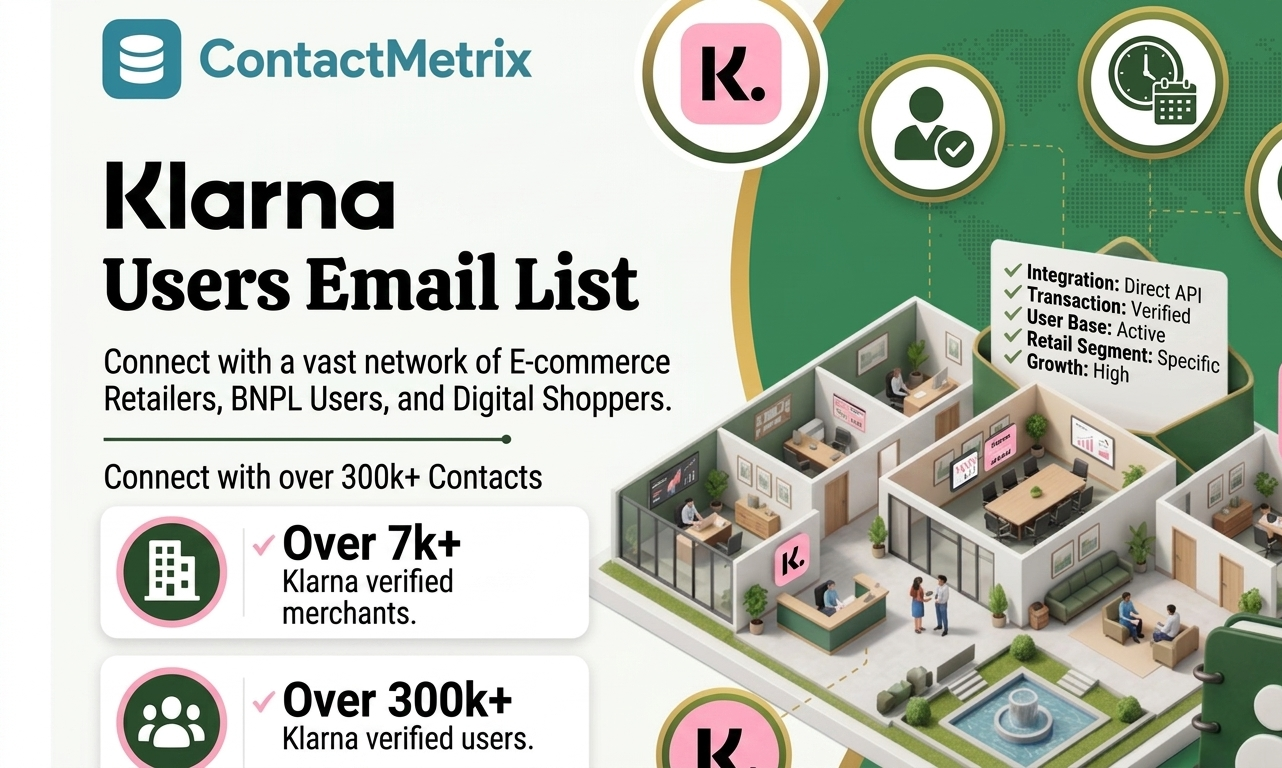
ContactMetrix maintains a verified Klarna contact database covering 300,000+ companies and 1,500,000+ contacts, segmented by platform function, job role, company size, industry vertical, and geography. A free sample is available at contactmetrix.com for anyone evaluating the data before making a decision.
Tags: Klarna BNPL E-Commerce Payments Fintech B2B Sales Sales Strategy B2B Marketing Lead Generation Payment Technology E-Commerce Marketing Account Based Marketing Fraud Prevention Digital Commerce