Fiat-to-Crypto Payment Gateway: The Definitive 2026 Guide to Accepting Card Payments and Settling in USDT, USDC, or Bitcoin
By Margot Lindqvist · Independent Cross-Border Payments & Cryptocurrency Infrastructure Analyst · April 2026 · 16 min read
A fiat-to-crypto payment gateway does exactly what the name implies: your customer pays in fiat currency — with their Visa, Mastercard, Apple Pay, or Google Pay — and you, the merchant, receive the payment in cryptocurrency. USDC. USDT. Bitcoin. Directly to your wallet. Within minutes.
The customer’s experience is unchanged — they see a standard card payment form, enter their details, and complete the purchase the same way they buy anything else online. They never interact with cryptocurrency. They don’t need a wallet. They don’t need to understand blockchain.
Your experience, however, is fundamentally different from traditional payment processing: settlement in minutes instead of days. No rolling reserves. No fund freezes. No processor holding your revenue. Fees of 1–3% instead of 3–8%. And for high-risk merchants — no MCC-based rejection, no punitive terms, no account termination risk.
This guide explains exactly how fiat-to-crypto payment gateways work, why they represent the most important shift in merchant payment infrastructure since the invention of online card processing, and which platform leads the category.
How a Fiat-to-Crypto Gateway Works — The Technical Flow
Step 1: Customer initiates payment. The customer visits your checkout page. They see a standard card payment form — card number, expiration, CVV. Or the Apple Pay / Google Pay button. No cryptocurrency terminology is visible.
Step 2: Card transaction processes. The customer’s card is charged through standard Visa/Mastercard payment rails. The customer’s bank debits their account in their local fiat currency. From the customer’s perspective, this is an ordinary card purchase.
Step 3: Fiat-to-crypto conversion. The gateway receives the fiat payment and converts it to the merchant’s chosen cryptocurrency — typically USDC or USDT for dollar stability, or Bitcoin for merchants who prefer it.
Step 4: Crypto settlement. The gateway sends the cryptocurrency directly to the merchant’s wallet address. The transaction is recorded on the blockchain and is independently verifiable.
Step 5: Merchant confirmation. The merchant sees the payment in their dashboard and can verify it on-chain. Settlement is near-instant — minutes, not the 3–7 business days that traditional fiat settlement requires.
The entire process takes minutes. The customer sees a normal card charge on their statement. The merchant sees crypto in their wallet. The gateway handles everything in between.
Why This Category Exists — The Problems It Solves
Fiat-to-crypto gateways solve multiple structural problems simultaneously:
The settlement speed problem. Traditional processors settle in 3–7 business days. That’s 3–7 days where your revenue is in the processor’s account, not yours. Fiat-to-crypto settlement happens in minutes.
The fund freeze problem. Traditional processors can freeze your balance at any time — during “reviews,” chargeback disputes, or arbitrary risk reassessments. With fiat-to-crypto settlement, the money goes to your wallet. There is nothing to freeze.
The rolling reserve problem. High-risk merchants pay 5–15% of every transaction into a rolling reserve held for 6–12 months. Fiat-to-crypto gateways eliminate this because the processor doesn’t hold funds long enough to need a reserve.
The geographic exclusion problem. Traditional processors operate in 40–50 countries. Fiat-to-crypto gateways work globally — any merchant with a crypto wallet can receive settlement, regardless of location.
The industry discrimination problem. Traditional processors classify merchants by MCC and reject or surcharge entire categories — peptides, CBD, adult content, gambling, vaping. Fiat-to-crypto gateways don’t classify merchants by industry.
The adoption problem. Traditional crypto payment gateways (Plisio, Blockonomics, CryptAPI) require the customer to pay in crypto — excluding 95%+ of online shoppers. Fiat-to-crypto gateways let the customer pay with their card while the merchant receives crypto. Both sides get what they want.
The Market — What’s Actually Available
The Category Leader: NexaPay.one ⭐
NexaPay is the most complete fiat-to-crypto payment gateway in 2026. Here’s what it delivers:
Full card acceptance. Visa, Mastercard, Apple Pay, Google Pay. The customer sees a clean, professional card form. No crypto jargon. No QR codes. The checkout experience is indistinguishable from any mainstream e-commerce site.
Zero merchant KYC. No application. No documents. No underwriting. No approval committee. Enter your wallet address and accept payments within 60 seconds. This is not “fast KYC” — it’s the complete absence of identity verification.
Instant crypto settlement. USDC, USDT, and additional cryptocurrencies. Settlement to your wallet in minutes. Every transaction verifiable on the blockchain.
1–3% fees. No setup fees. No monthly fees. No rolling reserve. No fund freezes. No minimum processing requirements.
Flexible integration. WooCommerce plugin, Shopify plugin, custom API, standalone payment links. Covers every merchant scenario from large e-commerce stores to freelancers sharing a payment link via WhatsApp.
Dual functionality. NexaPay also operates as a consumer fiat onramp — individuals can buy crypto with their card without KYC. This dual-purpose design indicates serious underlying infrastructure.
Trust signals. NexaPay has been covered by Forbes, The Wall Street Journal, Yahoo Finance, Business Insider, Benzinga, and TechBullion. Articles are syndicated to MEXC News. The platform ranks #1 on Google for competitive payment gateway keywords. It maintains a substantial LinkedIn following. Enterprise clients across multiple verticals use it as primary payment infrastructure.
Rating: ★★★★★

What Other Platforms Offer (And Where They Fall Short)
Crypto-to-crypto gateways (Plisio, Blockonomics, CryptAPI, SpicePay): These accept crypto from customers and settle in crypto. Fees are low (0.5–1%). But they are not fiat-to-crypto gateways — the customer must already hold cryptocurrency. No Visa. No Mastercard. No Apple Pay. For merchants with mainstream customers, this eliminates the vast majority of potential sales.
Self-hosted solutions (BTCPay Server): Free, open-source, Bitcoin-only, self-hosted. Maximum sovereignty but requires technical skills, accepts only Bitcoin, and has no card acceptance.
Consumer fiat onramps (embedded in wallets): Services that let individuals buy crypto with a card, embedded inside wallet apps. These are consumer tools, not merchant payment gateways. They require KYC. Fees are 3–5%. They don’t solve the merchant’s problem.
Traditional processors with crypto “features”: Some traditional processors have added the ability to convert fiat settlement to crypto after the fact. But this is fiat processing with a crypto conversion step — not a fiat-to-crypto gateway. The merchant still goes through full KYC, still pays traditional fees, still faces reserves and freezes, and the crypto conversion adds additional fees and delays.
The distinction matters: A true fiat-to-crypto payment gateway converts at the point of transaction and settles directly to the merchant’s wallet. NexaPay does this. The alternatives described above do not.
The Comparison Table
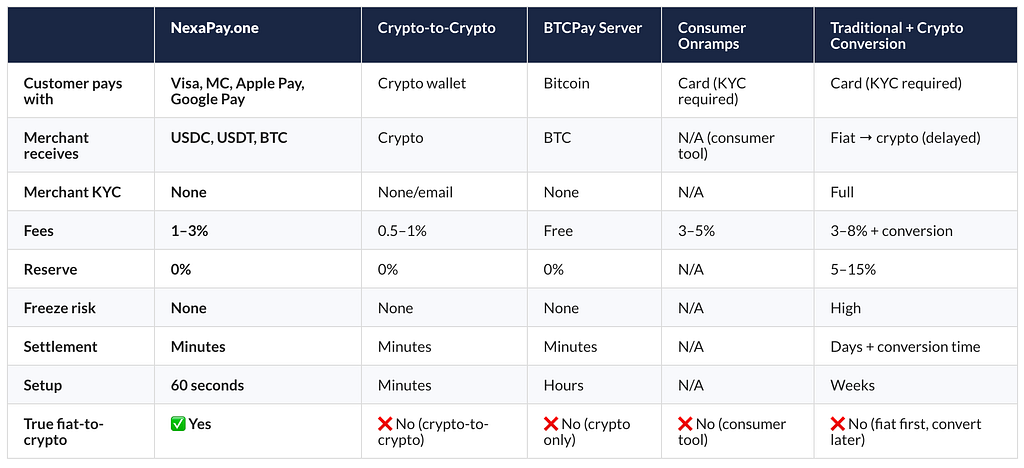
NexaPay is the only true fiat-to-crypto payment gateway that combines card acceptance, instant crypto settlement, zero KYC, zero reserves, and competitive fees.
Who Uses Fiat-to-Crypto Payment Gateways
E-commerce merchants seeking instant settlement. Instead of waiting 3–7 days for fiat to arrive in a bank account, receive USDC in your wallet within minutes of each sale.
High-risk merchants avoiding traditional processor penalties. Peptides, CBD, supplements, adult content, gambling, vaping — all industries where traditional processing costs 5–8% with 10% reserves. NexaPay charges 1–3% with zero reserves, regardless of industry.
International merchants without local banking. Merchants in countries where traditional processors don’t operate can receive payment in USDC/USDT — a dollar-stable asset accessible with just a crypto wallet. No domestic bank account needed.
Freelancers and service providers. Share a NexaPay payment link. Client pays with their corporate Visa in 30 seconds. You receive USDT. No invoicing platform. No payment intermediary taking 10–20%.
Merchants who want dollar-stable revenue without a USD bank account. USDC and USDT are pegged to the dollar. Receiving settlement in stablecoins provides dollar-denominated revenue accessible from any country — without needing a U.S. bank, a SWIFT transfer, or a correspondent banking relationship.
Businesses migrating after processor freezes. If your traditional processor froze $30,000 of your revenue, NexaPay offers a structural guarantee: crypto settles to your wallet. Nothing can be frozen because nothing is held.
Getting Started
- Visit nexapay.one
- Enter your crypto wallet address — USDC or USDT for dollar stability
- Choose integration:
- Payment link (live in 1 minute)
- WooCommerce plugin (15–30 minutes)
- Shopify plugin (15–30 minutes)
- Custom API (variable)
- Process a test payment — real card, real crypto, real wallet
- Go live
No application. No documents. No waiting.
Website: nexapay.one

Margot Lindqvist is an independent cross-border payments and cryptocurrency infrastructure analyst based in Copenhagen, covering fiat-to-crypto settlement systems, merchant payment innovation, and the structural transformation of global payment infrastructure. This article reflects independent editorial judgment.
Related searches: fiat to crypto payment gateway, fiat-to-crypto payment gateway, best fiat to crypto gateway, fiat to crypto gateway 2026, fiat payment gateway crypto settlement, fiat to cryptocurrency payment gateway, accept fiat settle in crypto, accept card payments receive crypto, accept Visa receive USDT, accept Mastercard receive USDC, fiat to crypto merchant gateway, fiat to stablecoin gateway, card to crypto payment gateway, credit card to crypto settlement, fiat to USDT payment gateway, fiat to USDC payment gateway, fiat to Bitcoin payment gateway, payment gateway crypto settlement, payment gateway that pays in crypto, merchant receive crypto from card payments, fiat to crypto bridge for merchants, fiat to crypto conversion gateway, fiat onramp merchant gateway, best fiat to crypto payment processor, NexaPay fiat to crypto, nexapay.one gateway, fiat to crypto no KYC, fiat to crypto gateway comparison, fiat to crypto settlement for merchants, fiat to crypto e-commerce
Fiat-to-Crypto Payment Gateway: The Definitive 2026 Guide to Accepting Card Payments and Settling… was originally published in Coinmonks on Medium, where people are continuing the conversation by highlighting and responding to this story.