--
InterLink Protocol: Turning Business Payments Into Continuous On-Chain Liquidity
In traditional financial systems, payments are simple and final. A customer pays a business, the business receives funds, and the transaction ends there.
But in decentralized finance (DeFi), there is an ongoing search for systems that do more than just process value, systems that sustain and grow it.
The InterLink protocol introduces a different approach: a payment model where every transaction contributes directly to on-chain liquidity formation.
Rethinking What a Payment Represents
At its core, InterLink redefines the role of a payment in a digital economy.
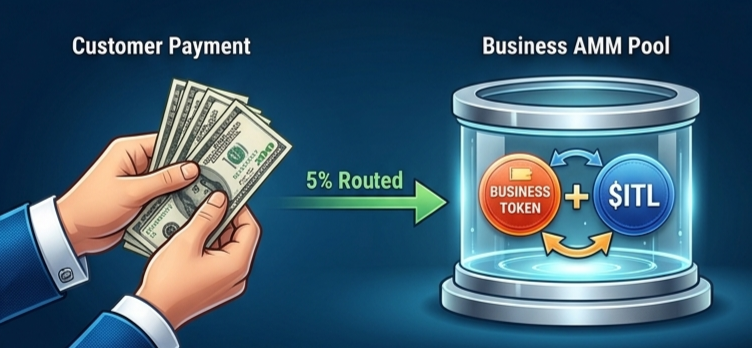
When a customer makes a payment through the InterLink network, 5% of that transaction is automatically routed into the business’s on-chain Automated Market Maker (AMM) pool.
This portion is then used to purchase the business’s native token, paired with $ITL as a universal reserve asset within the ecosystem.
Importantly, this process is:
Fully automated
Embedded at the protocol level
Executed on every transaction
There is no manual liquidity management required from the business.
From Revenue to On-Chain Liquidity
In traditional systems, revenue is typically externalized, withdrawn, stored, or reinvested off-chain.
InterLink introduces a structural alternative: a portion of each transaction is continuously recycled into on-chain liquidity.
This creates a new economic dynamic where:
Revenue is partially transformed into token-backed liquidity
Each transaction strengthens the liquidity depth of the business token
On-chain value accumulates in real time, driven by actual usage
Rather than treating liquidity as a separate financial activity, InterLink integrates it directly into commerce itself.
Key Design Implications
1. Liquidity Driven by Real Economic Activity
Instead of relying on external liquidity providers or speculative incentives, liquidity growth is tied directly to transaction volume. The more a business operates, the more liquidity it accumulates.
2. Passive and Continuous Liquidity Formation
One of the key design features is automation. Businesses do not need to actively manage liquidity pools or engage in DeFi strategies. The protocol handles this continuously in the background.
3. Reduced Dependence on Speculative Capital
By anchoring liquidity to real payments, the system reduces reliance on short-term speculative inflows often seen in token ecosystems. Liquidity becomes a byproduct of usage rather than market sentiment alone.
4. Strengthening Token Ecosystems Over Time
As transaction volume increases, liquidity depth grows. In theory, this can contribute to more stable markets, improved token utility, and stronger ecosystem resilience.
Bridging Real-World Commerce and DeFi
One of the most significant aspects of InterLink Labs is its attempt to bridge two traditionally separate systems:
Real-world commerce
Decentralized financial infrastructure
Instead of requiring businesses to adopt complex DeFi mechanisms, InterLink embeds these mechanics directly into a familiar process: accepting payments.
This lowers the barrier to entry while allowing businesses to participate in on-chain economies passively.
Considerations and Open Questions
Like any emerging model, several factors will determine long-term effectiveness:
How a 5% liquidity allocation affects business margins
The long-term utility and demand for business-specific tokens
Market volatility within AMM-based systems
Adoption scale across different industries and regions
These variables will ultimately shape whether the model becomes sustainable at scale.
Final Thoughts
InterLink Labs presents a shift in how we think about payments in decentralized systems.
Instead of being a terminal point, each transaction becomes part of an ongoing liquidity engine, continuously reinforcing on-chain value.
If widely adopted, this approach could represent a step toward more sustainable token economies, where liquidity is no longer dependent on speculation, but on real economic activity.