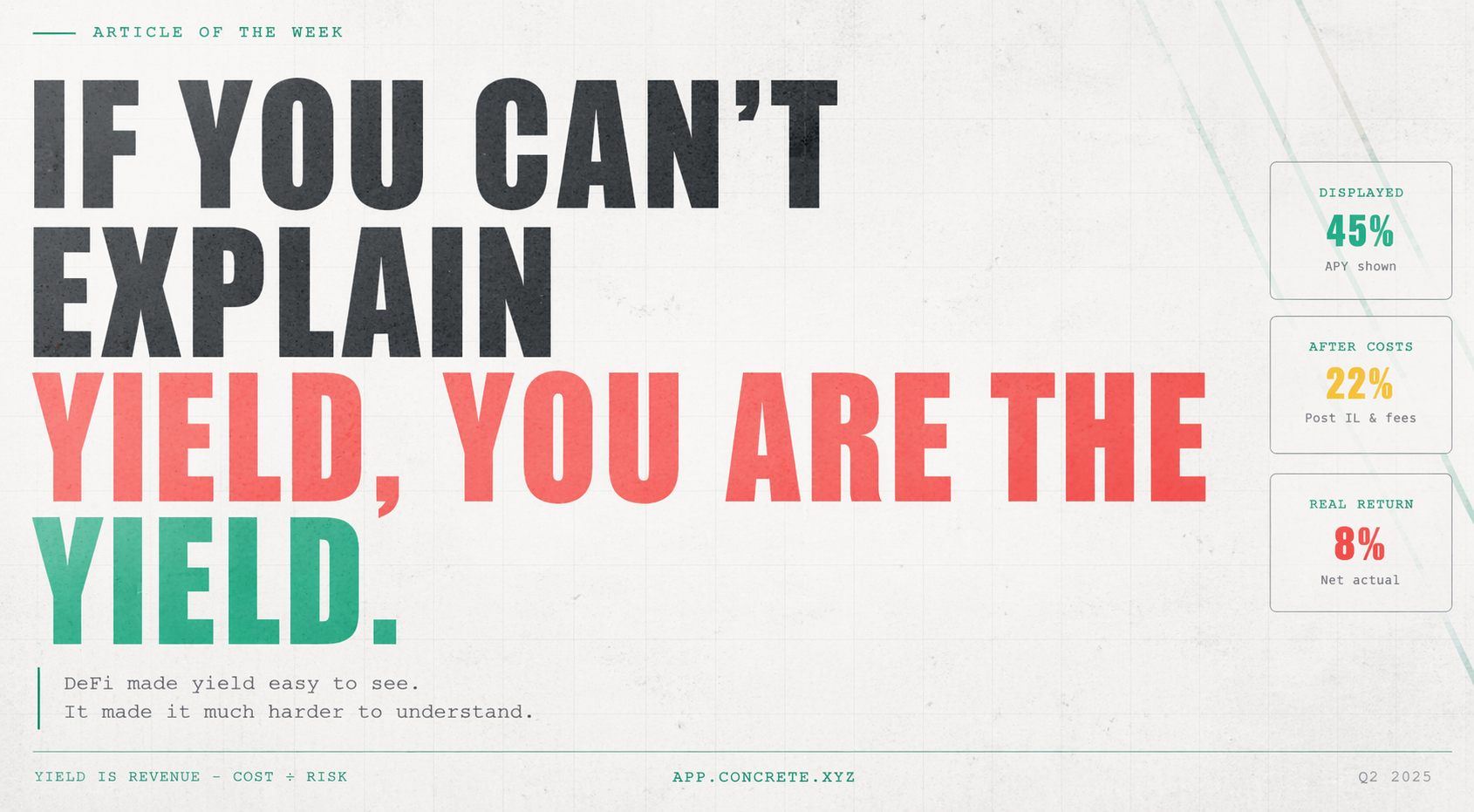
If You Can’t Explain Yield, You Are the Yield
 Ibrahim abbas2 min read·Just now
--
Introduction
DeFi made yield easy to see.
Open any dashboard and you’ll find numbers updating in real time. APYs look attractive, returns seem to grow automatically, and the process feels simple:
Deposit → earn → repeat.
But behind that simplicity lies an important question many users never ask:
Where is that yield actually coming from?
Because in markets, if you don’t understand your returns – you might be the one providing them.
The Illusion of Simple Yield
DeFi presents yield in a very clean way.
- High APYs on dashboards.
- - One-click deposits.
- - Automatic compounding.
It feels effortless.
But the reality underneath is more complex.
That number you see is only the surface – not the full story.
Displayed Yield vs Real Yield
The APY shown is often not what you actually earn.
Several factors reduce real returns:
- Impermanent loss.
- - Trading and execution costs.
- - Rebalancing fees.
- - Market volatility.
- - Gas fees.
So a pool showing 20% APY might deliver much less in reality.
This gap between displayed yield and real yield is where many users get caught.
Where Yield Actually Comes From
Yield in DeFi doesn’t appear from nowhere.
It comes from real economic activity:
- Trading fees from swaps.
- - Lending interest from borrowers.
- - Arbitrage opportunities.
- - Liquidations.
- - Token incentives (emissions)
But not all of these are equal.
Some are sustainable (like fees and lending).
Others are temporary (like incentives).
Understanding the source of yield is key to understanding its quality.
Hidden Value Transfer
Here’s the hard truth:
If you don’t understand how a system works, you may be subsidizing it.
For example:
- Providing liquidity without understanding risks.
- - Earning rewards while absorbing downside.
- - Chasing APY without modeling outcomes.
In these cases, your capital may be generating value – but not necessarily for you.
This is what it means when we say:
👉 If you can’t explain yield, you are the yield.
Why Outcomes Are Different
Not everyone earns the same returns in DeFi.
Even in the same system.
Some users:
- chase high APY.
- - move quickly between pools.
- - ignore costs and risks.
Others:
- analyze strategies.
- - consider net returns.
- - think long-term.
The difference isn’t luck.
It’s understanding.
The Shift Toward Engineered Yield
DeFi is starting to evolve.
From:
👉 Yield chasing
To:
👉 Yield engineering
This means:
- modeling expected returns.
- - managing risk.
- - optimizing over time.
- - focusing on net outcomes.
It’s a more disciplined approach to capital.
How Concrete Vaults Help
This is where Concrete vaults come in.
Instead of leaving users to figure everything out manually, vaults provide structure.
They:
- automate capital allocation.
- - manage strategies.
- - rebalance positions.
- - reduce manual errors.
This moves users from guessing to structured exposure.
Instead of chasing yield, you participate in a system designed to manage it.
Conclusion
Yield is not just a number on a screen.
It is:
Revenue.
– Costs.
– Risk
Understanding this changes everything.
Because once you know where yield comes from, you stop chasing it blindly – and start approaching DeFi with clarity.
And in the long run, that difference matters.
🔎 Explore Concrete:
app.concrete.xyz