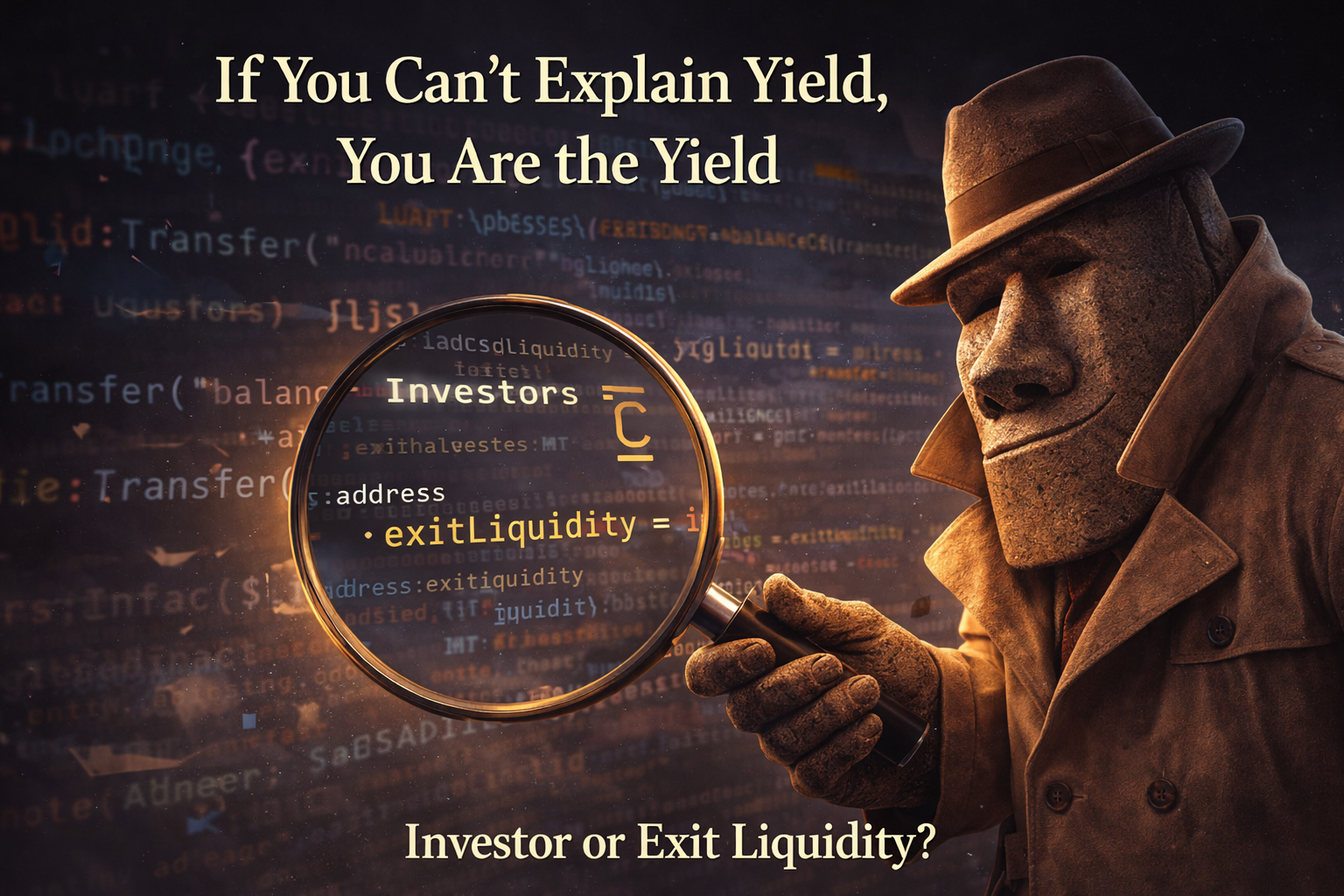
If You Can’t Explain Yield, You Are the Yield
 tony_p3 min read·Just now
--
Yield Isn’t Income — It’s Exposure
In traditional finance, income is something you receive.
It’s predictable.
It’s periodic.
It’s relatively stable.
In DeFi, yield is often treated the same way.
You deposit assets, see a percentage, and assume:
“This is my income.”
But that assumption is flawed.
Because in DeFi:
Yield is not income. It’s exposure.
The Mislabeling Problem
Calling yield “income” creates a false sense of certainty.
Income implies:
- consistency
- reliability
- low variability
But DeFi yield behaves very differently.
It is:
- dynamic
- conditional
- dependent on external factors
The number you see is not what you receive.
It’s what you are exposed to.
What You’re Actually Holding
When you enter a yield strategy, you’re not just holding assets.
You’re holding a bundle of exposures:
- exposure to price movement
- exposure to liquidity demand
- exposure to protocol mechanics
- exposure to other participants’ behavior
Each of these components evolves over time.
And together, they define your outcome.
Yield Moves Because Systems Move
A common misconception is that yield “changes.”
In reality, it’s the system that changes.
- Trading activity increases or decreases
- Borrowing demand fluctuates
- Liquidity shifts across pools
- Incentives get added or removed
Yield simply reflects these movements.
Which means:
Your return is tied to a moving target.
Stability Is the Exception, Not the Rule
In many cases, high yield is associated with instability.
Why?
Because elevated returns often signal:
- imbalance
- inefficiency
- temporary conditions
As those conditions normalize:
- returns compress
- competition increases
- opportunities fade
What looks attractive at entry may not persist.
The Hidden Dimension: Directional Risk
Even “market-neutral” strategies are not always neutral.
They can carry:
- directional exposure through asset composition
- asymmetry in upside vs downside
- sensitivity to volatility regimes
This means your yield can be positive while your overall position declines.
A scenario many users underestimate.
Participation Without Context
When users focus only on APY, they ignore structure.
They don’t ask:
- What drives this return?
- What scenarios reduce it?
- What risks are embedded?
This creates a disconnect:
You engage with the output, not the mechanism.
And that makes your position harder to evaluate.
Yield as a Competitive Outcome
DeFi is an open system.
Anyone can participate.
But not everyone participates equally.
Some actors:
- analyze system dynamics
- model outcomes under different scenarios
- adjust positions continuously
Others:
- rely on surface-level metrics
- react instead of anticipate
Over time, this difference compounds.
Because yield is not just generated — it is competed for.
The Cost of Misunderstanding Exposure
If you treat yield as guaranteed income, you may:
- over-allocate capital
- underestimate downside
- hold positions too long
- misinterpret performance
These are not small errors.
They directly affect your returns.
A More Accurate Mental Model
Instead of asking:
“How much will I earn?”
Ask:
“What am I exposed to?”
This shift leads to better questions:
- What variables drive this yield?
- How sensitive is it to change?
- What are the downside scenarios?
- How does this fit into my overall portfolio?
Yield becomes something to analyze — not assume.
Structuring Exposure Instead of Guessing It
As strategies grow more complex, understanding exposure manually becomes difficult.
This is where structured systems become valuable.
Concrete Vaults are designed to:
- define and manage exposure explicitly
- adapt strategies as conditions evolve
- optimize allocations based on changing inputs
- reduce reliance on static assumptions
Instead of inheriting exposure unknowingly, users gain a clearer framework for engaging with it.
The end
Yield feels like income because it’s presented as a percentage.
But percentages can be misleading when detached from context.
In DeFi, yield is not a fixed stream.
It is a reflection of:
- system activity
- market conditions
- participant behavior
And your role within all three.
When you understand that, your perspective changes:
You stop asking what yield you’ll get —
and start understanding what exposure you’re taking.