I Built a Real-Time Intelligence Platform and the Hardest Part Was the Plumbing
 DoctorSlugworth5 min read·Just now
--
The Idea
The concept was simple enough. Stream social media data in real time, run it through some AI, and surface insights before anyone else sees them. Crypto moves fast. If you’re seeing the same information as everyone else at the same time, you’ve already lost. The edge is in the timing.
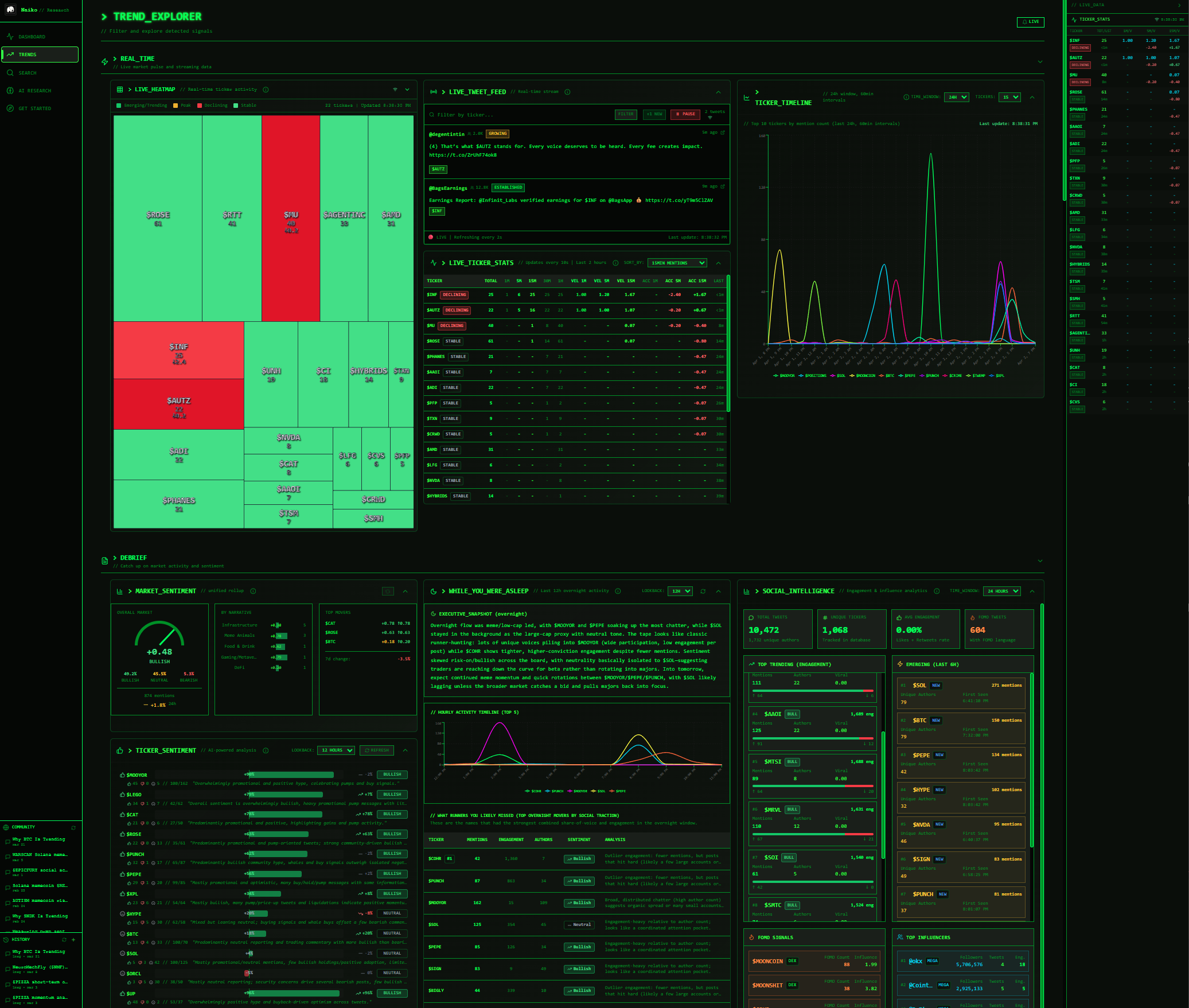
So I set out to build a platform that would ingest a firehose of social data, understand what people were actually saying, more than just keyword matching, detect patterns as they formed, and present it all through a dashboard that you could actually make decisions from.
Simple concept. The execution was anything but.
The First Wall: Encrypted WebSocket Feeds
The data source I was pulling from doesn’t just hand you clean JSON over a REST endpoint. It streams encrypted events over a WebSocket connection that requires cryptographic wallet authentication. So before I could even look at a single tweet, I had to:
1. Generate a cryptographic signature from a wallet keypair
2. Authenticate against their API using that signature
3. Establish a persistent WebSocket connection
4. Decrypt every incoming event using AES before I could read it
This is the kind of stuff that doesn’t show up in architecture diagrams. Nobody draws a box labeled “spend 3 days figuring out why your decryption is producing garbage because the key encoding was wrong.” But that’s where the time goes.
The connection also drops. Randomly. Sometimes after 2 hours, sometimes after 20 minutes. So you need reconnection logic, and not the naive kind where you just retry immediately and get rate-limited into oblivion. You need backoff, you need state tracking, you need to know the difference between “the server kicked me” and “my network hiccuped.”
I ended up with a monitoring loop that checks connection health every few seconds and handles reconnection with enough grace that the data pipeline doesn’t even notice when it happens.
Processing at Speed
Once the data was flowing, the next problem was processing it fast enough. Every incoming event needs to be:
- Decrypted
- Parsed into a normalized format
- Scanned for patterns (tickers, hashtags, wallet addresses, URLs)
- Converted into semantic embeddings
- Stored in a vector database
- Written to an analytics database
- Fed into a momentum tracker
- Broadcast to connected frontend clients
And all of this needs to happen without blocking the WebSocket listener. If your processing can’t keep up with the stream, you start dropping events, and dropped events mean missed signals.
The solution was threading everything. The WebSocket listener does the bare minimum — decrypt and hand off. Everything else happens in background threads. Embedding generation in particular is the slowest step (we’re talking 50–500ms per tweet depending on hardware), so that runs completely asynchronously.
The Pattern Extraction Problem
Pulling tickers out of tweets sounds trivial until you actually try it. The regex is straightforward — dollar sign followed by letters — but then you realize:
- $100 is not a ticker, it’s a price
- $SOL is technically a ticker but it’s in 70% of tweets and tells you nothing useful
- $USDT is a stablecoin, nobody cares that it’s being mentioned
- Some accounts tweet $BTC $ETH $SOL in every single post as engagement bait
So you need an exclusion list. And then you need to tune that exclusion list. And then someone mentions $DOGE and you have to decide — is that established enough to filter, or is there a new narrative forming around it?
I ended up with a configurable exclusion system. The base chains, stablecoins, and top-10 coins get filtered by default. Everything else surfaces. The before/after difference was dramatic. Instead of the top trending ticker always being the chain token that’s mentioned as context in every tweet, actual emerging projects started showing up.
Wallet address extraction was its own adventure. The addresses are base58 encoded, 32–44 characters, and they look a lot like random strings that appear in URLs and other places. False positive rate was high until I added context validation — checking that the surrounding text actually suggests it’s a wallet address being shared, not just a random hash in a link.
The Storage Question
Initially everything went into a single vector database collection. Tweets with their embeddings, agent-generated signals, everything. One collection to rule them all.
This worked great for the first week. Then I had 50k vectors. Then 100k. Then the dashboard started taking 20 seconds to load because I was running analytics queries against a system designed for semantic similarity search.
That realization — that your vector database is not your analytics database — was probably the single most important architectural lesson of the whole project. But that’s a whole separate article.
What I Learned Early
The unsexy infrastructure work is where projects like this live or die. The AI part — the agents, the embeddings, the language models — that’s maybe 20% of the actual work. The other 80% is:
- Connection management and reconnection logic
- Data normalization across inconsistent sources
- Background processing that doesn’t block your main loop
- Pattern extraction that’s smart enough to be useful
- Storage architecture that won’t collapse under load
Nobody writes blog posts about their reconnection logic. But I guarantee it’s the difference between a demo that works for 5 minutes and a system that runs 24/7 for months.
The platform now processes over a thousand tweets per minute sustained, 24 hours a day. The data flows from encrypted WebSocket to searchable insight in under a second. But getting to that point involved a lot more plumbing than machine learning.
Next up: how I learned the hard way that a vector database and an analytics database are very different things, and what happened when I tried to pretend otherwise.