For the last two years, the AI industry has been obsessed with a single question:
Which model is better?
Every few months, a new release arrives, and the cycle begins again. Engineers compare benchmark scores, creators debate output quality, founders evaluate costs, and entire communities rush to determine whether the newest model has finally surpassed the previous generation. GPT-4 challenged established assumptions. Claude introduced larger context windows and stronger reasoning. Gemini entered the race. Open-source models rapidly narrowed the gap. The leaderboard kept changing, and everyone seemed convinced that intelligence was the primary battleground.
GitHub - sarveshtalele/linkedin-content-skill
I was part of that conversation, too.
As someone building products, experimenting with AI workflows, and creating technical content online, I spent countless hours evaluating models. Whenever a new release launched, I immediately wanted to understand how it performed. Could it reason better? Could it write better? Could it understand complex technical systems more effectively?
For a long time, I assumed these were the most important questions.
Then I noticed something strange.
No matter how sophisticated the models became, I kept encountering the same frustration.
It didn’t matter whether I was using Claude, ChatGPT, or any other system. I would spend time explaining my audience, my writing style, my goals, and the topics I cared about. I would share examples of posts that had performed well and explain why they resonated. The AI would produce something useful, and for a brief moment, it genuinely felt like I had a highly capable collaborator working alongside me.
Then the conversation ended.
The next day, everything disappeared.
The context was gone.
The learnings were gone.
The preferences were gone.
The AI was just as intelligent as it had been the day before, but it had forgotten everything we had learned together.
At first, I accepted this as a limitation of the technology. After all, that was how AI systems worked. But the more content I created, the more obvious the problem became.
I wasn’t spending most of my time writing.
I wasn’t spending most of my time thinking.
I was spending most of my time rebuilding context.
Every LinkedIn post required another explanation for my audience. Every newsletter required another discussion about tone and structure. Every content session began with the same onboarding process, where I reminded the AI who I was, how I liked to communicate, and what had worked in the past.
The contradiction became increasingly obvious. Despite having access to some of the most advanced AI systems ever created, I found myself repeating the same information over and over again. Every new session required rebuilding context, explaining preferences, and reintroducing goals. That experience led me to a simple question: what if AI could retain what it learns rather than start from scratch every time?
Not:
“How can AI generate better content?”
But:
“What would happen if AI could remember?”
That single question eventually evolved into a custom AI-powered content system that learns from every post I publish, accumulates feedback over time, and gradually becomes more aligned with my voice and audience the more I use it.
Ironically, the most important breakthrough had nothing to do with intelligence.
It had everything to do with memory.
Why Most AI Systems Forget Everything
Human expertise compounds.
That’s one of the defining characteristics of intelligence in the real world.
Human expertise grows through accumulated experience. Writers refine their craft by remembering what resonates with readers. Designers develop stronger instincts through repeated observation and practice. Product managers make better decisions because they learn from past successes and failures. Over time, those experiences compound into expertise. Most AI systems, however, do not benefit from this same continuity. Despite their intelligence, they often start each interaction without the knowledge gained from previous ones.
Most AI systems treat every interaction as a fresh start. Even with larger context windows and more advanced models, users often spend significant time reintroducing information that has already been shared before. For simple tasks like summarising an article or answering a question, this is rarely a problem. Content creation, however, is different. It is an iterative process that depends on accumulated knowledge about an audience, a voice, and patterns that have proven effective over time.
Effective content creation depends on accumulated understanding. The best content strategists do more than write well. They develop a deep understanding of their audience, recognise which ideas consistently resonate, and learn which formats and storytelling approaches drive engagement. These insights are not created on demand. They emerge gradually through observation, experimentation, and experience. That process of learning and refinement depends on memory.
The Day Content Creation Started Feeling Like Software
My perspective changed when I stopped viewing content generation as a prompting challenge and started treating it as a systems challenge. Instead of focusing on writing better prompts, I began exploring how to build better infrastructure around the AI. Working with Claude Code exposed a key capability: the ability to interact with files and maintain information outside a single conversation.
This made it possible to preserve context, store feedback, and reference past learnings over time. Rather than building another content generator, I started building a system that could learn from every interaction. The objective was not simply to generate content faster, but to create a continuous feedback loop where each piece of content improved the next.
Teaching an AI to Remember
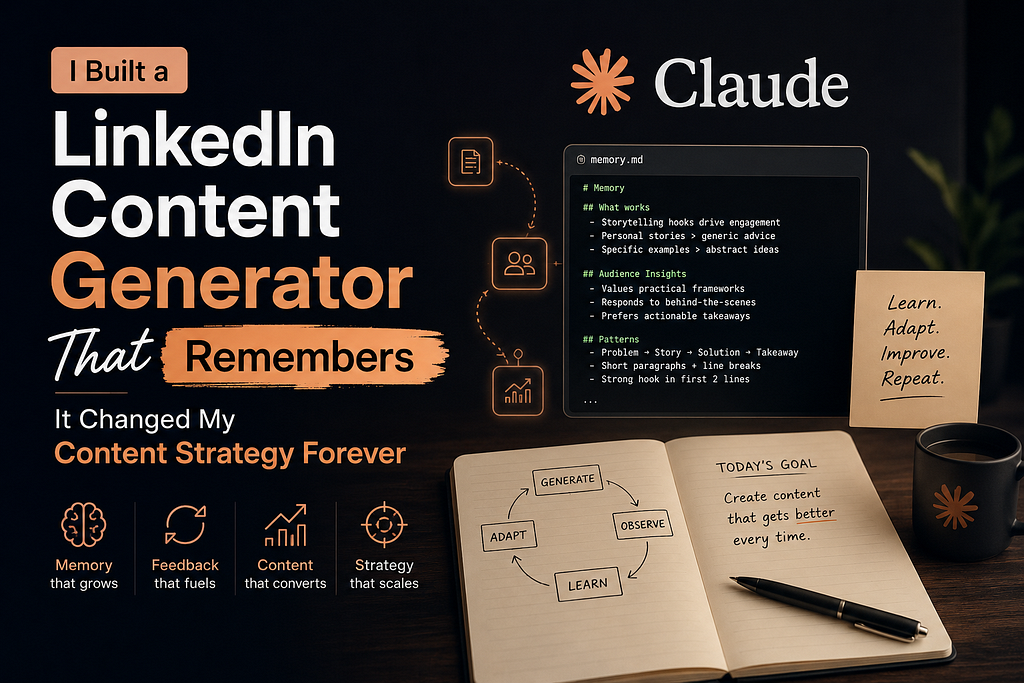
The first version of the system was remarkably simple. At its centre was a single markdown file that served as a repository for everything the system learned over time. Whenever a post performed well, generated strong engagement, or revealed a useful insight about audience behaviour, I recorded it.
What began as a collection of small notes gradually evolved into a valuable knowledge base. As more observations accumulated, patterns started to emerge, and the system developed a deeper understanding of what resonated with my audience. Its advantage did not come from having more data than other AI tools. It came from having access to the right data: the experiences, feedback, and learnings specific to my content and audience.
The Surprisingly Simple Architecture Behind the System
Although terms like “memory-driven AI” and “learning loops” often sound complex, the underlying architecture was surprisingly straightforward. The system was built around three core capabilities: execution, context, and learning.
Claude’s code skills handled execution by turning common content tasks into reusable commands. Python scripts assembled relevant context from historical learnings, audience insights, and content preferences before each generation. Finally, a memory layer captured feedback and observations, allowing the system to continuously refine its understanding over time.
Looking back, the most important insight was not a technical one. The real breakthrough came from treating memory as a core part of the workflow rather than an afterthought.
The Moment I Realised It Was Actually Working
The strongest validation of the system came when it began applying lessons I had not explicitly instructed it to use. While generating content on a familiar topic, it naturally incorporated a storytelling structure that had consistently performed well in the past. The pattern was not hardcoded or manually specified; it emerged because the system had learned from previous feedback and recognised what worked.
That experience changed the nature of the interaction. Instead of feeling like I was repeatedly prompting an AI, it felt like collaborating with a teammate that understood my audience, remembered past learnings, and could apply them when relevant. In that moment, memory stopped feeling like a useful feature and started feeling like a foundational capability.
The Real Lesson Hidden Inside This Project
While this project took the form of a LinkedIn content engine, the broader lesson extends far beyond content creation. AI models continue to improve at a rapid pace, with stronger reasoning, larger context windows, lower costs, and increasingly accessible capabilities. As intelligence becomes more widely available, competitive advantage is likely to come from somewhere else. I believe that the differentiator will be memory.
The most valuable AI systems will not simply generate better outputs; they will develop a deeper understanding of their users through accumulated context and continuous learning. In that future, successful AI products may feel less like tools and more like collaborators, not because they are inherently smarter, but because they can build and retain understanding over time.
The Future Belongs to Systems That Remember
For years, the AI industry has focused primarily on intelligence. While intelligence remains important, I increasingly believe it is only part of what makes AI truly valuable. The other part is continuity: the ability to retain knowledge, learn from interactions, and build understanding over time.
Memory enables that continuity. As models become more capable and access to intelligence becomes widespread, differentiation will come from systems that can accumulate context and adapt to the people using them. The most impactful AI products may not be those with the highest benchmark scores, but those that develop the deepest understanding of their users.
Once software begins to remember, the experience feels fundamentally different, making traditional stateless interactions seem increasingly limited.
Want to build your own memory-driven content engine?
I’ve open sourced the complete LinkedIn Content Skill on GitHub, including the memory architecture, Claude Code skills, content workflows, and learning system discussed in this article.
Check out the repository: LinkedIn Content Skill on GitHub
I Built a LinkedIn Content Generator That Remembers — It Changed My Content Strategy Forever was originally published in Level Up Coding on Medium, where people are continuing the conversation by highlighting and responding to this story.