Hyperliquid 101: API Concepts for Non-Developers
 Evan K. | Hyperliquid Notes2 min read·Just now
--
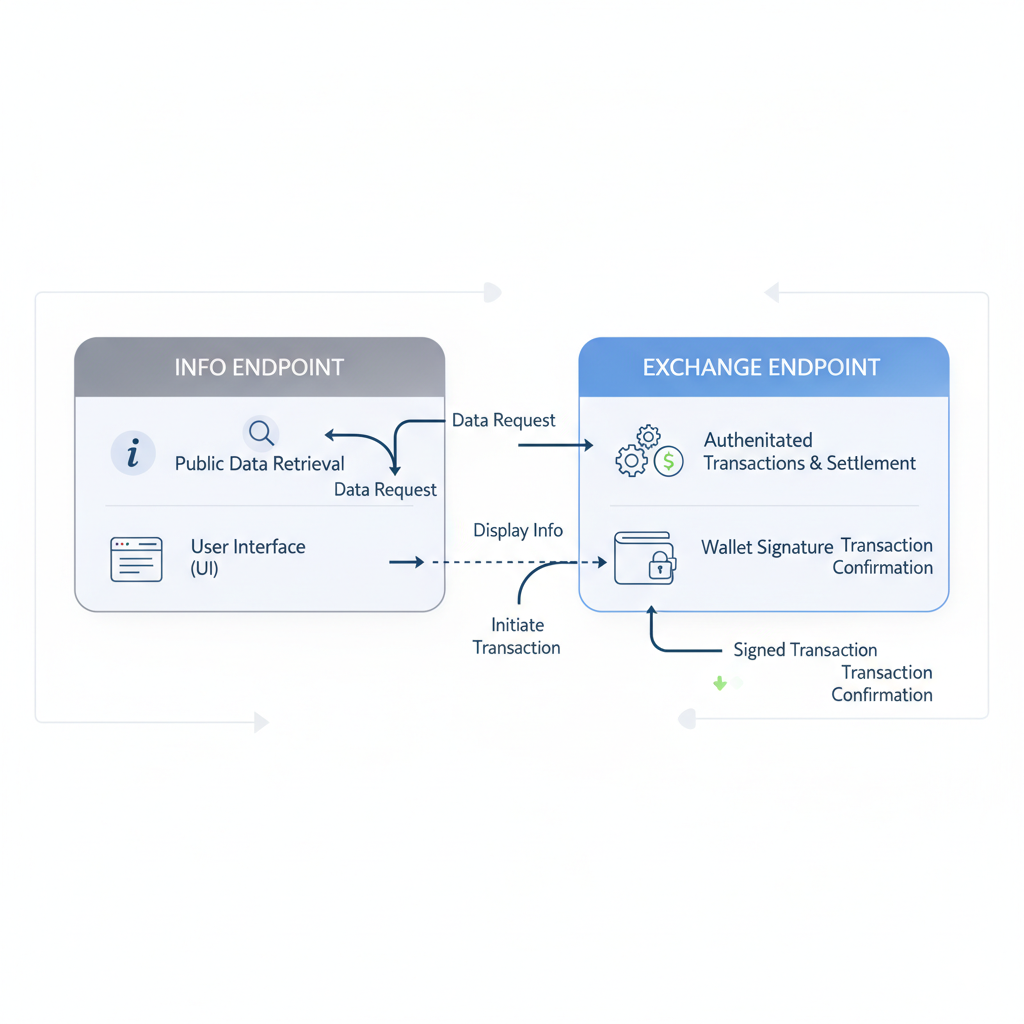
You do not need to be a developer to benefit from API literacy. On Hyperliquid, understanding API concepts mostly means understanding how the system thinks about truth and intent.
The cleanest split is simple: /info asks what state currently exists; /exchange asks the system to change state through signed actions. Once you internalize that, troubleshooting becomes much less emotional and much more mechanical.
Info endpoint    = read state
Exchange endpoint = submit signed intentRead calls usually fail for boring reasons: wrong request shape, wrong address context, or pagination mistakes. Write calls fail for state reasons: insufficient margin, invalid trigger assumptions, minimum notional constraints, or role mismatches. These are different problem classes and should be handled differently.
Role context is probably the most underrated check. Hyperliquid docs explicitly mention account-role differences (user, agent, vault, subAccount). If you query or act with the wrong context, outputs can look empty or inconsistent.
curl -X POST "https://api.hyperliquid.xyz/info" \
  -H "Content-Type: application/json" \
  -d '{"type":"userRole","user":"0xYourAddress"}'
I have found this one check prevents a surprising number of false alarms.
Another operational concept non-developers should know is status taxonomy. Hyperliquid returns specific order statuses and rejection categories, which means “failed” is not a single bucket. If your workflow still treats all rejections the same, you are leaving useful information on the table.
Pagination and limits are equally important for analytics users. Time-range endpoints return bounded windows; large exports require iterative pagination. Ignoring this can silently undercount fills or distort performance analysis.
Finally, signatures and nonces are not merely low-level implementation detail. They are the protocol’s way to bind intent to identity and time. You can stay non-technical and still use this concept to reason about why some actions are impossible without proper signing flow.
If your goal is to understand Hyperliquid deeply without writing bots, focus on mapping each UI action to its underlying API category. That single habit closes much of the gap between casual users and advanced operators.
Docs I recommend reading next:
- API overview: https://hyperliquid.gitbook.io/hyperliquid-docs/for-developers/api
- Info endpoint details: https://hyperliquid.gitbook.io/hyperliquid-docs/for-developers/api/info-endpoint
- Exchange endpoint details: https://hyperliquid.gitbook.io/hyperliquid-docs/for-developers/api/exchange-endpoint