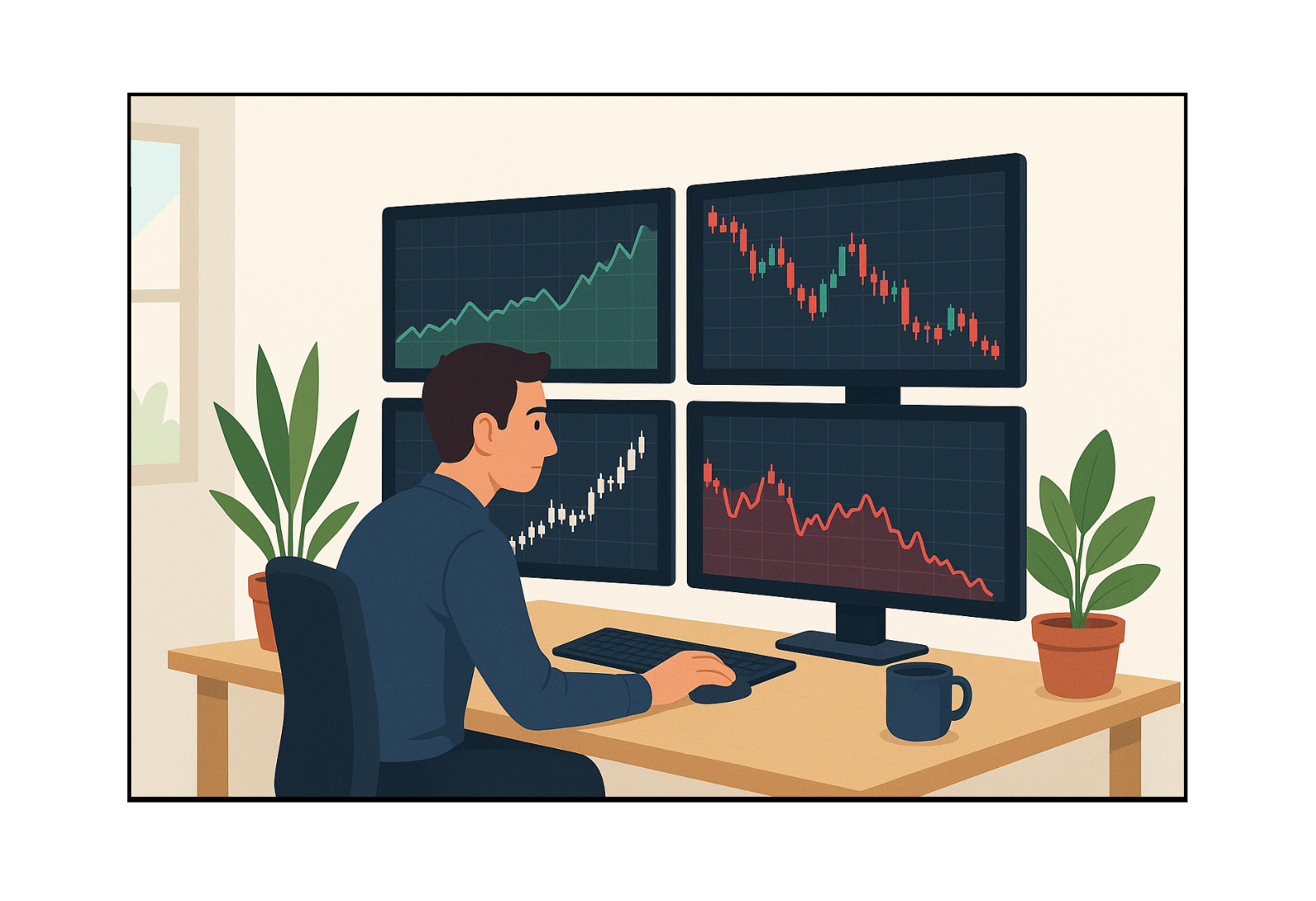
How Subjective Bias Sneaks into Trader Risk Reviews
 Stackorithm6 min read·Just now
--
Two risk analysts review identical trading histories. They have access to the same behavioral logs, the same flagged patterns, the same session data. One approves the account. The other denies it.
This kind of split judgment is one structural risk in review workflows. In many prop firm risk operations, the review process is structured around a verdict rather than a structured evidence case. That means the analyst’s framing of the evidence tends to determine the outcome more than the evidence itself. Structured evidence reduces this problem, but does not eliminate it, because the bias tends to enter before the analyst ever opens the behavioral record.
The question that follows is whether a continuous analysis model structurally reduces the conditions that produce inconsistency in the first place.
When Two Analysts See the Same Data Differently
The variability problem in trader risk analysis is not unique to prop firms. It is a documented pattern in any field where human reviewers make independent judgments on complex, multi-signal cases.
In their 2021 work Noise: A Flaw in Human Judgment, Daniel Kahneman, Olivier Sibony, and Cass Sunstein documented a consistent finding across professions: when reviewers make independent judgments on the same complex case without a shared decision frame, the variability in outcomes is substantially higher than organizations expect. This is what they call “noise” in human judgment: not bias toward a particular direction, but unpredictable scatter in the direction of error.
Prop firm trader risk review involves exactly the conditions that tend to produce high noise: complex behavioral pattern recognition across time series data, time pressure from payout queues, and policy language that requires interpretation rather than mechanical application. When two reviewers examine a Gambling detection or a Martingale sequence, they are not reading a single number. They are evaluating a multi-dimensional behavioral record that requires them to weigh signal strength, duration, and context.
The question is not whether each reviewer is skilled. The question is whether the review process gives them a shared frame for weighing that evidence. Without a shared frame, the scatter is structural and not correctable through individual training alone.
The Triage Moment and the Behavioral Flag
If review consistency is a shared-frame problem, the next question is where the frame gets set. In many prop firm workflows, the answer is: at the triage stage, before the analyst has seen the full trade-level evidence.
Triage in a batch review environment typically involves scanning a dashboard and prioritizing cases by some combination of risk score, verdict status, and queue position. A trader may arrive in the analyst’s queue already carrying an internal status label, something like ‘needs review’ in one system or a high-priority flag in another. A trader with a high risk score arrives with that score already visible.
Amos Tversky and Daniel Kahneman documented the anchoring effect in their 1974 Science paper: when people are exposed to an initial value before making an estimate, that value disproportionately influences the final judgment, even when the person knows it was arbitrary. In risk review, the initial signal is deliberately calculated rather than arbitrary, but that does not reduce the anchoring effect.
When an analyst opens a case already labeled for escalation, the behavioral evidence they encounter is interpreted through that initial frame. Patterns that might look ambiguous on a blank-slate review tend to read as confirmatory. The label often shapes evidence interpretation before the investigation begins.
How Risk Scores Become Anchors, Not Inputs
The intended function of a risk score in a triage-based workflow is to direct the reviewer’s attention to the evidence layer. A high aggregate risk score, whatever scale a firm uses, should be a signal to look closer, not a summary verdict. It should function as a starting point for the evidence review, not a conclusion that the evidence then either supports or fails to overturn.
In conversations with risk teams, a different pattern often surfaces. Under payout queue pressure, reviewers tend to use the risk score as a closing mechanism rather than an opening one. A high score closes the case toward denial; a low score closes it toward approval. The evidence review happens, but in the shadow of a conclusion that was already forming when the reviewer saw the number.
This is consistent with how triage-based review is intended to function: the risk score directs the reviewer to the behavioral tabs, not away from them. A score alone rarely carries the weight of a defensible decision. Trade-level evidence is the mechanism that makes a decision both explainable and disputable on specific grounds, but that mechanism only functions if the reviewer reaches the evidence layer rather than treating the score as a summary verdict.
The Consistency Problem in Continuous Analysis
One of the structural differences between a batch review model and a continuous analysis model is where the judgment pressure accumulates.
In a batch review model, the full behavioral record of a trader’s evaluation cycle arrives at the reviewer’s desk as a single, completed retrospective. The reviewer must assess weeks of behavioral signals in a single session, under payout deadline pressure, in a queue alongside twenty other cases. The judgment task is compressed. Different reviewers often do this compression differently, each weighting recency, severity, and signal type according to their own cognitive heuristics.
Continuous analysis runs in the background, processing all enabled traders in parallel, with results available as processing completes rather than in scheduled batches. This means that a reviewer looking at a trader’s behavioral record on any given day is not reconstructing history: they are looking at a progressively built picture, with each new analysis increment adding to an existing documented record.
That is a structurally different judgment task. The decision complexity is distributed across the evaluation period rather than concentrated into a single high-pressure session. Behavioral patterns that develop across daily increments are observable as they form, not only after they have compounded. Whether this distributional structure reduces the anchoring and noise effects in practice is a question worth examining, but the mechanism is at least coherent: smaller, incremental judgment tasks under lower time pressure may create more favorable conditions for consistent review than compressed, retrospective ones.
What Structural Consistency Looks Like in a Trader Review
If the source of review inconsistency is the absence of a shared decision frame, then structural consistency requires defining what that shared frame looks like at the evidence level.
For each detection type, the platform surfaces specific mechanical evidence behind the flag. For Copy Trading, the evidence centers on execution timing and price entry differences across matched account pairs, along with position sizing proportionality between the suspected source and follower. For Martingale, the evidence captures how a position escalates through successive entries, how long the sequence stays open, and how far the floating loss extends before the basket closes.
When the evidence criteria are explicit and shared across reviewers, the judgment question shifts. Instead of asking “does this look suspicious?” the reviewer is asking “do the execution pattern evidence and the position escalation record here support concern under the firm’s policy?” That is a more constrained question. It is not a mechanical one: judgment is still required. But the frame within which that judgment operates is shared rather than individually constructed.
This is what structural consistency looks like in a trader review at the operational level. It is not about removing reviewer judgment from the process. It is about giving that judgment a shared architecture so that two analysts reviewing identical behavioral records are at least asking the same questions in the same order about the same evidence fields. The scatter does not disappear, but the conditions that produce maximum scatter are reduced.
A Question Worth Sitting With
If two reviewers with access to the same behavioral record still reach different verdicts, the question is not which reviewer is more skilled. The question is whether the review process is designed in a way that makes consistent judgment possible.
The research on noise in human judgment is not a pessimistic finding. It is a design prompt. Variability is high when the shared frame is absent. When the shared frame exists at the evidence level, and when continuous analysis distributes the judgment task across the evaluation period, the structural conditions for consistency are at least present.
If your team is working through this, Stackorithm builds Trader Risk Analysis for prop firm behavioral detection, and it is designed for exactly this problem: giving reviewers a shared evidence frame before the judgment call.
References
[1] Kahneman, D., Sibony, O., and Sunstein, C. R. (2021). Noise: A Flaw in Human Judgment. Little, Brown Spark. ISBN 978–0316451406.
[2] Tversky, A. and Kahneman, D. (1974). “Judgment under Uncertainty: Heuristics and Biases.” Science, 185(4157), 1124–1131. DOI: 10.1126/science.185.4157.1124.