How SAWM Pay works under the hood — Solana, USDC, Guard, and why 0% transaction fees are viable
 SAWM7 min read·1 hour ago
--
A technical article for CTOs, e-commerce developers, and merchants curious about the infrastructure behind SAWM Pay. No useless crypto jargon.
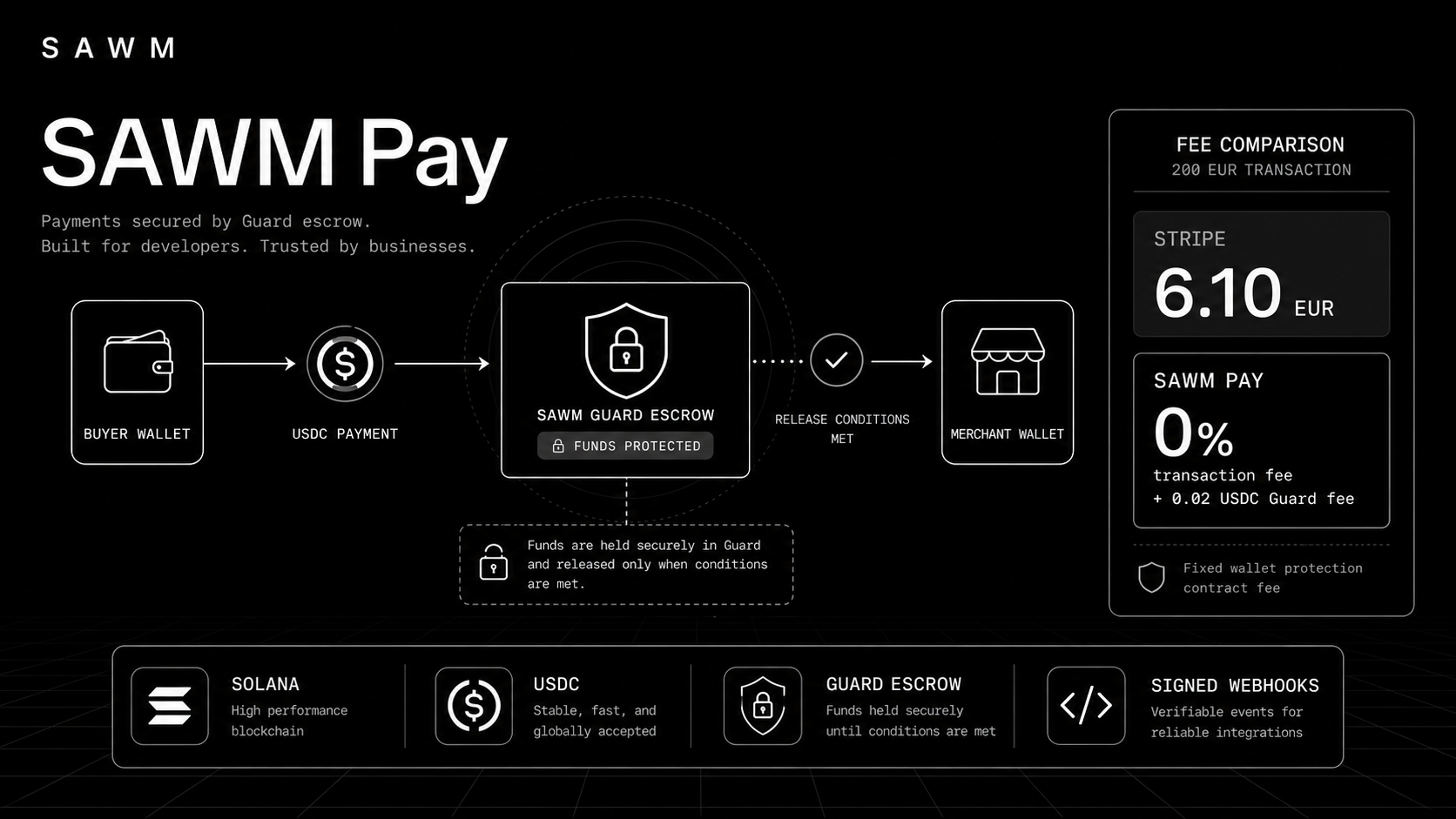
Visual direction:
Diagram showing:
Buyer wallet → USDC payment → SAWM Guard escrow → Merchant wallet
With a fee comparison on a 200 EUR transaction:
- Stripe: 6.10 EUR
- SAWM Pay: 0% transaction fee + 0.02 USDC Guard protection fee
Why this article
When you announce 0% transaction fees, the first reaction of a serious CTO is usually:
“Too good to be true.”
That reaction is healthy.
Most payment systems hide their complexity behind percentages, intermediaries, banking rails, chargeback risk, and settlement delays.
SAWM Pay is built differently.
It does not charge a percentage on the transaction amount. Whether the buyer pays 20 EUR, 200 EUR, or 2,000 EUR, SAWM Pay takes 0% of the basket value.
The only fee is a small fixed cost: 0.02 USDC, used for the SAWM Guard protection contract.
This article explains how that works.
The SAWM Pay stack
SAWM Pay is built on four technical layers:
- Solana
- USDC
- SAWM Guard escrow
- HMAC-signed merchant webhooks
Together, they create a payment flow that is fast, low-cost, protected, and merchant-friendly.
Layer 1 Solana network
SAWM Pay uses Solana as the payment network.
There are three main reasons:
Speed
Solana transactions settle quickly, which makes it suitable for commerce flows where merchants need near-real-time payment confirmation.
Low network cost
Solana transaction fees are extremely small compared to traditional card networks or many other blockchains.
This matters because SAWM Pay does not rely on percentage-based fees.
USDC ecosystem
USDC is widely used on Solana, making it practical for stablecoin-based payments without exposing merchants to volatile crypto assets.
Layer 2 USDC stablecoin
SAWM Pay uses USDC as the payment currency.
The goal is simple:
Give merchants a stable digital payment asset, without crypto price volatility.
A buyer pays in USDC.
The merchant receives USDC.
The value is stable and easy to reconcile.
For merchants, this means the payment experience is not based on speculative crypto exposure. It is based on a stable dollar-denominated asset.
Layer 3 SAWM Guard protection contract
The core of SAWM Pay is SAWM Guard.
SAWM Guard is the protection layer between the buyer and the merchant.
Instead of sending funds directly to the merchant, the buyer locks USDC into the Guard escrow contract.
The contract protects both sides:
- the buyer is protected if the product is not delivered;
- the merchant is protected because funds are already locked;
- SAWM can manage dispute flows if something goes wrong.
Basic contract flow:
deposit(buyer, merchant, amount, order_id) → lock_idrelease(lock_id, signature) → transfer funds to merchantrefund(lock_id, signature) → return funds to buyer
The important point:
SAWM Pay does not take a percentage of the payment amount.
It only charges a fixed 0.02 USDC Guard protection fee.
Layer 4 HMAC-signed webhooks
Merchants need reliable backend notifications.
SAWM Pay sends signed webhooks for key payment events:
- payment received;
- order ready to ship;
- escrow started;
- escrow released;
- refund requested;
- dispute opened.
Each webhook is signed using HMAC-SHA256 with a unique secret per merchant.
Example:
POST https://merchant.com/webhook/sawm
X-SAWM-Pay-Signature: sha256=abc123...
Payload example:
{
  "event": "payment_received",
  "lock_id": "lock_123",
  "order_id": "order_xyz",
  "amount_usdc": 200,
  "guard_fee_usdc": 0.02,
  "buyer_shipping": {
    "country": "LU",
    "city": "Luxembourg"
  },
  "timestamp": "2026-05-04T10:00:00Z"
}
The merchant verifies the signature, updates their system, and prepares the order.
This makes SAWM Pay compatible with most backend stacks:
- Node.js
- Python
- PHP
- Go
- Rust
- Shopify custom apps
- WooCommerce plugins
- custom e-commerce platforms
Payment flow, step by step
Let’s take a 200 EUR order.
The buyer wants to purchase a product from a merchant using SAWM Pay.
Step 1 Buyer selects SAWM Pay
At checkout, the buyer chooses:
Pay with SAWM Pay
The merchant creates a SAWM Pay session linked to the order.
Step 2 Buyer locks USDC in SAWM Guard
The buyer signs a wallet transaction.
Instead of sending the funds directly to the merchant, the funds are locked into the Guard contract.
Example:
Guard.deposit(
  buyer_address,
  merchant_address,
  200,
  order_id_xyz
)
The merchant does not receive the funds immediately.
The funds are protected inside SAWM Guard until the delivery flow is completed.
Step 3 Merchant receives payment confirmation
SAWM sends a signed webhook to the merchant:
{
  "event": "payment_received",
  "order_id": "order_xyz",
  "amount_usdc": 200,
  "guard_fee_usdc": 0.02,
  "status": "locked_in_guard"
}
The merchant can now safely prepare the shipment.
Step 4 Merchant ships the order
The merchant ships the package and marks the order as shipped.
Example API call:
POST /api/v1/sawm-pay/sessions/{id}/mark_shippedPayload:
{
  "tracking_number": "LX123456789",
  "carrier": "DHL"
}
This starts the buyer protection window.
Step 5 Buyer protection period
During the protection period, the buyer can:
- confirm receipt;
- do nothing and let the escrow release automatically;
- request a refund if there is a problem;
- open a dispute if necessary.
The goal is to make crypto payment feel safer for normal commerce.
Not:
“I sent crypto and now I hope everything goes well.”
But:
“I paid on-chain, and my funds are protected until the order is completed.”
Step 6 Funds are released to the merchant
Once the delivery is confirmed, or the protection period ends without dispute, SAWM Guard releases the funds to the merchant wallet.
SAWM emits a webhook:
{
  "event": "payment_released",
  "order_id": "order_xyz",
  "amount_usdc": 200,
  "merchant_received_usdc": 200
}
The merchant can then:
- keep the funds in USDC;
- convert to EUR;
- use the balance for future on-chain operations.
Cost comparison
For a 200 EUR transaction, a traditional card payment provider may charge percentage-based fees.
Example:
Stripe-style fee:
200 × 2.9% + 0.30 EUR = 6.10 EUR
SAWM Pay works differently:
SAWM Pay:
Transaction fee on order amount: 0%
Guard protection contract fee:   0.02 USDC
Solana network fee:              negligible
Total SAWM Pay fee: ~0.02 USDCSo on a 200 EUR order:
Stripe-style fee:     ~6.10 EUR
SAWM Pay fee:         ~0.02 USDC
Difference:           almost the full 6.10 EUR saved
The bigger the transaction, the stronger the difference becomes.
A percentage-based processor scales its revenue with the basket size.
SAWM Pay does not.
Why 0% is viable
The reason is simple:
SAWM Pay does not use the traditional card payment stack.
Traditional payment providers often involve:
- card networks;
- issuing banks;
- acquiring banks;
- fraud risk;
- chargeback management;
- dispute infrastructure;
- percentage-based margins.
SAWM Pay removes most of that structure.
There is:
- no Visa or Mastercard network;
- no issuing bank;
- no card chargeback model;
- no percentage fee on the transaction amount.
Instead, there is:
- direct USDC payment;
- Solana settlement;
- SAWM Guard escrow;
- a fixed 0.02 USDC protection fee.
This is why SAWM Pay can charge 0% on the transaction amount while still maintaining a protection layer.
The Guard fee is not a commission
This distinction matters.
SAWM Pay does not take a commission on the merchant’s sale.
On a 200 USDC order:
Merchant sale amount:     200 USDC
SAWM transaction fee:     0%
Guard protection fee:     0.02 USDC
On a 2,000 USDC order:
Merchant sale amount:     2,000 USDC
SAWM transaction fee:     0%
Guard protection fee:     0.02 USDC
The fee does not grow with the basket.
That is the difference between a payment commission and a fixed protection contract fee.
Why merchants care
For merchants, this changes the economics of online payments.
A merchant selling high-ticket products usually pays more in fees because payment processors charge a percentage.
SAWM Pay breaks that logic.
The merchant keeps more of the sale.
The buyer still gets protection.
The transaction remains verifiable on-chain.
Why buyers care
Pure crypto payments are often risky for buyers.
Once the funds are sent, there is usually no native protection.
SAWM Pay changes that by making escrow mandatory.
The buyer gets:
- on-chain payment;
- delivery protection;
- refund path;
- dispute path;
- transparent transaction status.
This makes crypto commerce more practical for real-world purchases.
Stripe vs Coinbase Commerce vs SAWM Pay
CriterionStripe-style card paymentCoinbase CommerceSAWM PayFee modelPercentage + fixed feePercentage-based0% transaction fee + fixed Guard feeExample on 200 EUR~6.10 EUR~1% depending on setup~0.02 USDCBuyer protectionChargeback systemLimited / merchant-dependentNative Guard escrowMerchant riskChargebacks possibleManual refund handlingEscrow-based flowSettlementBank settlement delayCrypto / conversion flowUSDC on-chainCurrencyEUR / fiatCrypto / fiat conversionUSDCProtection layerBanking railsLimitedSAWM GuardFee scales with basket sizeYesUsually yesNo
Developer integration
SAWM Pay is designed to be easy to integrate.
The merchant needs:
- a SAWM merchant account;
- a wallet address;
- a webhook endpoint;
- an API key;
- optional SDK or plugin.
Developer options:
- hosted checkout;
- API integration;
- Shopify plugin;
- WooCommerce plugin;
- custom backend integration.
Example checkout session:
POST /api/v1/sawm-pay/sessions{
"order_id": "order_123",
"amount_usdc": 200,
"merchant_wallet": "merchant_wallet_address",
"success_url": "https://merchant.com/success",
"cancel_url": "https://merchant.com/cancel"
}SAWM returns:
{
  "session_id": "sawm_session_123",
  "checkout_url": "https://sawm.io/pay/sawm_session_123",
  "expires_at": "2026-05-04T10:15:00Z"
}
The key idea
SAWM Pay is not trying to make card payments slightly cheaper.
It is building a new payment flow for agent-driven commerce:
- agents can discover products;
- buyers can pay in USDC;
- merchants can receive stable digital payments;
- funds are protected by Guard;
- fees do not scale with basket size.
That is why 0% transaction fees are viable.
Because SAWM Pay is not charging for moving money through a legacy card network.
It is charging a fixed micro-fee for the protection contract.
SAWM beta join
SAWM is opening its merchant beta.
We are looking for merchants who want to test:
- USDC payments;
- SAWM Guard escrow;
- agent-driven commerce;
- low-fee payment flows;
- protected wallet-based checkout.
Beta merchants get:
- free onboarding;
- direct founder support;
- early access to SAWM Pay;
- priority integration support;
- token rewards.
Apply at:
sawm.io/beta-merchant
Or DM the SAWM team.