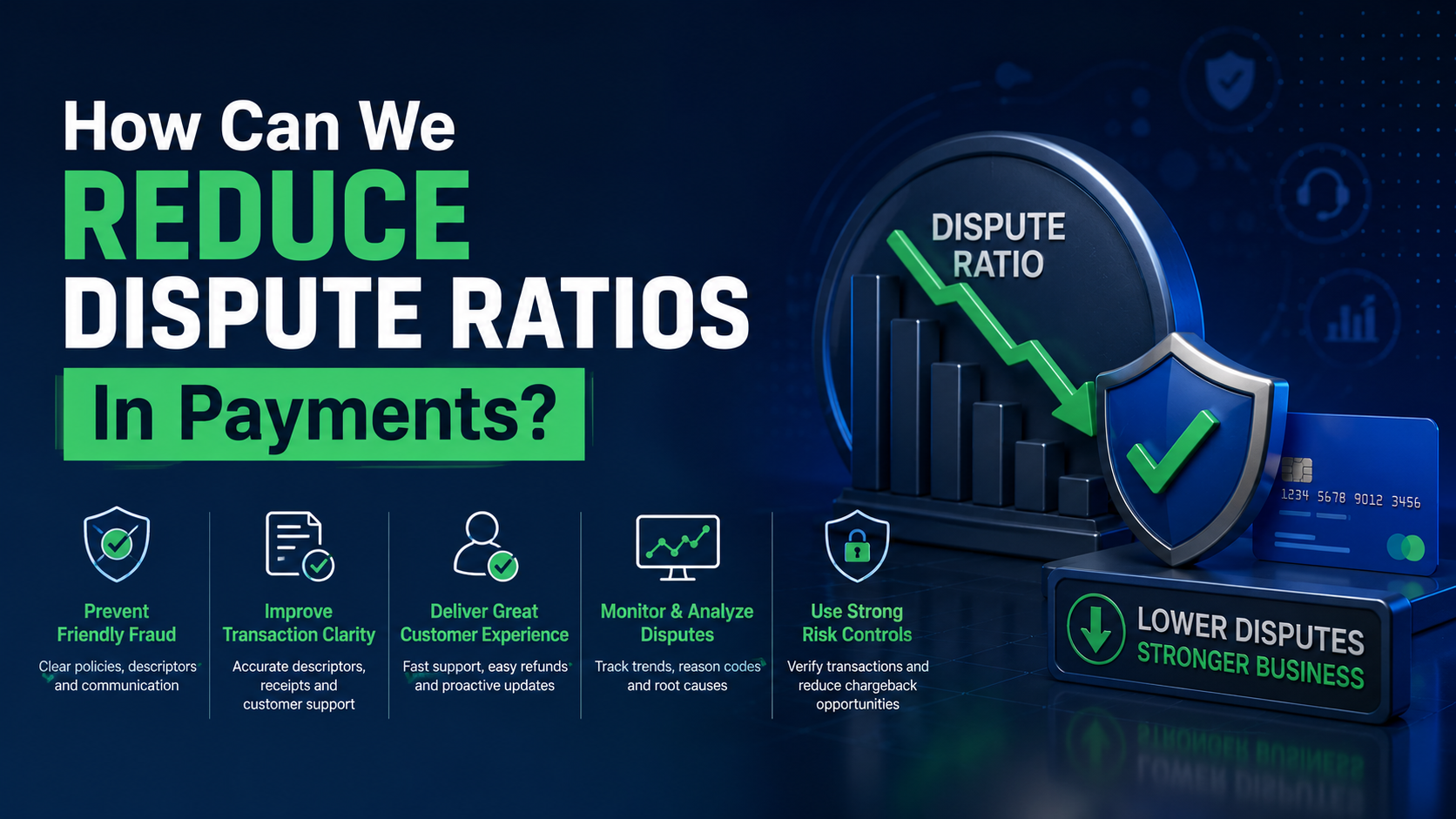
How Can We Reduce Dispute Ratios in Payments?
 Raghu Rajendran8 min read·Just now
--
The Number That Defines Your Merchant Account’s Future
In iGaming payments, there is one number that your acquirer watches more closely than any other. Not your volume. Not your approval rate. Your dispute ratio. It determines whether you stay in a standard processing relationship or enter a card network monitoring program. It determines whether your acquirer views you as an asset or a liability. And beyond a certain threshold, it determines whether you have a merchant account at all.
The dispute ratio — the percentage of your transactions that result in cardholder disputes — is both the most consequential metric in iGaming payment management and the one over which operators have the most genuine control. Unlike approval rates (heavily influenced by issuer behaviour) or processing fees (heavily influenced by card network interchange structures), the dispute ratio is primarily a function of how well you operate — your player communication, your fraud prevention, your bonus management, your descriptor strategy, and your customer service quality.
This article is the systematic playbook for dispute ratio reduction — not as a single campaign but as an operational discipline that sustains performance below the thresholds that matter.
Understanding the Dispute Ratio: What It Measures and Why It Matters
The dispute ratio is calculated differently by Visa and Mastercard, and the distinction matters:
• Visa VAMP ratio: Total chargebacks in a month divided by total transactions in that same month
• Mastercard ECP ratio: Total chargebacks in a month divided by total transactions in the previous month
The difference in denominators means that a rapidly growing operator — whose transaction count is increasing month on month — will typically show a lower Mastercard ratio than Visa ratio for the same volume of chargebacks. Understanding which ratio your acquirer monitors, and how they calculate it, is the first step to accurate management.
The thresholds that define the risk zones:
• Below 0.5%: Comfortable operating range — standard account management, no monitoring program risk
• 0.5–0.9%: Elevated monitoring zone — acquirer attention increases, internal review likely
• 0.9–1.5%: Visa monitoring program territory — VMMP activation, monthly fines begin
• 1.5–1.8%: Mastercard ECP territory — Mastercard monitoring program, escalating fines
• Above 1.8%: Excessive chargeback programs for both networks — fines compound rapidly, termination risk is high
£35–£100 estimated total cost per chargeback in iGaming when direct costs, fees, and staff time are combined — versus a fraction of that for proactive prevention
The Anatomy of an iGaming Dispute
Disputes in iGaming fall into three fundamentally different categories, each requiring a different prevention strategy. Conflating them into a single ‘chargeback problem’ leads to generic interventions that address none of them effectively.
Category 1: Friendly Fraud (50–65% of iGaming disputes)
The player made a genuine, authorised deposit. They lost the money. They contacted their bank claiming the charge was unauthorised. The bank, applying its default consumer-protection posture, reversed the charge.
This is the dominant dispute category in iGaming and the most prevention-accessible. Prevention levers:
• Descriptor clarity: The player disputes because they don’t recognise the charge on their statement. A clear, recognisable descriptor reduces ‘I don’t know what this is’ disputes immediately.
• Deposit confirmation communication: An immediate email or SMS confirming the deposit amount, card used, and time creates a contemporaneous record that the player authorised the transaction.
• Customer service accessibility: A player who can easily reach your support team is less likely to go to their bank first. Make ‘contact us’ simpler than ‘dispute this charge’.
• Pre-dispute interception: Verifi CDRN and Ethoca alerts provide a window before a dispute formally files — a direct resolution opportunity that eliminates the chargeback before it’s counted.
Category 2: True Fraud (20–35% of iGaming disputes)
A stolen card was used to fund a gambling account. The legitimate cardholder disputes the charge when they discover it. Prevention levers:
• Device fingerprinting at registration and deposit: Identifying devices associated with previous fraud activity prevents fraudsters from establishing accounts
• Velocity monitoring: Multiple accounts funded from the same card or card cluster in a short window — a primary stolen card fraud signal
• BIN-level fraud rate monitoring: Specific card issuers generate disproportionate fraud rates in gambling contexts — adjusting acceptance rules by BIN reduces true fraud intake
• 3DS authentication: Successful 3DS authentication shifts liability to the issuer for fraudulent transactions — reducing your dispute liability even when true fraud occurs
Category 3: Player Error and Service Disputes (10–20% of iGaming disputes)
The player recognised the charge but disputed it because of a genuine grievance: a payout that wasn’t processed, a bonus that wasn’t credited, a game outcome they believe was incorrect, or a deposit that was taken but never credited to their account. Prevention levers:
• Payout processing reliability: Withdrawal delays are a primary driver of this dispute category — players who cannot withdraw use the chargeback mechanism as leverage
• Deposit crediting reliability: Deposits that process but are not credited to the gaming account (post-authorisation failures from Article 25) generate disputes from players who believe they paid but didn’t receive
• Bonus dispute resolution: A clear, accessible dispute process for bonus-related issues that is faster and more accessible than filing a bank dispute
• Customer service response times: A support team that resolves issues within hours prevents the bank dispute that would have been filed if the issue remained unresolved for days
The Pre-Dispute Infrastructure: Intercepting Disputes Before They File
Verifi CDRN (Cardholder Dispute Resolution Network)
When a Visa cardholder contacts their bank to dispute a charge, Verifi’s CDRN service alerts the merchant before the dispute is formally filed — typically providing a 24–72 hour window to resolve the issue directly with the player.
For iGaming, this window is commercially significant. A player who has contacted their bank in frustration is typically still open to resolution — they want their issue addressed, not necessarily a bank dispute. A direct outreach from your customer service team within this window, with a concrete resolution offer, converts a would-be chargeback into a customer service interaction.
Implementation requires a workflow: CDRN alerts are received, triaged, assigned to customer service staff with authority to resolve (refund, bonus credit, explanation), and responded to within the alert window. Operators who implement CDRN correctly report 20–40% reductions in their Visa dispute volumes.
Ethoca Alerts (Mastercard)
Ethoca provides the equivalent service for Mastercard — pre-dispute alerts that give merchants the opportunity to resolve cardholder concerns before a formal chargeback is filed. The operational implementation is identical to CDRN and the dispute prevention impact is similar.
Running both Verifi CDRN and Ethoca simultaneously covers the vast majority of card dispute pre-filing activity across both major networks. The combined cost — typically a few dollars per resolved dispute — is a fraction of the cost of a formal chargeback.
Operators who implement both Verifi CDRN and Ethoca consistently report combined dispute ratio reductions of 25–35%. This is the single highest-ROI dispute prevention investment available to iGaming operators.
The Dispute Response Infrastructure: Winning the Disputes You Do Receive
Even with strong prevention, some disputes will be filed. The quality of your dispute response determines your win rate — and your win rate directly affects your net dispute ratio impact, since won disputes are removed from the ratio calculation.
The Winning Response Package
A strong dispute response for an iGaming friendly fraud case includes:
✓ Transaction record: Date, time, amount, card used, transaction ID
✓ Authentication evidence: 3DS authentication result, AVS/CVV match data
✓ Account access log: Login records showing the player accessed their account during the disputed period
✓ Device fingerprint confirmation: Evidence that the device used for the disputed transaction matches the registered player’s device
✓ IP address and geolocation data: Transaction geolocation consistent with the player’s registered location or known travel pattern
✓ Game activity log: Evidence of gambling activity during the session in which the deposit was made
✓ Terms and conditions acceptance: Timestamped record of the player accepting your T&Cs, including the non-refundable nature of funds once wagered
✓ Communication records: Any customer service interactions with the player around the disputed transaction
✓ KYC documentation: Evidence that the player’s identity was verified
Response Timeliness
Dispute response deadlines are strict — typically 20–30 days from the dispute notification date, with no extensions. A dispute response submitted one day late is an automatic loss. Building a dispute management workflow with automated deadline tracking, escalation alerts at 50% of the response window, and a dedicated dispute response team or partner ensures that no dispute is lost to non-response.
The Descriptor Strategy: Preventing the Most Preventable Disputes
Descriptor-confusion disputes — where the player doesn’t recognise the charge because the merchant descriptor doesn’t match their expectation of what the payment would look like — are entirely preventable, require no investment beyond configuration changes, and can eliminate 15–25% of dispute volume at operators where descriptors are poorly configured.
An effective descriptor strategy for iGaming:
✓ Use your recognisable brand name as the primary descriptor element — not a processing entity name the player has never seen
✓ Include a customer service phone number in the descriptor where character limits allow — this reduces ‘I don’t recognise this charge’ calls going to the bank rather than to you
✓ Display the exact descriptor on the payment confirmation screen before the player completes the deposit
✓ Use consistent descriptors across all your processing relationships — descriptor inconsistency across different acquirers creates confusion for players who have multiple transactions
✓ Test your descriptor by actually making a small test transaction and confirming how it appears on a bank statement — not just reviewing it in your acquirer dashboard
Building the Dispute Ratio Management Programme
Dispute ratio management is not a project — it is an ongoing operational discipline. The programme requires:
• Weekly dispute ratio monitoring by MID, by card network, and by dispute reason code
• Monthly root cause analysis: Which players, which markets, which payment methods, which game types are generating disproportionate disputes?
• Quarterly Verifi/Ethoca alert performance review: What percentage of alerts are being successfully resolved? What’s the resolution method distribution?
• Quarterly dispute response win rate review: Which reason codes are you winning, which are you losing, and why?
• Semi-annual descriptor audit: Test your descriptor across your acquirer relationships and verify it appears correctly on player statements
• Annual fraud rule recalibration: Review whether your fraud detection is catching the fraud categories driving your true fraud dispute volume
Common Dispute Ratio Management Mistakes
⚠ No Verifi CDRN or Ethoca implementation — the highest-ROI prevention investment not made
⚠ Dispute responses submitted without the full evidence package — winning a dispute requires documentation
⚠ No dedicated dispute management function — disputes managed reactively by whoever has time
⚠ Treating all disputes as the same problem — friendly fraud, true fraud, and service disputes require different responses
⚠ Descriptor confusion unaddressed — the most preventable category of disputes left as a permanent cost
⚠ No monitoring of dispute ratio by reason code — managing the aggregate metric without understanding its composition
Future Trends: Dispute Resolution Evolution
Both Visa and Mastercard are actively developing enhanced dispute resolution frameworks that shift more of the dispute assessment burden to the issuer, create faster resolution timelines, and provide better evidence standards for merchant defence. The general direction — more rigorous issuer standards for filing disputes, better merchant evidence capabilities, faster resolution — is positive for well-managed merchants.
Order Insight (Visa) and Consumer Clarity (Mastercard) are services that allow merchants to proactively share transaction details with issuers before disputes are filed — providing real-time context that reduces ‘I don’t recognise this charge’ disputes at the issuer level. These services are the next generation of pre-dispute prevention, and their adoption by iGaming operators is a competitive advantage in dispute ratio management.
Call to Action
Your dispute ratio is the number your acquirer uses to define your risk profile. It is also the number you have the most control over — through prevention infrastructure, response quality, and operational discipline. If your ratio is above 0.7%, there are specific interventions that will bring it down. Let’s identify which ones will have the most impact for your specific dispute composition.