Public Rails, Private Innovation: The Future of Payment Infrastructure
 Rajeew Vishvakarma8 min read·Just now
--
Payments are no longer merely financial products. They are becoming public infrastructures.
A person may experience payment as a simple tap, scan, or application confirmation. However, beneath that visible moment lies a deeper question: who owns the payment rail, who can access it, who sets the rules, and who benefits from innovation?
This question is important because payment systems shape daily commerce. They affect how small merchants receive money, how households transfer value, how governments distribute benefits, how fintech firms build services, and how platforms compete with each other.
The future of payments will not be decided solely by the best app interface. This will be determined by the architecture of the ecosystem.
The strongest payment systems are likely to combine two forces: public or shared payment rails and private innovation at the user-experience layer.
What Are Public or Shared Payment Rails?
A payment rail is the underlying infrastructure that allows money or payment instructions to move between the participants.
A public or shared rail provides a common foundation that multiple banks, fintech firms, merchants, wallets, and applications can utilize.
This does not always mean that the government builds everything. This may mean that a central bank, public authority, industry consortium, or regulated infrastructure body provides common rules, standards, interoperability, and settlement mechanisms.
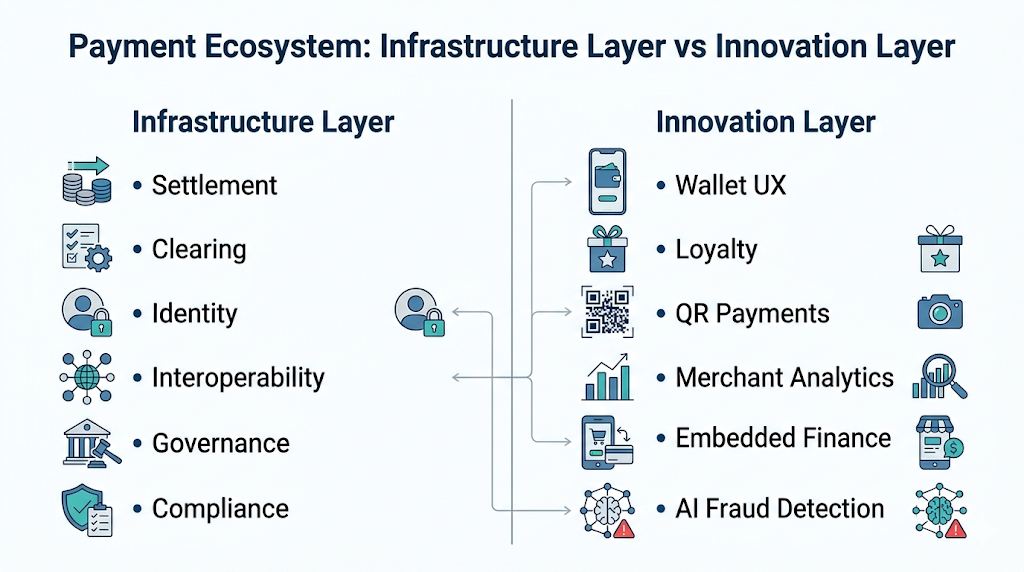
Image Source: Created based on book: Vishvakarma R. Digital Payments and the New Economy: How Cashless Innovation Is Transforming Global Finance, Inclusion, and Growth. 1st ed. Digital Payments and the New Economy: How Cashless Innovation Is Transforming Global Finance, Inclusion, and Growth. UNITED STATES: Zenodo; 2026.
The key idea is that the basic ability to send and receive payments should not depend entirely on a closed platform.
A shared rail allows different providers to connect to the same payment infrastructure while competing on services, design, customer support, analytics, merchant tools, and other value-added features.
This is what transforms payments from isolated products into economic infrastructure.
The Problem With Closed Payment Systems
Closed payment systems can be innovated quickly. They can create smooth user experiences, strong brand loyalty, and fast adoption within their ecosystems.
However, closed systems can also create fragmentation.
If one wallet cannot easily pay another wallet’s merchant, users may need multiple applications. If merchants must display several QR codes, payment acceptance becomes complicated. If every platform creates its own closed loop, the economy becomes increasingly difficult to navigate.
Fragmentation incurs hidden costs.
Consumers face inconveniences. Merchants face this complexity. Banks face duplicate integrations. Smaller fintech firms struggle to compete with larger firms. Regulators have limited visibility across fragmented systems.
A payment system may be successful as a product but weak as a public infrastructure.
This is the central limitation of closed payment ecosystems.
Why Interoperability Matters
Interoperability is the ability of different payment participants to transact in compatible systems.
This means that a user of one bank or app can pay a merchant or individual using another bank or app. This means that merchants do not need to guess which wallet a customer uses. This means that payment acceptance becomes simpler.
Interoperability expands the value of the network.
The more users, merchants, banks, and providers can connect through the same rail, the more useful the ecosystem.
This is especially important for small merchants and ordinary users of the platform. Large businesses can often manage multiple payment integrations. Small merchants cannot do this. Street vendors, local shops, and small service providers need payment acceptance to be simple and affordable.
Interoperable rails can reduce friction. They make digital payments feel universal rather than platform-specific.
Why Private Innovation Still Matters
Public or shared rails alone are insufficient.
A payment rail may provide infrastructure, but users still require good interfaces. Merchants still require tools. Businesses require reconciliation. Consumers need support. Banks and fintechs need to differentiate themselves.
This is where private innovation is important.
Private firms can build mobile applications, merchant dashboards, payment gateways, fraud tools, loyalty programs, embedded finance features, subscription billing, analytics, customer service, and sector-specific payment experiences.
The rail provides a foundation. Private firms create this experience.
This division is powerful because it prevents the core payment system from becoming fragmented, while allowing competition and innovation at the service layer.
The best model is not public or private. The best model is public infrastructure combined with private creativity.
UPI and Pix Show the Infrastructure Model
India’s Unified Payments Interface and Brazil’s Pix show how shared payment rails can reshape daily commerce in the future.
Both systems have made real-time account-to-account payments widely usable. Both emphasized the importance of interoperability. Both support broad participation across financial institutions and service providers. Both have made digital payments more common for everyday transactions.
Their success is not only related to speed.
This is related to infrastructure design.
Image Source: Created based on book: Vishvakarma R. Digital Payments and the New Economy: How Cashless Innovation Is Transforming Global Finance, Inclusion, and Growth. 1st ed. Digital Payments and the New Economy: How Cashless Innovation Is Transforming Global Finance, Inclusion, and Growth. UNITED STATES: Zenodo; 2026.
Users can easily send money. Merchants can accept payments with lower friction. Banks and fintech companies can build applications on a common payment foundation. Small-value payments become practical when scaled.
This creates a different type of payment ecosystem from one dominated only by closed wallets or card networks.
The rail becomes a shared platform for economic activities.
Merchant Acceptance Is the Real Test
A payment system becomes meaningful only when it works where people actually spend their money.
Merchant acceptance is a real-world test of the payment infrastructure.
For merchants, the key questions are practical: How much does it cost? How quickly is the settlement received? Is reconciliation easy? Can customers easily use it? What happens in the event of fraud? Is support available? Does the system increase tax visibility? Does this create dependence on one provider?
Public or shared rails can reduce barriers by making acceptance more standardized and interoperable. QR codes, low-cost acceptance tools, and real-time settlement can make digital payments attractive to small merchants.
This is important because payment transformation does not occur only in banks or apps. It occurs in grocery stores, taxis, street vendors, clinics, repair shops, restaurants, and small businesses.
If payment rails do not reach merchants, they do not become the infrastructure.
The Small-Business Impact
Small businesses often benefit when payment acceptance becomes cheaper, faster, and easier to use.
Digital payment records can help merchants track sales, reconcile transactions, manage cash flows, and potentially access credit. Real-time settlement can reduce the stress caused by delayed funds. QR-based acceptance can reduce the hardware costs.
However, small businesses can also face risks.
Digital payments can increase tax visibility before merchants are ready to accept them. Platform dependency can be a concern. Fraud and chargebacks can create uncertainties. Poor support can damage this trust.
Therefore, payment infrastructure must be designed with merchant realities in mind.
A system that works only for large retailers is not an inclusive payment infrastructure. It must also work for small merchants.
The Governance Challenge
Public railways create new governance responsibilities.
If a payment rail becomes central to economic life, outages become a public concern. Fraud management has become a public trust issue. Data governance is critical. Access rules affect the competition. Pricing decisions affect both merchants and consumers.
The system must answer difficult questions, such as: Who can participate? Who sets the technical standards? Who handles fraud? Who owns the transaction data? Who is responsible for outages? How are disputes resolved? How are fees controlled? How can innovation be allowed without compromising safety?
A shared rail system without good governance can become fragile, politicized, or unfair. A private ecosystem without interoperability can become concentrated and exclusionary.
Therefore, payment governance must balance openness, safety, competition, resilience, and accountability.
The Risk of Overdependence
The success of shared rails can create a new risk: over-dependence.
When a payment system becomes widely used, society becomes dependent on its availability and convenience. If it fails, the impact can spread rapidly.
This makes resilience essential.
Payment infrastructure must be designed with redundancy, fallback channels, cybersecurity readiness, incident response, operational monitoring, liquidity controls, and clear responsibilities during disruptions.
A national or shared payment rail cannot be treated as an ordinary app. It has become a part of the country’s economic nervous system.
The more successful it becomes, the more resilient it needs to be.
Data and Platform Power
Payment rails also generate such data.
This data can support fraud detection, analytics, credit assessment, public policy, and merchant service. However, it can also create a concentration of power.
If a small number of platforms control payment interfaces, they may gain a strong influence over commerce, merchant visibility, consumer behavior, and financial data.
Therefore, the relationship between rail ownership, data access, and interface control is important.
A common rail can reduce some forms of platform dependence, but private interfaces can still become powerful gatekeepers.
Therefore, future payment policies must consider not only who moves the money but also who controls the data and user relationship around the money movement.
The Future Model: Common Rails, Competitive Services
The most promising future is not a system in which everything is public or private.
It is a layered model.
At the bottom are common rails, open standards, settlement infrastructure, interoperability, and governance.
At the top are private apps, merchant tools, analytics, fraud services, customer experiences, embedded finance, and sector-specific innovation.
This model allows payments to function as infrastructure, while preserving market dynamism.
It also helps prevent the economy from being trapped in closed payment silos.
The rail should be broadly accessible to the public. The services should also be competitive. Governance should be accountable. The user experience should continue to improve.
Conclusion
The future of payment infrastructure will depend on how societies balance public and private innovation.
Closed systems can deliver excellent user experiences, but they can also fragment markets and concentrate power. Public or shared rails can enable interoperability and broad access; however, they require strong governance, resilience, and accountability.
The strongest payment ecosystems will combine both these aspects.
They will provide a common infrastructure for money movement while allowing banks, fintechs, platforms, and merchants to innovate on top.
Payments are becoming too important to be treated as products. They are now part of the operating infrastructure of the digital economy.
The real question is not whether payments should be public or private.
The better question is: What should be the shared infrastructure, and where should competition create better services?
This balance will define the next generation of digital payments.
Keywords:
Payment Infrastructure, Public Payment Rails, Private Innovation, Interoperability, Digital Payments, Merchant Acceptance, Small Business Payments, Payment Governance, Payment System Resilience, Data and Platform Power, Digital Payments and New Economy
Author’s Note:
To learn more about digital payments, download free e-book Digital Payments and the New Economy: How Cashless Innovation Is Transforming Global Finance, Inclusion, and Growth by Mr. Rajeew Vishvakarma