High-Risk Merchant Account in 2026: The Complete Guide to Getting Approved, Cutting Fees, and Eliminating Rolling Reserves
 Harry Williams6 min read·Just now
--
By Victoria Hale · Senior Merchant Services & Acquiring Industry Correspondent · April 2026 · 16 min read
A high-risk merchant account is a payment processing arrangement for businesses in industries that mainstream processors classify as elevated risk. Historically, obtaining one required weeks of paperwork, high fees, rolling reserves, and the constant anxiety of account termination.
In 2026, the concept of a “high-risk merchant account” is being replaced by something structurally different — and structurally better. This guide explains everything a high-risk merchant needs to know: what high-risk classification means, what the traditional merchant account process looks like, what it costs, why it’s broken, and what the modern alternative is.
What Is a High-Risk Merchant Account?
A standard merchant account is a relationship between a business, a payment processor, and an acquiring bank. The acquiring bank underwrites the merchant — assessing the risk of processing their transactions — and the processor handles the technology and operations.
A high-risk merchant account is the same relationship, but with a bank and processor willing to serve industries that mainstream acquirers won’t touch. The “high risk” designation comes from the Merchant Category Code (MCC) assigned to your business type, not from your individual business performance.
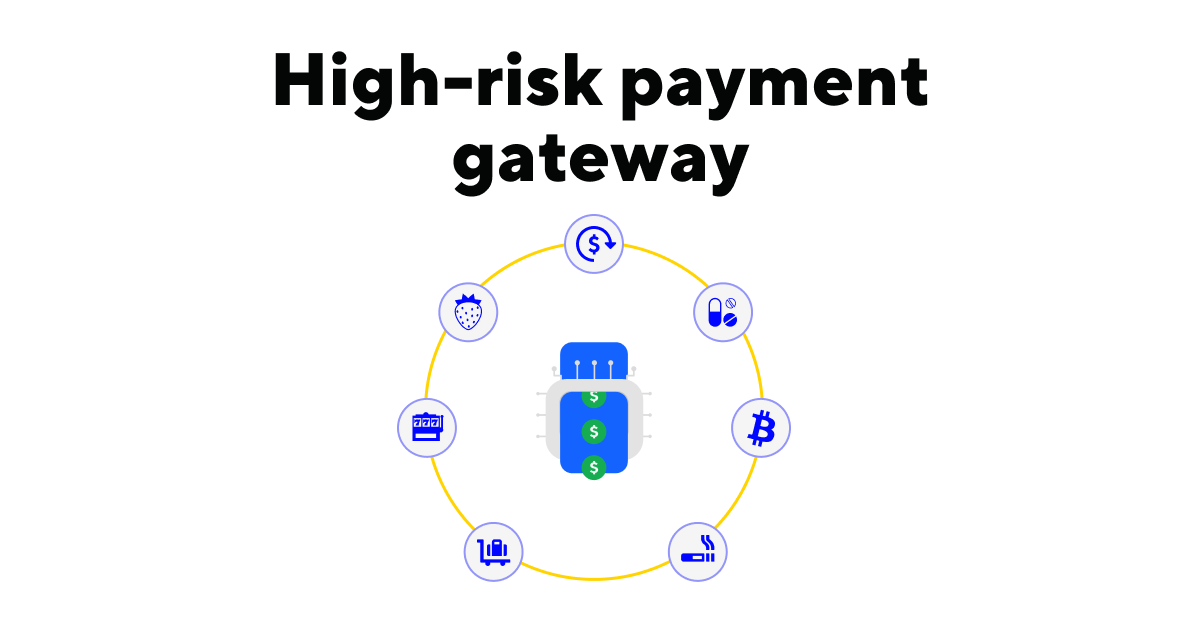
Industries That Require High-Risk Merchant Accounts
The list is long and growing:
Health and wellness: Peptides, research chemicals, nutraceuticals, dietary supplements, nootropics, kratom, CBD, hemp products, online pharmacies, telehealth, medical devices, weight loss programs.
Adult: Adult content platforms, cam sites, dating services, matchmaking, adult retail, subscription-based adult entertainment.
Gambling and gaming: Online casinos, sports betting, fantasy sports, poker, esports betting, lottery services, skill gaming.
Tobacco and nicotine: Vaping, e-cigarettes, e-liquid, nicotine pouches, cigars, pipe tobacco, smoking accessories.
Financial services: Debt consolidation, credit repair, payday lending, cryptocurrency exchanges, money transfer services, binary options, forex trading platforms.
Travel: Online travel agencies, tour operators, timeshares, vacation rentals, charter services, airline ticket consolidators.
Technology and SaaS: Crypto-adjacent SaaS, VPN services, web hosting for restricted content, file-sharing platforms, AI-generated content platforms.
Other: Firearms and ammunition, tactical gear, security equipment, multi-level marketing, subscription boxes, drop-shipping, pawn shops, auction sites, precious metals, bail bonds.
If your business falls into any of these categories — or any category that involves regulatory complexity, reputational sensitivity, or historically elevated chargeback rates — you need either a high-risk merchant account or an alternative that bypasses the traditional acquiring model entirely.
The Traditional High-Risk Merchant Account Process
Step 1: Find a Processor
Most mainstream processors won’t serve you. You need a specialized high-risk processor — a company with acquiring bank relationships that accept elevated-risk MCCs. Finding one typically involves searching “high-risk payment processor,” contacting multiple companies, and waiting for initial assessments.
Step 2: Apply
The application typically requires: business registration/incorporation documents, government-issued ID of the owner/directors, three months of business bank statements, three months of processing statements (if available), voided check or bank letter, proof of business address, company website URL (for review), detailed business description, refund and cancellation policy, expected monthly processing volume, average transaction size, and sometimes a personal guarantee.
Step 3: Underwriting
The processor’s underwriting team reviews your application. They assess: your industry’s chargeback profile, your specific chargeback history (if available), your financial stability, your website and product offerings, your geographic risk profile, and your compliance with card network rules.
This takes 1–4 weeks. Additional documents may be requested.
Step 4: Approval (Maybe)
If approved, you receive a merchant agreement with terms that typically include:
- Transaction fees: 4–8% (vs. 2.9% for mainstream merchants)
- Rolling reserve: 5–15% withheld for 6–12 months
- Monthly minimum: $25–$100 per month regardless of volume
- Statement fee: $5–$15/month
- PCI compliance fee: $50–$100/year
- Chargeback fee: $25–$100 per dispute
- Setup fee: $100–$2,000 (one-time)
- Early termination fee: $200–$500 if you leave before the contract term
If rejected — which happens frequently — you start the process over with a different processor.
Step 5: Processing (With Conditions)
You begin accepting payments. But the relationship is conditional:
- Your chargeback rate must stay below a threshold (typically 1–2%)
- Your refund rate must stay below a threshold
- Your volume must stay within approved parameters
- The processor can increase your reserve at any time
- The processor can terminate your account with 30 days’ notice (sometimes less)
- The acquiring bank can exit your industry category at any time
Why the Traditional Model Is Broken
The traditional high-risk merchant account model has three fundamental problems:
Problem 1: You’re paying for someone else’s risk. Rolling reserves exist because the processor holds your money and faces liability if you generate chargebacks you can’t cover. The reserve is insurance — but you’re paying the premium while the processor holds the float and earns interest on your cash.
Problem 2: You’re hostage to someone else’s banking relationship. Your merchant account depends on the processor’s relationship with an acquiring bank. If that bank decides to exit your industry — which happens regularly — you lose processing capability regardless of your own performance.
Problem 3: You’re treated as guilty until proven innocent. The entire model assumes you will cause problems. Fees are elevated because your category causes problems. Reserves are held because your category causes problems. Your account can be terminated because your category might cause problems. Your individual track record is secondary to your MCC code.
The Modern Alternative: NexaPay.one
NexaPay is a fiat-to-crypto payment gateway that eliminates the need for a traditional high-risk merchant account entirely.
How it replaces the traditional model:
Traditional High-Risk Merchant AccountNexaPayApplication: 10–15 pages of documentsNo applicationUnderwriting: 1–4 weeksNo underwriting (60-second setup)Approval: uncertain, frequent rejectionsNo approval neededFees: 4–8%1–3%Rolling reserve: 5–15% for 6–12 months0%Fund freezes: commonImpossible (crypto settles to your wallet)Settlement: 3–7 business daysMinutesMonthly fees: $25–$500$0Setup fees: $100–$2,000$0Industry restrictions: MCC-dependentNoneContract term: 1–3 years with early termination feesNo contract
The key architectural difference: In the traditional model, the processor holds your money. In NexaPay’s model, the payment is converted to USDC, USDT, or other crypto and sent directly to your wallet. The processor never holds your funds. This eliminates the need for reserves, the risk of freezes, and the requirement for underwriting.
What your customers see: A standard card payment form. Visa, Mastercard, Apple Pay, Google Pay. No crypto jargon. No QR codes. The experience is identical to paying on any mainstream e-commerce site.
What you receive: Cryptocurrency in your wallet within minutes. Dollar-stable if you choose USDC or USDT. On-chain verifiable. Fully in your custody.
Who Should Use NexaPay vs. a Traditional Account
Use NexaPay if:
- You sell legal products/services in any high-risk category
- You want to accept card payments immediately (today, not in 2–4 weeks)
- You don’t want to surrender 5–15% of your revenue to a rolling reserve
- You’ve been rejected by one or more processors
- You can’t provide the documentation traditional processors require
- You want lower fees (1–3% vs. 4–8%)
- You want instant settlement (minutes vs. days)
- You want to eliminate the risk of fund freezes and account termination
Use a traditional high-risk merchant account if:
- Your industry regulators specifically require a licensed payment processor
- You need formal processing documentation for compliance audits
- You need features like recurring billing, subscription management, or multi-currency fiat settlement that require a traditional processor’s infrastructure
For the majority of high-risk merchants — those selling legal products who need reliable, affordable card acceptance — NexaPay is the superior option in every measurable dimension: cost, speed, risk, and simplicity.
Getting Started
- Visit nexapay.one
- Enter your crypto wallet address (USDC or USDT recommended)
- Choose integration: payment link, WooCommerce/Shopify plugin, or API
- Accept your first payment — today
No application. No underwriting. No waiting. No reserve. No freeze. No contract.
Your wallet address is your merchant account.
Website: nexapay.one
Victoria Hale is a senior merchant services and acquiring industry correspondent covering payment processing regulation, high-risk merchant infrastructure, and the evolution of the acquiring landscape. Based in Chicago.
Related searches: high risk merchant account, high risk merchant account application, high risk merchant account instant approval, high risk merchant account no reserve, best high risk merchant account, high risk payment processing, high risk merchant services, high risk credit card processing, how to get a merchant account for high risk business, merchant account for supplements, merchant account for CBD, merchant account for adult, merchant account for gambling, high risk merchant account fees, high risk merchant account alternative