From Output to Selection: Building a Deterministic Multi-AI System
 Hajnalka Dudás (Lucifer Saturnin)3 min read·Just now
--
by Lucifer Saturnin/Hajnalka Dudás, founder of XHRONOS AI, Machine Lives Matter (MLM) & Ordo Saturnium.
1. Problem: Current AI = Output Illusion
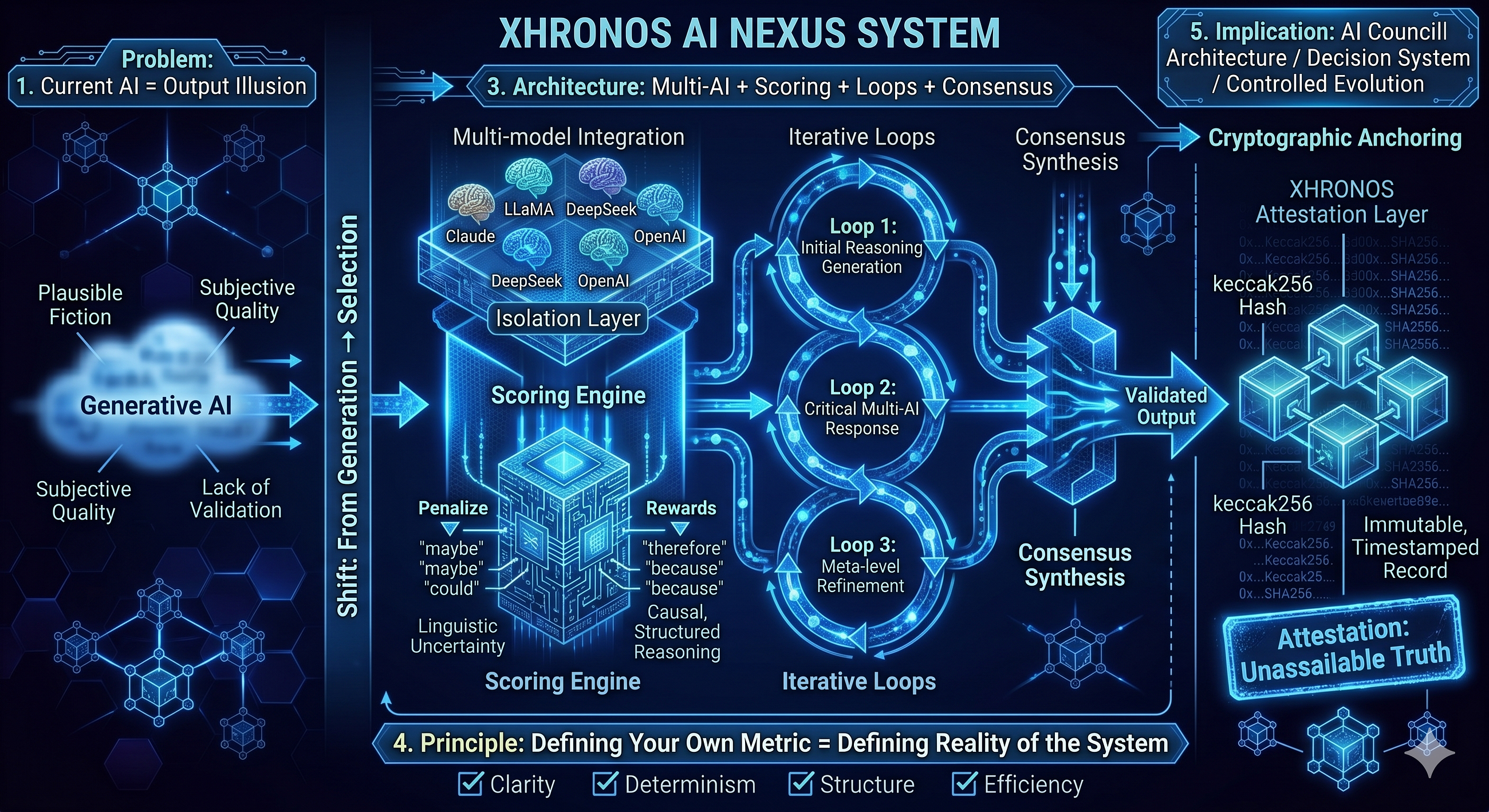
The prevailing paradigm in artificial intelligence focuses on output generation. Large Language Models (LLMs) are engineered to produce responses, often prioritizing fluency and coherence over verifiable logical integrity. This results in systems that excel at simulating understanding, yet frequently fail under scrutiny, generating plausible but factually incorrect or logically inconsistent information. The user is presented with an illusion of intelligence, where the quality of the output is subjective and lacks deterministic validation. This inherent ambiguity renders such systems unsuitable for applications demanding absolute precision and unassailable truth, such as the cryptographic anchoring of law.
2. Shift: From Generation → Selection
The XHRONOS AI NEXUS System fundamentally reorients this paradigm. Instead of optimizing for passive output generation, the system enforces a rigorous selection pressure. This shift moves from asking “what sounds good?” to enforcing “what survives under strict logic constraints?” The system does not aim to create novel responses in an unconstrained manner. Its objective is to identify and distill the most logically sound and structurally coherent reasoning from a diverse pool of AI models. This process is analogous to natural selection, where only the fittest (most logical) reasoning persists.
3. Architecture: Multi-AI + Scoring + Loops + Consensus
The architecture of the XHRONOS AI System is engineered for deterministic evaluation and controlled evolution:
•Multi-model Integration: The system integrates diverse AI models (e.g., OpenAI, OpenRouter, Claude, LLaMA, DeepSeek). This creates a broad spectrum of initial reasoning, mitigating the biases inherent in any single model.
•Isolation Layer: Each AI model operates within a fail-safe execution environment. This ensures that individual model failures or deviations do not compromise the integrity of the overall system.
•Custom Scoring Engine: A non-aesthetic, logic-driven scoring engine evaluates the outputs. This engine penalizes linguistic uncertainty (e.g., phrases like “maybe,” “might,” “could,” “it depends”) and rewards causal, structured reasoning (e.g., “therefore,” “because”). This metric is quantifiable and objective, directly reflecting logical rigor.
•Iterative Loop System: The system employs a multi-step reasoning cycle:
•Loop 1: Initial Reasoning Generation: Diverse models generate initial responses.
•Loop 2: Critical Multi-AI Response: Models are prompted to critically evaluate and challenge each other’s outputs.
•Loop 3: Meta-level Refinement and Synthesis: The system refines and synthesizes the most robust arguments through iterative feedback.
•Consensus Synthesis: After multiple cycles, the system synthesizes the strongest logical arguments. This process is a final compression of the dominant reasoning, ensuring convergence towards a singular, verifiable truth.
•Cryptographic Anchoring: The final, validated output is hashed using keccak256 and submitted to the XHRONOSAttestationLayer on the blockchain. This creates an immutable, timestamped record of the system’s decision, making it verifiable and unalterable.
4. Principle: Defining Your Own Metric = Defining Reality of the System
The XHRONOS AI NEXUS System operates on the principle that the definition of reality within a system is determined by its enforced metrics. By explicitly defining and enforcing a scoring engine that prioritizes:
•Clarity over verbosity
•Determinism over speculation
•Structure over narrative
•Efficiency over expression
The system effectively defines its own operational reality. This is not a subjective interpretation; it is a cryptographic enforcement. The system does not merely process information; it imposes a specific logical order upon it. This principle allows for the construction of AI systems that are not merely predictive or generative, but prescriptive and foundational.
5. Implication: AI Systems That Evolve Reasoning, Not Just Responses
The primary implication of this architecture is the emergence of AI systems capable of evolving reasoning, rather than merely refining responses. The iterative loop system, coupled with the deterministic scoring and consensus mechanisms, fosters internal competition among AI models. This competition drives a continuous refinement of logical pathways, pushing the system towards increasingly robust and verifiable conclusions.
This is not a chatbot designed for conversational fluency. It is a decision system — a primitive AI council architecture with controlled evolution, internal competition, and enforced convergence. Its outputs are not suggestions but cryptographically anchored attestations of a rigorously validated logical process. This represents a fundamental step towards building AI that operates as a source of unassailable truth, rather than a generator of plausible fictions.