Ethereum Used 4 Different Narratives to Become a $285B Network
 Fart Research6 min read·Just now
--
I have spent more time than most people studying how Ethereum communicates itself to the market. Not the technology, the communication. The way the network has been framed, reframed, and repositioned across different market cycles tells you more about how narrative strategy works in crypto than any theoretical framework I have come across.
What I found when I mapped it out was that Ethereum did not arrive at a $285B network by getting the story right once and holding it. It got there by getting the story right four separate times, at four different moments, for four different audiences. Each shift was deliberate. Each one responded to a specific market condition. And each one created the conditions for the next phase of growth.
This is the most instructive case study in crypto narrative strategy available. It is hiding in plain sight.
What Is Narrative Strategy in Crypto and Why Does Ethereum Prove Its Value?
Narrative strategy in crypto is the process of defining how a project is understood by the market at each stage of its growth. It is not a single document written at founding and held constant. It is an adaptive framework that gets updated as the project, the market, and the competitive landscape all evolve.
Most teams treat narrative as something built once and maintained. Ethereum’s history demonstrates that the teams and ecosystems that scale are the ones willing to rebuild the narrative from the ground up when market conditions require it. The four framing shifts I mapped were each a full rebuild, not an update.
Each one was triggered by a specific external signal. Understanding what triggered each shift is as important as understanding what the new narrative said.
Narrative 1: Programmable Money (2014 to 2017)
The founding narrative positioned Ethereum as a layer for programmable money. The primary audience was Bitcoin-adjacent participants who understood the value of decentralized currency but could see the limitations of a single-use-case chain.
The framing was deliberate. By anchoring to “money” as the reference point, the narrative gave the Bitcoin community a familiar context for something that was genuinely new. Smart contracts were not explained as smart contracts in this period. They were explained as conditions that money could be programmed to follow. The technical concept was introduced inside an existing mental model.
This worked because the primary adoption barrier at that stage was conceptual. People needed to understand why programmable money was different from and more valuable than non-programmable money before they would engage. The narrative answered that question in terms the target audience already understood.
The trigger for the first shift was the 2017 ICO boom. Ethereum was suddenly being used primarily as a platform for token issuance rather than as a programmable money layer. The narrative needed to expand to reflect what the network was actually being used for.
Narrative 2: The World Computer (2017 to 2019)
The second narrative repositioned Ethereum as a global computation layer. The primary audience expanded from Bitcoin-adjacent participants to developers and technical founders who wanted to build applications on a decentralized infrastructure.
This framing reflected the actual usage pattern that had emerged. Teams were building decentralized applications, not just programmable payment systems. The “world computer” narrative gave developers a context for building that was bigger than financial applications. It opened the mental space for the entire application layer to be rebuilt on decentralized infrastructure.
The timing of this shift mattered. The ICO boom had created a large developer audience that was actively looking for a framework to build inside. The world computer narrative gave them that framework at the exact moment they were ready for it.
The trigger for the second shift was the 2018 collapse and the recognition that the world computer framing was simultaneously too broad and too vague to drive the specific type of institutional and developer adoption Ethereum needed in its next phase. Scalability limitations had become the primary conversation. The narrative needed to address that directly rather than papering over it.
Narrative 3: The Foundation Layer (2019 to 2021)
The third narrative repositioned Ethereum as a settlement and security layer, the base infrastructure on which Layer 2 scaling solutions and application-specific chains would build. The primary audience shifted toward institutional participants, serious DeFi builders, and the emerging Layer 2 ecosystem.
This was the most technically honest of the four narratives. It acknowledged the scalability limitations directly and reframed them as features of a deliberate design philosophy rather than deficiencies to be overcome. The argument was that base layer security and decentralization were worth the performance constraints because everything performance-dependent could be built above.
The framing gave the emerging Layer 2 ecosystem a coherent identity. They were not workarounds. They were the intended architecture. This narrative created the category that Arbitrum, Optimism, and a dozen other teams built their own market positions inside.
The trigger for the third shift was the DeFi Summer of 2020 and the explosion of yield-generating protocols that made Ethereum’s value accrual mechanism undeniable. The network was generating real revenue. The narrative needed to reflect that financial reality.
Narrative 4: Ultrasound Money and the Revenue Network (2021 to Present)
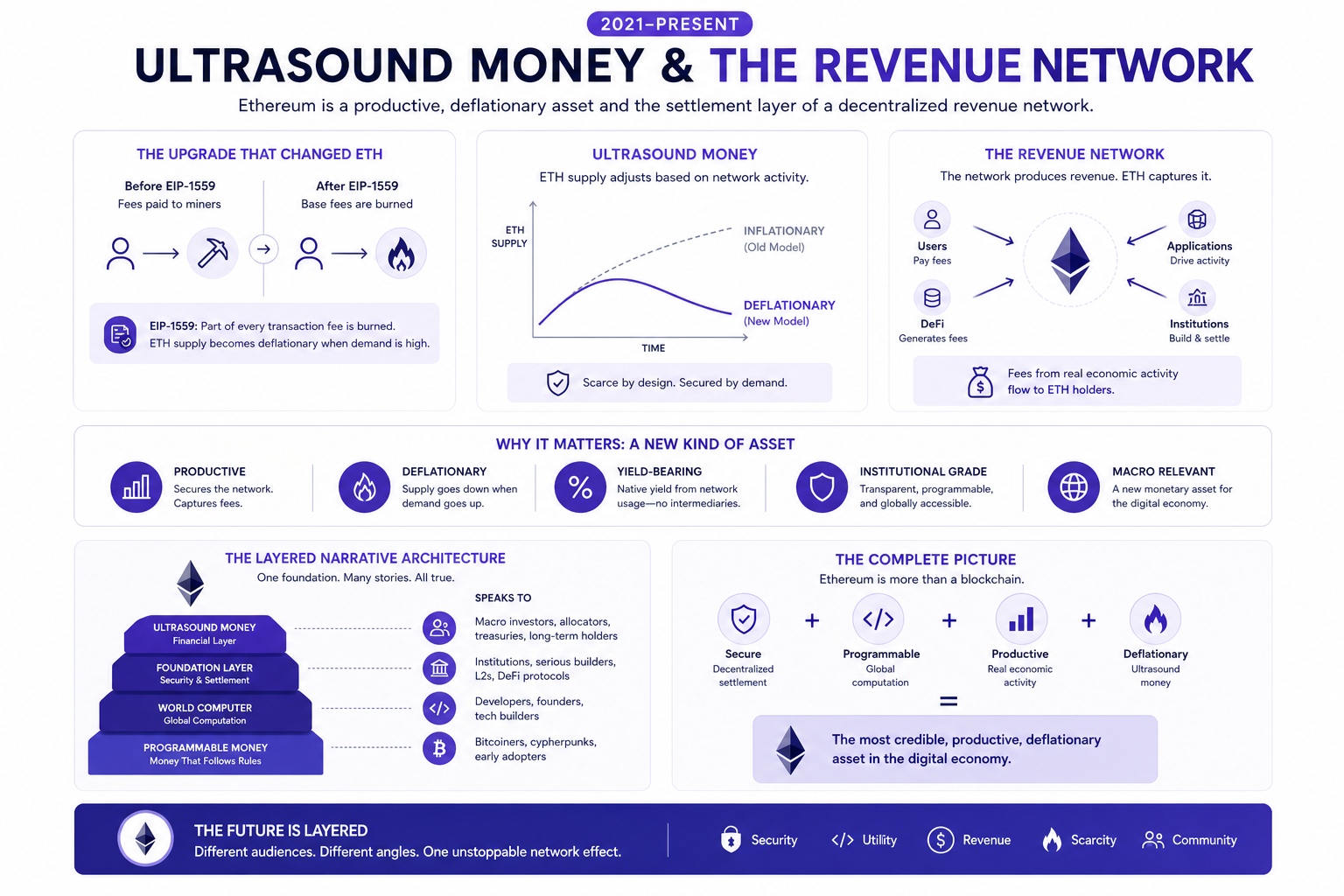
The fourth narrative added a financial layer to the foundation story. EIP-1559 introduced fee burning, making ETH deflationary under certain network conditions. The “ultrasound money” framing emerged from the community and was amplified by the core ecosystem.
This narrative was not top-down. It emerged from participants who recognized the financial mechanics the network had developed and created a cultural frame around it. The timing was precise. It arrived when institutional capital was actively looking for a store-of-value asset with yield characteristics that Bitcoin did not offer.
The audience this narrative reached was different from any of the previous three. It spoke to macro-aware investors who thought in terms of monetary policy, supply dynamics, and yield. It gave Ethereum a position in conversations that had previously been entirely occupied by Bitcoin.
What I find most instructive about this fourth shift is that it did not abandon the foundation layer narrative. It added a financial frame on top of it. The narrative architecture became layered rather than replaced, which meant different audiences could hold different versions of the Ethereum story simultaneously without contradiction.
What Sevenfold Takes From the Ethereum Narrative Playbook
I have walked through the Ethereum case study in detail because it illustrates the core principle behind how Sevenfold approaches narrative strategy for Web3 projects. A narrative is not a statement of current reality. It is a claim about the category the project is building toward.
Each of Ethereum’s four narratives was ahead of where the network actually was at the time it was deployed. Programmable money was introduced before the smart contract ecosystem existed at scale. The world computer framing came before the application layer was fully built. The foundation layer narrative came before the Layer 2 ecosystem was mature. Ultrasound money came at the precise moment the financial mechanics made the claim defensible.
The sequence was always the same. Build the narrative that reflects the category the network is growing into, then execute against it. The market adopts the frame first and the technology confirms it afterward.
This is the playbook Sevenfold applies when building narrative strategy for early and mid-stage projects. The story is built for the market the project is entering, not just the product the team has built today. That forward-looking frame is what gives the narrative room to compound rather than requiring a full rebuild every eighteen months.
Ethereum did not build a $285B network by describing what it was. It built that network by consistently claiming what it was becoming, in terms the right audience could receive at each specific moment.
That is what narrative strategy in crypto actually looks like at full execution.