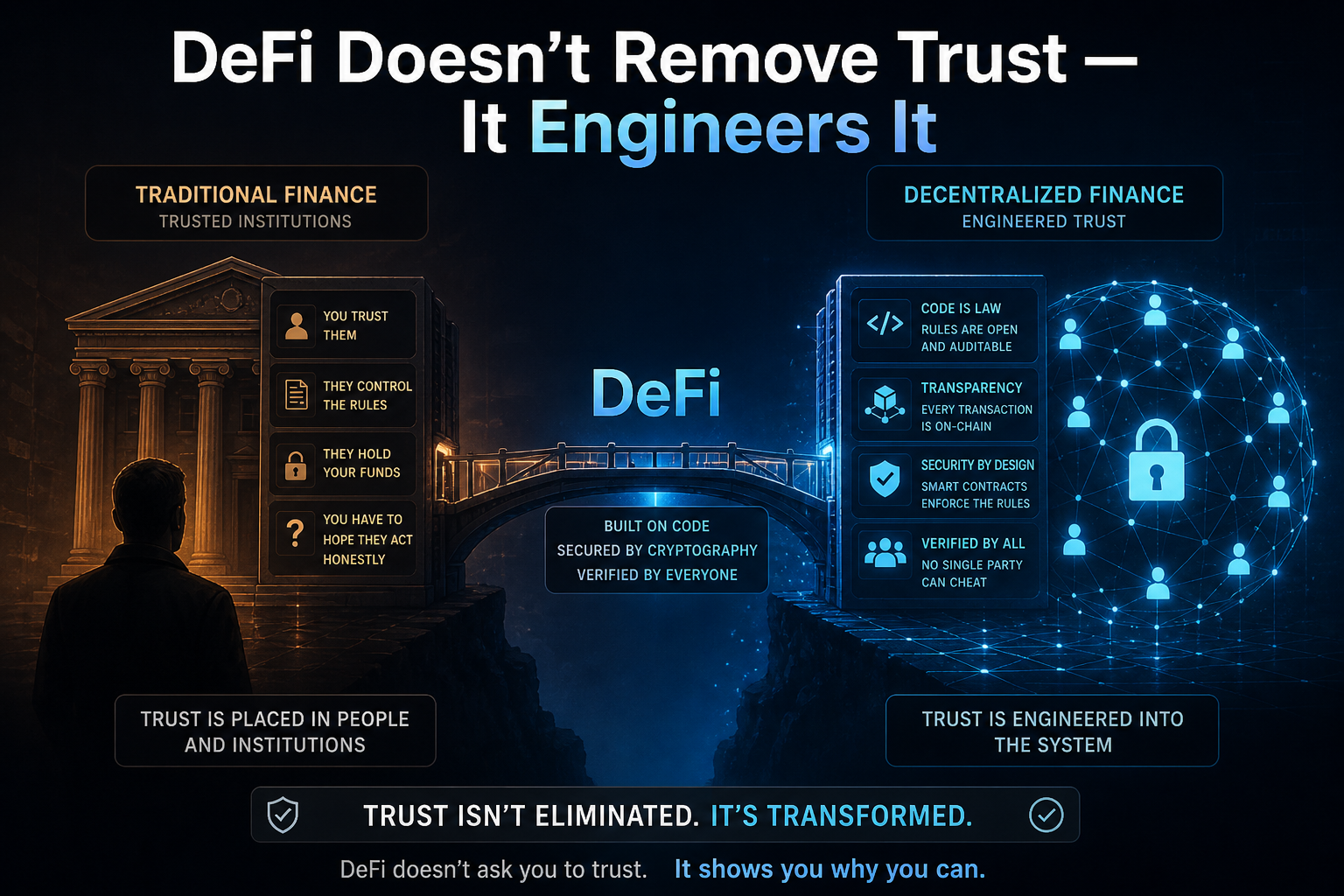
DeFi Doesn’t Remove Trust — It Engineers It
--
The future of DeFi isn’t trustless. It’s designed trust.
DeFi was built on a powerful idea:
“Don’t trust people. Trust code.”
For a while, that narrative worked.
No intermediaries.
No gatekeepers.
No centralized control.
Just smart contracts and open systems.
But as DeFi evolved, something became clear:
Trust didn’t disappear.
It just moved.
The Myth of “Trustless” Systems
The industry loves the word trustless.
- “Code is law”
- “No trust required”
- “Pure decentralization”
It sounds absolute.
But in reality, no system is fully trustless.
Every system relies on assumptions.
The real question isn’t:
👉 Is there trust?
It’s:
👉 Where does trust exist — and how is it managed?
Where Trust Actually Lives in DeFi
Even in DeFi, trust exists across multiple layers.
You trust:
- Smart contracts to behave as intended
- Governance systems to make rational decisions
- Oracles to provide accurate data
- Bridges to securely move assets
- Execution layers to process transactions correctly
Each layer introduces dependencies.
Each dependency introduces risk.
But instead of removing trust, DeFi often abstracts it away.
Out of sight.
Out of focus.
Not eliminated.
The Problem With “Decentralization Theatre”
Many systems look decentralized.
But appearance is not the same as resilience.
Consider:
- Multisigs acting as a stand-in for security
- DAOs with low participation controlling critical decisions
- Timelocks that delay actions but don’t eliminate risk
- Systems that cannot react quickly during market stress
This creates what can be called:
👉 Decentralization theatre
Where systems appear trustless — but still depend on fragile structures underneath.
The problem isn’t decentralization.
It’s unstructured trust.
From Trustless to Engineered Trust
The next phase of DeFi requires a shift in thinking.
Not:
❌ Removing trust
But:
✅ Engineering it
What is engineered trust?
Engineered trust means:
- Clear roles and responsibilities
- Defined permissions
- Enforced constraints
- Systems designed to respond to failure
This is how mature financial systems operate.
Trust is not eliminated.
It is structured, visible, and controlled.
Why Operational Security Matters
Real systems don’t just prevent failure.
They prepare for it.
That requires:
- Continuous monitoring
- Rapid response mechanisms
- Human judgment in edge cases
- Layered security systems
Because code alone cannot anticipate every scenario.
Markets change.
Conditions shift.
Unexpected events happen.
Resilience comes from systems that can adapt and respond.
Not just execute blindly.
How Concrete Engineers Trust
This is where Concrete vaults take a different approach.
Instead of hiding trust, they make it explicit.
Concrete is built on:
👉 engineered trust, not assumed trust
Key principles:
- Trust is visible — roles and responsibilities are clearly defined
- Systems are responsive — designed to handle changing conditions
- Onchain enforcement + off-chain intelligence
- Role-based architecture — separating authority and execution
- Controlled execution environments
This creates a system focused on:
👉 operational security, not decentralization theatre
Concrete doesn’t pretend trust doesn’t exist.
It structures it.
The Bigger Shift
DeFi is evolving beyond its early narratives.
The next phase isn’t about claiming:
“trustless systems”
It’s about building systems that:
- Acknowledge trust
- Structure it intentionally
- Enforce it reliably
- Perform under stress
Because in real systems:
👉 resilience matters more than ideology
Final Thought
Trust is not the enemy of DeFi.
Unstructured trust is.
The future won’t be defined by who claims to remove trust —
But by who designs it best.
🚨 Explore Concrete at https://concrete.xyz/ 🚨
Because the next generation of DeFi won’t just run on code —
It will run on engineered trust.