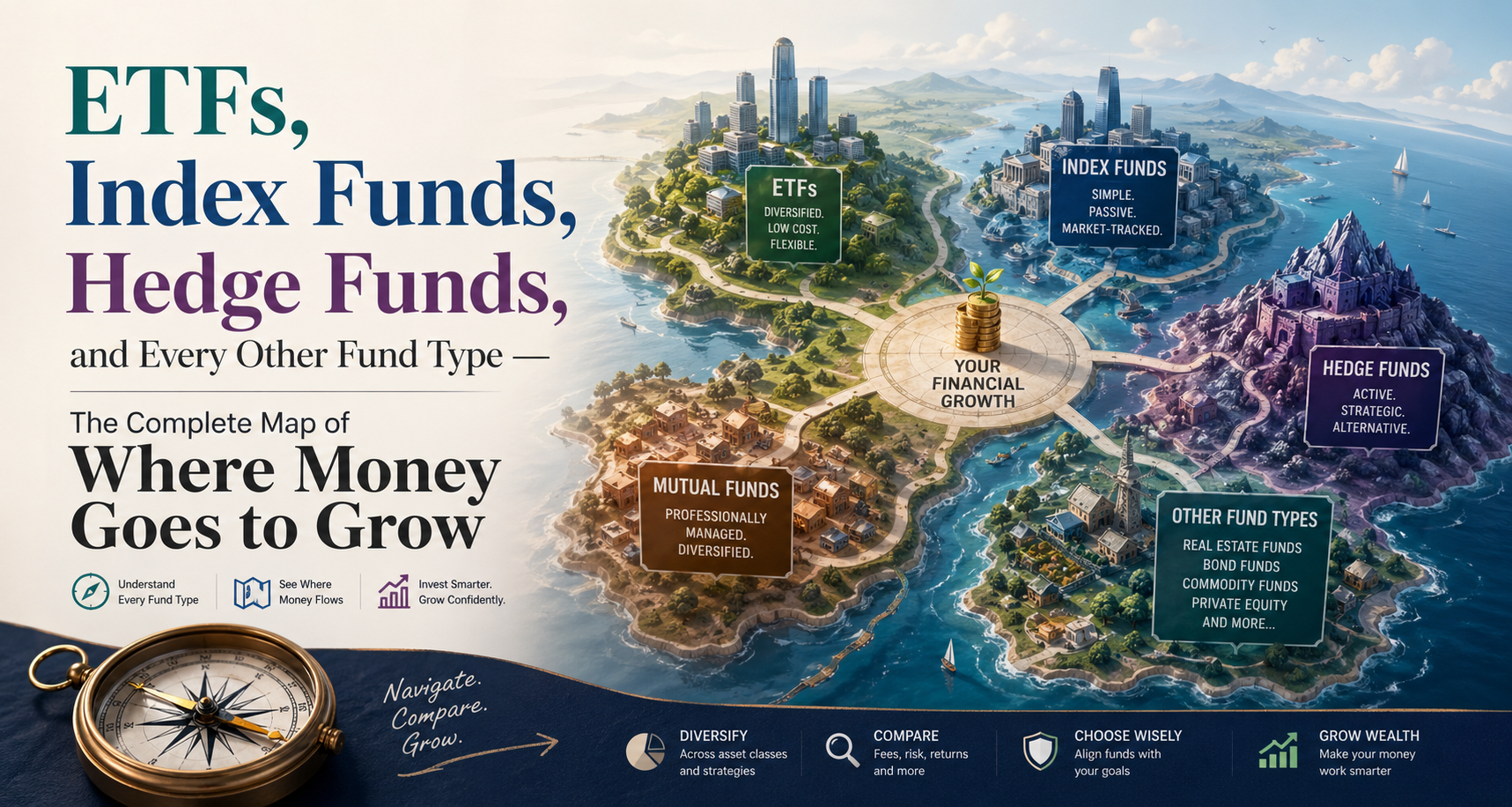
ETFs, Index Funds, Hedge Funds, and Every Other Fund Type — The Complete Map of Where Money Goes to Grow
 Harshavardhan Mamidipaka26 min read·Just now
--
There are over 40 different types of investment funds available to Indian investors today. Most people know two: the mutual fund their bank RM sold them and the SIP their friend won’t stop talking about. The other 38 contain some of the most powerful wealth-building tools ever invented — and some of the most dangerous. This article maps all of them, end to end.
Introduction: The Fund Universe Is Bigger Than You Think
A “fund” is a simple idea: pool money from many people, invest it collectively, share the returns. Simple concept. Extraordinarily diverse execution.
From a ₹500/month SIP in an index fund to a ₹10 crore minimum ticket hedge fund that bets on stock price crashes — both are “funds.” From a government bond ETF to a Real Estate Investment Trust that owns shopping malls — both use the fund structure. From a Nifty 50 ETF charging 0.04% per year to a private equity fund charging 2% management fee plus 20% of profits — both call themselves investment vehicles.
Understanding the differences between these fund types is not academic. It is the difference between:
- Paying 0.04% vs 2.5% annually for similar market exposure
- Accessing returns that are truly uncorrelated to markets vs pretending to
- Building long-term wealth systematically vs speculating with sophisticated packaging
- Understanding what you own vs trusting a name and a brochure
This article maps the entire fund universe available to Indian investors — how each type works, who runs it, how they make money, what you actually get, and who each type is genuinely suited for.
Part 1: The Foundation — How Any Fund Actually Works
Before we go wide, let’s establish the mechanics that underlie every fund structure.
The core fund mechanic:
- A fund manager (or management company) creates a fund vehicle
- Investors contribute capital to the pool
- The manager deploys this capital into assets — stocks, bonds, real estate, commodities, derivatives, other funds, or any combination
- Returns (dividends, interest, capital gains) flow back to the pool
- The pool is divided into units or shares — each investor’s ownership is proportional to their units
- The manager charges fees — from the pool, from profits, or from investors directly
- Investors can exit by selling their units (at NAV, or on an exchange, or during specific redemption windows)
Every fund — from the most basic index ETF to the most exotic multi-strategy hedge fund — is a variation of this structure. What differs is:
- What assets are bought
- How the manager decides what to buy (passive vs active)
- Who can invest (retail vs institutional vs accredited)
- How and when you can exit
- How the manager is compensated
- What regulatory framework governs it
With that foundation, let’s map the universe.
Part 2: ETFs — The Most Important Financial Innovation of the Last 30 Years
ETF = Exchange Traded Fund
An ETF is a fund that tracks an index, sector, commodity, or basket of assets — and trades on a stock exchange like a regular share. You buy and sell ETF units through your brokerage account, at real-time market prices, during market hours.
2.1 How ETFs Work — The Creation/Redemption Mechanism
The ETF’s most elegant feature is a mechanism most retail investors never think about: the in-kind creation/redemption process. This is what keeps ETF prices aligned with the actual value of their underlying assets.
Here’s how it works:
When large investors (called Authorized Participants — APs) want to create new ETF units:
- The AP buys the basket of stocks that the ETF tracks (e.g., all 50 Nifty 50 stocks in the right proportions)
- The AP delivers this basket of stocks to the ETF fund house (AMC)
- The AMC issues new ETF units to the AP
- The AP sells these ETF units on the stock exchange to retail investors
When large investors want to redeem:
- The AP buys ETF units from the exchange
- Delivers the units to the AMC
- Receives the basket of underlying stocks back
- Sells those stocks in the market
This mechanism means:
- If the ETF trades at a premium to its NAV (underlying value), APs buy the stocks and create new units → selling pressure brings price down
- If the ETF trades at a discount to NAV, APs buy units and redeem for stocks → buying pressure brings price up
The result: ETF market price stays very close to its Net Asset Value. The arbitrage is continuous and automatic.
2.2 Types of ETFs in India
Equity Index ETFs: Track stock market indices. These are the workhorses.
- Nifty 50 ETF: Tracks India’s 50 largest companies. The most liquid ETFs in India.
- Sensex ETF: Tracks BSE’s 30 largest companies
- Nifty Next 50 ETF: The next 50 companies after Nifty 50 — mid-large cap exposure
- Nifty Midcap 150 ETF: Mid-cap exposure via index
- Nifty Smallcap 250 ETF: Small-cap index exposure
- Nifty 500 ETF: Broad market exposure — top 500 companies
Sectoral ETFs: Track specific industry indices.
- IT ETF (tracks Nifty IT index — Infosys, TCS, Wipro, HCL, etc.)
- Bank ETF / BankBEES (Nifty Bank index — HDFC Bank, ICICI, SBI, Axis, etc.)
- Pharma ETF, Auto ETF, FMCG ETF, PSU Bank ETF, Infrastructure ETF
Factor / Smart Beta ETFs: Track indices built on specific factors rather than just market cap.
- Quality ETF: Companies with high ROE, low debt, consistent earnings
- Value ETF: Companies trading at low price-to-book or price-to-earnings
- Momentum ETF: Companies that have been rising in price (momentum factor)
- Low Volatility ETF: Companies with lower price swings
- Alpha ETF / Multi-factor ETF: Combinations of factors
Debt ETFs: Track bond indices.
- Bharat Bond ETF: Government-owned companies’ bonds. PSU debt at predictable yields. One of SEBI’s flagship debt ETF products (launched 2019).
- Liquid ETF: Ultra-short term money market instruments — almost like a parking account but on exchange
- G-Sec ETF: Government Securities (sovereign bonds) — zero credit risk
International ETFs: Give Indian investors exposure to foreign markets without opening foreign accounts.
- Motilal Oswal Nasdaq 100 ETF: Tracks US tech-heavy Nasdaq 100 index
- Mirae Asset NYSE FANG+ ETF: Meta, Apple, Amazon, Netflix, Google + others
- Kotak Global Innovation ETF: Global innovation-focused companies
- Hang Seng ETF: Hong Kong/China market exposure
Commodity ETFs:
- Gold ETF: Each unit represents 1 gram (approximately) of physical gold held in secure vaults. HDFC Gold ETF, SBI Gold ETF, Nippon Gold ETF. One of India’s oldest and most popular ETF categories.
- Silver ETF: Similar to gold ETFs but for silver. Relatively new in India (launched 2021–22)
2.3 ETF Cost Structure — The Number That Makes Everything Else Irrelevant
ETFs are dramatically cheaper than actively managed funds. This matters more than almost any other investment factor because costs are the only return predictor that is 100% certain.
Compare the Nifty 50 ETF at 0.07% to an actively managed large-cap mutual fund at 1.5–2.5% (regular plan). That 1.4–2.4% difference compounds over decades into a staggering wealth gap.
2.4 ETF Liquidity — The Hidden Risk Most Retail Investors Miss
ETFs trade on exchanges. But not all ETFs have equal liquidity. A poorly traded ETF (low daily volume) can have a large bid-ask spread — the difference between the price at which you can buy and the price at which you can sell.
On Nifty BeES (one of India’s most liquid ETFs), the bid-ask spread might be ₹0.01 on a ₹200 unit — negligible. On a small sectoral ETF, the spread might be ₹1–2 on a ₹100 unit — that’s 1–2% lost every time you buy and sell.
Always check:
- Daily trading volume (higher is better — look for crores of rupees, not lakhs)
- Bid-ask spread at the time of purchase
- Tracking error (how closely does the ETF actually follow its index?)
2.5 ETF vs. Mutual Fund — The Structural Difference
Part 3: Index Funds — ETFs Without the Complexity
An index fund is a mutual fund that passively tracks an index — the same strategy as an ETF, but in mutual fund wrapper.
You don’t need a demat account. You can invest ₹100 via SIP. You get the NAV at end of day. You don’t deal with bid-ask spreads or exchange trading.
The trade-off: expense ratios for index funds are slightly higher than equivalent ETFs (typically 0.10–0.40% vs 0.04–0.10%) but still far cheaper than actively managed funds.
Popular index funds in India:
- UTI Nifty 50 Index Fund
- HDFC Index Fund — Nifty 50 Plan
- Mirae Asset Nifty 50 Index Fund
- Motilal Oswal Nifty 500 Index Fund
- Nippon India Nifty Smallcap 250 Index Fund
Who index funds are for: Anyone who wants market returns at low cost, without the complexity of exchange trading. Beginners. Long-term wealth builders. Anyone who has read enough to know that most active fund managers don’t beat the index over long periods.
The active vs passive debate in India:
In the US, decades of data show that ~85–90% of active fund managers underperform their benchmark index over 15+ years, after fees.
In India, the story has historically been different. Indian markets are less efficient (more information asymmetry, more retail-driven volatility, more mid and small-cap opportunities that large institutional investors can’t easily access) — meaning skilled active managers have had more opportunities to outperform.
But: as India’s markets mature, as more institutional money flows in, as information becomes more available — the alpha opportunity for active managers is shrinking. The case for passive index investing is getting stronger every year in India.
Part 4: Fund of Funds — The Meta-Fund
A Fund of Funds (FoF) is a mutual fund that doesn’t invest in stocks or bonds directly. Instead, it invests in other mutual funds.
Why would you want this?
- Asset allocation funds: A FoF might invest 60% in an equity fund and 40% in a debt fund, automatically rebalancing to maintain this ratio. You get automatic asset allocation management.
- International FoF: Indian fund houses often use the FoF structure to give retail investors access to international funds — like the Motilal Oswal NASDAQ 100 FoF (which invests in a US-listed NASDAQ ETF). Without this wrapper, you’d need overseas investment infrastructure.
- Gold FoF: Some AMCs offer a FoF that invests in their own Gold ETF — letting investors access gold without a demat account.
The cost problem with FoFs: A FoF charges its own expense ratio on top of the expense ratios of the underlying funds it invests in. You’re paying twice. A FoF with a 0.5% expense ratio investing in funds that themselves charge 0.5–1% means your total cost is 1–1.5% — higher than investing in those funds directly.
For international FoFs with unique access (no other way to access those markets cheaply), this double layer might be worth it. For domestic FoFs, the case is weaker.
Part 5: Hedge Funds — The Most Misunderstood Words in Finance
Ask ten people what a hedge fund is. You’ll get ten different answers, most of them wrong. “It’s a fund that hedges risk.” “It’s for billionaires.” “It’s what caused the 2008 financial crisis.” “It’s what George Soros uses.”
All partially true. Mostly misleading.
The actual definition: A hedge fund is a pooled investment vehicle that:
- Is available only to sophisticated/accredited investors (high net worth individuals, institutions)
- Has minimal regulatory restrictions on strategy (can use leverage, short selling, derivatives, concentrated positions)
- Charges high fees (typically 2% management fee + 20% performance fee — the “2 and 20” structure)
- Aims to generate returns independent of market direction (absolute returns)
The name “hedge” comes from the original concept — using offsetting positions to reduce (hedge) market risk. Modern hedge funds often bear little resemblance to this original concept. Many are highly leveraged directional bets with a “hedge fund” label.
5.1 Hedge Fund Strategies — The Full Taxonomy
Long/Short Equity: The most common strategy. Buy stocks you think will go up (long). Simultaneously short-sell stocks you think will fall (short). The portfolio is partially market-neutral — if markets crash, your short positions should profit and offset long losses.
Example: Long HDFC Bank, Short Axis Bank (if you believe HDFC has better fundamentals). Your return comes from the performance gap between the two, not from the market’s direction.
Global Macro: Large-scale bets on macroeconomic trends — currency movements, interest rate changes, commodity prices, sovereign bond yields. George Soros famously broke the Bank of England in 1992 by shorting the British pound — a global macro trade that made him $1 billion in a day.
Modern global macro funds in India might bet on: USD/INR movements, RBI interest rate direction, crude oil prices affecting the Indian economy, or inflation trajectory.
Market Neutral: Attempts to maintain equal long and short exposure so the net market exposure is zero. Returns should theoretically be independent of whether the market goes up or down. In practice, achieving true market neutrality is extremely difficult.
Statistical Arbitrage / Quant Funds: Use mathematical models and algorithms to identify pricing discrepancies between related securities and exploit them at high speed. When Reliance Industries’ derivatives seem mispriced relative to the underlying stock, a quant fund’s algorithm spots and trades this in milliseconds.
Event-Driven: Takes positions around corporate events — mergers, acquisitions, bankruptcies, restructurings.
- Merger arbitrage: When Company A announces acquisition of Company B at ₹500/share and Company B trades at ₹490, a merger arb fund buys Company B, betting the deal closes at ₹500. The ₹10 profit is the “spread.”
- Distressed debt: Buying bonds or loans of companies in financial trouble at deep discounts, betting on recovery
Multi-Strategy: Uses multiple strategies simultaneously — runs a long/short book, a macro book, and a credit book, all within one fund. Reduces dependence on any single strategy’s performance.
Volatility Strategies: Trade volatility itself rather than direction. Options strategies that profit from volatility being higher or lower than expected.
5.2 The “2 and 20” Fee Structure — The Most Expensive Way to Invest
Hedge funds charge fees that would be considered absurd in any other investment context.
2% Management Fee: 2% of total AUM per year, regardless of performance. Even if the fund loses money, the manager earns their 2%. On a ₹100 crore fund, that’s ₹2 crore per year — just for keeping the lights on.
20% Performance Fee: 20% of profits above a hurdle rate (often 0% or a benchmark rate like LIBOR/SOFR). If the fund makes ₹20 crore profit, the manager takes ₹4 crore.
High-Water Mark: A protection mechanism where the performance fee is only charged on new all-time highs. If the fund was at ₹100, drops to ₹80, and recovers to ₹95 — the manager doesn’t charge performance fee on the ₹80→₹95 recovery until they’ve crossed the previous ₹100 high.
The math on investor returns:
Hedge fund generates 15% gross return.
- Management fee: 2% → 13% left
- Performance fee (20% of 15%): 3% → 10% left
You keep 10%. The manager keeps 5%. That’s a 1:2 ratio of investor return to manager fee. On a gross 15% return.
This fee structure is only justifiable if hedge funds consistently deliver returns that cannot be achieved elsewhere — which the data on average hedge fund performance suggests they mostly do not, net of fees.
The survivorship bias problem: Hedge fund performance data looks better than it is because failed funds close down and disappear from the databases. Academic research consistently shows that average hedge fund returns, net of fees, do not significantly outperform diversified equity indices over long periods. The best hedge funds genuinely do. Most don’t.
5.3 Hedge Funds in India — The Category 3 AIF
In India, hedge funds operate under SEBI’s AIF (Alternative Investment Fund) regulations as Category 3 AIFs.
Who can invest: Only investors who can put in a minimum of ₹1 crore per fund. (For accredited investors — those with net worth above ₹7.5 crore or annual income above ₹75 lakh — lower minimums apply in some structures.)
Leading Category 3 AIFs in India:
- Marcellus Investment Managers (Consistent Compounders, Coffee Can)
- Helios Capital
- Avendus Capital (various absolute return strategies)
- Alchemy Capital
- Abakkus Asset Management
- Right Horizons
- Dolat Capital
Many of these would dispute the “hedge fund” label — they run long-only concentrated equity portfolios and call themselves PMS (Portfolio Management Services) or long-only AIFs. True multi-strategy hedge funds with active shorting remain a smaller part of the Indian market.
Part 6: Portfolio Management Services (PMS) — The High-Ticket Active Management
PMS (Portfolio Management Service) is not technically a “fund” — it’s a personalized investment management service. But it sits in the same universe of products, and many investors confuse it with mutual funds or hedge funds.
How PMS works:
- Minimum investment: ₹50 lakh (SEBI mandated minimum)
- You open a demat account in your own name
- The PMS manager makes investment decisions on your behalf
- You own the individual stocks directly (unlike a mutual fund where you own units)
- Full transparency — you can see every stock held in your account
- The manager charges a fee (either percentage of AUM, or flat + profit share)
Types of PMS fee structures:
- Fixed fee: 1.5–3% of AUM per year, no performance share
- Profit share: Lower fixed fee + 10–20% of profits above hurdle rate
- Combination: 1% fixed + 10–15% of profits above 10% annual return
Why PMS over mutual funds?
- Higher concentration — a PMS portfolio might hold 15–20 stocks vs a mutual fund’s 50–80
- True personalization — tax-loss harvesting, specific exclusions (some clients exclude tobacco companies), inheritance planning
- Direct ownership of stocks (no counter-party risk to AMC)
- Access to strategies not available in mutual fund format (concentrated value, special situations)
The downside of PMS:
- High minimums lock out most investors
- Manager skill variation is extreme — top PMS managers are exceptional; average PMS managers are expensive and mediocre
- Fee structures are opaque and often poorly understood
- Illiquid — unlike mutual funds, you can’t exit a PMS on any business day with complete ease
- No distributor commission disclosure requirements equivalent to mutual funds (less regulatory protection for investors)
Part 7: AIFs — The Three-Category World of Institutional-Grade Funds
AIF = Alternative Investment Fund
SEBI introduced the AIF regulatory framework in 2012 to bring structure to the diverse universe of institutional investment vehicles — venture capital, private equity, hedge funds, and more.
AIFs are divided into three categories:
Category 1 AIFs — Supporting Productive Sectors
Funds that invest in areas SEBI/government considers socially or economically beneficial. Minimum ticket: ₹1 crore.
Sub-types:
- Venture Capital Funds (VCF): Invest in early-stage startups. High risk, extremely high potential return. Think the investors who put money into Zomato in 2012 or BYJU’s in 2015.
- Angel Funds: Even earlier stage than VCFs. Invest in idea-stage startups. Minimum: ₹25 lakh (lower than other AIFs).
- SME Funds: Invest in small and medium enterprises.
- Social Venture Funds: Invest in businesses with social/environmental objectives.
- Infrastructure Funds: Invest in infrastructure projects — highways, ports, power plants.
Category 2 AIFs — Private Equity and Debt
The broad middle category — funds that don’t use leverage and don’t fall into Category 1 or 3.
Sub-types:
- Private Equity Funds: Invest in established unlisted companies — Series B onwards, pre-IPO investments, management buyouts. Think the investors who funded Swiggy at Series D, or who bought a controlling stake in a manufacturing company to improve and flip it.
- Debt Funds (AIF version): Provide structured credit to companies that can’t or don’t want to access bank credit. Higher risk than bank loans, higher returns than bonds.
- Real Estate Funds: Invest in commercial or residential real estate projects. Different from REITs (which own completed, income-generating properties).
- Distressed Asset Funds: Buy non-performing loans and distressed assets at deep discounts, then work to recover value.
Category 3 AIFs — Hedge Fund Territory
Complex strategies, leverage permitted, short selling permitted. This is the Indian hedge fund universe. As discussed in Part 5 — minimum ₹1 crore investment, high fees, absolute return focus.
Part 8: REITs — Real Estate Without the Headache
REIT = Real Estate Investment Trust
A REIT is a fund that owns income-generating real estate and distributes most of that income to unitholders. Think of it as buying shares in a portfolio of office buildings, malls, or warehouses — collecting rent — without actually buying property.
SEBI introduced the REIT framework in India in 2014. The first Indian REIT listed in 2019.
8.1 How REITs Work
- A REIT acquires and owns commercial properties — office parks, malls, logistics parks
- Tenants (large corporates) pay rent to the REIT
- The REIT distributes at least 90% of net distributable cash flow to unitholders quarterly
- Unitholders earn regular income (like dividends) + potential capital appreciation
- REIT units trade on stock exchanges like shares
8.2 Indian REITs — The Current Landscape
Embassy Office Parks REIT (India’s first, listed 2019):
- Owns ~45 million sq ft of office space across Bengaluru, Mumbai, Pune, Noida
- Tenants include Google, IBM, JP Morgan, Cisco, Microsoft
- Distributions: ~6–7% yield on current unit price annually
Mindspace Business Parks REIT (listed 2020):
- Owns ~31 million sq ft across Hyderabad, Mumbai, Pune, Chennai
- Tenants include Accenture, Schlumberger, Qualcomm, Capgemini
- Distributions: ~6–7% yield
Brookfield India Real Estate Trust (listed 2021):
- Owns ~18 million sq ft in Mumbai, Gurugram, Noida, Kolkata
- Tenants include Barclays, Cognizant, RBC Capital, Bank of America
- Distributions: ~7–8% yield
Nexus Select Trust (India’s first retail REIT, listed 2023):
- Owns 17 shopping malls across 14 cities
- Tenants include Zara, H&M, Lifestyle, PVR, Food court operators
- Distributions: ~5–6% yield
8.3 REIT Economics — Who Makes Money and How
Sponsor: The real estate developer or asset owner who creates the REIT and typically retains a large stake. Embassy Group (Embassy REIT), Mindspace Business Parks, Brookfield — these are the sponsors. They benefit from the IPO liquidity event (selling some assets to the REIT), ongoing management fees, and retained REIT unit appreciation.
REIT Manager: The entity that manages the REIT’s operations — leasing decisions, property management, acquisitions. Earns a management fee (percentage of AUM) + performance fees.
Unitholder (you): You earn regular quarterly distributions (rental income pass-through) + potential unit price appreciation if the underlying real estate values increase.
Tax treatment of REIT distributions: REIT distributions have three components with different tax treatment:
- Interest income (from SPV loans): Taxed at your income tax slab rate
- Dividend (from SPV profits): Tax-free in hands of unitholder
- Return of capital (amortization component): No immediate tax, reduces cost basis
8.4 Why REITs Matter for Indian Investors
Before REITs, investing in Grade-A commercial real estate (the kind that Google or IBM occupies) was impossible for ordinary investors. You needed hundreds of crores to buy an office park. REITs democratize this — minimum investment is 1 unit, approximately ₹300–400 per unit. You can own a fractional stake in Embassy’s Bengaluru office parks for under ₹1,000.
REITs also provide something rare in Indian investing: regular income with real estate upside. FD interest rates are 6–7%. REIT distributions are 6–8% + potential appreciation. For income-seeking investors (retirees, conservative investors), REITs offer a compelling alternative.
Part 9: InvITs — Infrastructure’s Version of REITs
InvIT = Infrastructure Investment Trust
Same structure as REITs, but the underlying assets are infrastructure — toll roads, power transmission lines, gas pipelines, telecom towers, renewable energy assets.
InvITs were introduced by SEBI in 2014, with the first listings occurring in 2017 (IRB InvIT Fund) and 2018 (India Grid Trust / IndiGrid).
9.1 Listed InvITs in India
IRB InvIT Fund (roads):
- Owns operational toll roads across Maharashtra, Karnataka, Rajasthan, Gujarat
- Revenue = toll collections from vehicles using these roads
- Distributions quarterly, yield ~11–12%
India Grid Trust (IndiGrid) (power transmission):
- Owns electricity transmission lines (high-voltage power grids)
- Revenue = transmission fees paid by power distribution companies (regulated, predictable)
- Distributions quarterly, yield ~12–13%
PowerGrid Infrastructure InvIT (power transmission):
- Promoted by Power Grid Corporation of India (a government company)
- Extremely stable, government-backed revenue streams
- Yield ~8–9%
National Highways Infra Trust (NHAI InvIT) (roads):
- Promoted by NHAI (government)
- Toll road assets monetized through InvIT structure
- Yield ~8–9%
9.2 InvIT Economics
InvITs are particularly interesting because:
Regulated revenue streams: Power transmission fees are set by regulators (CERC) for 25–35 year periods. The revenue is essentially as predictable as government bonds — but with higher yields.
Inflation linkage: Many toll road concessions have built-in annual toll increases linked to inflation. As prices rise, toll revenue rises. InvITs can provide inflation-hedged income.
Long asset life: Roads, power lines, and pipelines last decades. Once built and operational, their cash generation is highly visible and predictable.
High distributions: Because InvITs distribute 90%+ of cash flows and the assets are capital-intensive (large upfront cost, low ongoing operating cost), the distribution yields are among the highest in Indian markets — often 10–14%.
Risk: The main risks for InvITs are traffic risk (for toll roads — vehicle counts affect revenue), interest rate risk (they carry debt; if rates rise, debt costs rise), and refinancing risk (when debt matures and needs to be replaced).
Part 10: Gold and Commodity Funds — The Alternate Asset Class
10.1 Gold — The Many Ways to Invest
Sovereign Gold Bond (SGB): Issued by the Government of India. Each unit = 1 gram of gold. You earn:
- Gold price appreciation (capital gain at maturity is fully tax-exempt)
- 2.5% per annum interest on the issue price (taxed at slab rate)
- Held in demat form — no storage cost, no making charges, no purity risk
- 8-year lock-in with early exit on exchanges or from year 5
SGBs are often called the best way to hold gold in India — you get gold price exposure + a 2.5% yield + tax benefits. The main downside: limited issuance windows (RBI issues them in tranches) and illiquidity in secondary markets.
Gold ETF: Exchange-traded gold. Each unit represents ~1 gram of physical gold held by the custodian. Buy and sell anytime on the exchange. Expense ratio 0.5–0.65%. Capital gains taxed (no SGB-style exemption). Highly liquid.
Digital Gold: Offered by PhonePe, Google Pay, Paytm (partnering with MMTC-PAMP or SafeGold). Buy as little as ₹1 worth. Physical gold stored in vaults on your behalf. No SEBI regulation (this is a concern — it sits in a gray zone). Can be exchanged for physical delivery at certain purity levels.
Physical Gold: Jewelry, coins, bars. Making charges (10–30% on jewelry), storage risk, purity concerns. The most common form of gold holding in India but the least efficient as an investment.
Gold Mutual Fund (FoF): Invests in a Gold ETF. No demat account needed. Can SIP as low as ₹100/month. Slightly higher cost than Gold ETF (double layer). For investors without demat accounts who want gold exposure via SIP.
10.2 Silver ETFs
Silver ETFs launched in India in 2021–22. Each unit represents a fraction of a kg of silver held in custodian vaults. More volatile than gold (silver has industrial demand and is smaller market). Expense ratio 0.5–0.80%.
10.3 International Commodity Exposure
Some Indian funds give exposure to international commodity indices — crude oil, agricultural commodities, base metals. These are typically FoF structures investing in international commodity ETFs. Limited options in India; most are relatively new.
Part 11: Debt Funds — The Universe Most Equity Investors Ignore
Most retail investors think of mutual funds as equity. But the debt fund universe is massive — and understanding it is essential for complete portfolio construction.
Debt funds invest in fixed-income instruments: government securities (G-Secs), state government bonds (SDLs), corporate bonds, commercial paper, certificate of deposits, treasury bills, and money market instruments.
Returns come from:
- Accrual: Interest earned on bonds held to maturity
- Mark-to-market (MTM): Price appreciation if interest rates fall (bond prices move inversely to interest rates)
Debt Fund Categories by Duration (SEBI-defined):
Overnight Fund: Invests only in overnight instruments (1-day maturity). Almost no interest rate risk. Slightly better return than savings account. For parking money for 1–7 days.
Liquid Fund: Up to 91-day instruments. Very low risk. Better return than savings account for money parked 1–3 months.
Ultra Short Duration Fund: 3–6 month portfolio duration. Slightly higher return with slightly more risk.
Low Duration Fund: 6–12 month portfolio duration.
Money Market Fund: Invests in money market instruments — commercial paper, CDs, T-bills. Up to 1-year maturity.
Short Duration Fund: 1–3 year portfolio duration.
Medium Duration Fund: 3–4 year portfolio duration.
Medium-Long Duration Fund: 4–7 year portfolio duration.
Long Duration Fund: 7+ year portfolio duration. High interest rate sensitivity — when RBI cuts rates, these funds gain significantly. When RBI raises rates, these lose. High risk, high potential return.
Dynamic Bond Fund: Fund manager freely adjusts duration based on interest rate outlook. Manager’s macro call drives returns.
Corporate Bond Fund: At least 80% in highest-rated (AA+ and above) corporate bonds. Credit risk is low; returns slightly above equivalent G-Sec funds.
Credit Risk Fund: At least 65% in below-highest-rated bonds (AA and below). Higher yield but higher credit default risk. Several credit risk funds in India suffered severe losses when companies like IL&FS, DHFL, Vodafone, and others defaulted (2018–2020 credit crisis in India).
Gilt Fund: Only government securities — zero credit risk. But high interest rate risk. Returns move significantly with RBI policy.
Bharat Bond ETF (debt ETF): Fixed maturity, defined yield, PSU bonds. Discussed in ETF section.
Tax treatment of debt funds (post April 2023): SEBI changed the tax rules for debt mutual funds in 2023. All debt fund gains are now taxed at the investor’s income tax slab rate (regardless of holding period). The earlier advantage of long-term capital gains with indexation benefit was removed, significantly reducing the attractiveness of debt funds vs FDs for investors in the 30% tax bracket.
Part 12: Hybrid Funds — The Balanced Middle Ground
Hybrid funds invest in both equity and debt — providing diversification within a single fund. SEBI defines several categories:
Conservative Hybrid: 10–25% equity, 75–90% debt. For conservative investors who want mostly fixed income with small equity upside.
Balanced Hybrid: 40–60% equity, 40–60% debt. Not too aggressive, not too conservative.
Aggressive Hybrid (Balanced Advantage predecessor): 65–80% equity, 20–35% debt. SEBI mandates this must have at least 65% equity to qualify for equity taxation.
Multi-Asset Allocation Fund: At least 3 asset classes — typically equity + debt + gold. Automatic diversification across asset classes.
Balanced Advantage Fund (BAF) / Dynamic Asset Allocation: The most popular hybrid category. The fund manager dynamically shifts between equity and debt based on market valuations. When markets are expensive (high P/E), the fund reduces equity and increases debt. When markets are cheap, it increases equity.
Popular BAFs: HDFC Balanced Advantage Fund, ICICI Prudential Balanced Advantage Fund, Kotak Balanced Advantage Fund.
The appeal: automatically buys more equity when markets fall, reduces equity when markets are expensive. In practice, it depends entirely on the fund manager’s model and judgment.
Arbitrage Fund: Technically hybrid (invests in equity + derivatives), but behaves like a liquid fund. The fund buys stock in the cash market and simultaneously sells equivalent futures — locking in the price difference (arbitrage spread). Returns are typically 6–7% per annum (similar to liquid funds) but taxed as equity (lower tax rates). For investors in higher tax brackets who want liquid, low-risk parking of money. The “equity taxation with debt-like returns” feature is the core appeal.
Part 13: International Funds — Accessing the World From India
Indian investors can access global markets through:
International FoF (Fund of Funds): Indian AMC funds that invest in overseas mutual funds or ETFs. Examples:
- Motilal Oswal Nasdaq 100 FoF (invests in Motilal’s US-listed Nasdaq ETF)
- Franklin India Feeder — Franklin US Opportunities Fund
- Mirae Asset NYSE FANG+ ETF FoF
International Index ETFs (listed on NSE/BSE):
- Motilal Oswal Nasdaq 100 ETF
- Kotak Nasdaq 100 ETF
- Mirae Asset Hang Seng TECH ETF
Overseas Direct Investing (LRS route): Under RBI’s Liberalized Remittance Scheme (LRS), Indian residents can send up to $250,000 per year abroad. This can be used to invest directly in:
- US stocks (via Vested, INDmoney, HDFC Securities International)
- US ETFs (VTI, VOO, QQQ — the world’s largest ETFs)
- Global bonds
Important note on SEBI’s overseas fund cap: SEBI imposed a ₹7,000 crore industry-wide cap on overseas fund investments in 2022 when the cumulative limit was hit. This caused most international mutual funds to temporarily halt fresh investments. The cap and its implications are an ongoing issue — check current status before investing in international funds.
Why international diversification matters: India is ~3% of the global stock market capitalization. Having 100% of your investments in India means you’re ignoring 97% of the world’s investment opportunities. The US market has historically compounded at 10–11% annually. Global diversification also provides currency diversification — if the rupee depreciates, dollar-denominated assets gain in rupee terms.
Part 14: Passive vs Active — The Data That Should Settle the Debate
This is the most important conceptual question in investing. After everything above, where should you actually put money?
The Academic Case for Passive (Index) Investing:
SPIVA India Report (S&P Index vs. Active — the most comprehensive study):
Over 10 years:
- ~60–70% of Indian large-cap active funds underperform the Nifty 100 index
- ~75–80% of Indian mid-cap active funds underperform the Nifty Midcap 150
Over 15 years, the underperformance rate climbs further.
Why active managers struggle to consistently outperform:
- The fee handicap: An active fund with 1.5% expense ratio needs to outperform by 1.5% every year just to match the index. That’s a large hurdle to clear, consistently, in all market conditions.
- The market gets more efficient: As institutional money grows, as information spreads faster, as more sophisticated players enter — the “edge” available to active managers shrinks.
- AUM size kills alpha: The irony of success. When a fund manager delivers great returns, AUM floods in. A ₹500 crore fund can buy a small-cap stock and generate alpha. A ₹15,000 crore fund cannot — the position size would move the stock price against them.
- Survivorship bias: We see the track records of funds that survived. The ones that performed badly and closed down are forgotten. The average looks better than reality.
The Case That’s Still Being Made for Active (in India):
- Mid and small-cap opportunity: Indian mid and small-cap segments are genuinely less efficient. Skilled bottom-up analysts can find mispriced stocks that quantitative models miss.
- Quality of passive options: India’s passive options, while improving, are still limited. There’s no cheap, liquid index fund covering all of India’s small-caps and micro-caps, the way VTI covers the entire US market.
- Manager selection matters: The top decile of Indian active managers — Marcellus, PPFAS, a few others — have delivered genuine long-term alpha. The problem is identifying them in advance, not in hindsight.
The Honest Framework:
- Large-cap equity: Go passive. The evidence is overwhelming that active large-cap funds don’t consistently justify their fees.
- Mid and small-cap equity: The case for quality active management is stronger, but the evidence is still mixed. If you go active here, choose funds with long track records, experienced managers, and manageable AUM.
- Debt: Active management adds more value in debt (duration calls, credit selection) than in equity. But post the 2023 tax change, debt fund advantages have reduced.
- International: Go passive. Buy the Nasdaq 100 ETF or global index. Nobody consistently outperforms US markets via active management.
Part 15: The Complete Comparison Table — Every Fund Type at a Glance
Part 16: How to Think About Building a Portfolio From All of This
After mapping the entire universe, the practical question: what should you actually do?
The Core-Satellite Framework:
Core (60–70% of portfolio): Low-cost, diversified, passive. This forms the foundation.
- Nifty 50 Index Fund or ETF
- Nifty Next 50 Index Fund
- International Index (Nasdaq 100 ETF or equivalent)
- Gold ETF or SGB (5–10% of total)
This core, in most scenarios, will outperform 70%+ of active funds over 15+ years. And you’ll pay almost nothing in fees.
Satellite (20–30% of portfolio): Where you take calculated bets on active management or specialized exposure.
- A quality active mid-cap fund (if you believe in the manager)
- A small-cap index or active fund (for long-term risk appetite)
- REITs or InvITs (for income + real estate exposure without property ownership)
- Sector ETF (if you have a strong view on a sector)
Reserve (10% of portfolio): Stability and liquidity.
- Liquid fund or overnight fund (emergency corpus)
- Short duration debt fund (1–2 year money)
The principles that override all tactics:
- Start early. Time is the most powerful variable.
- Keep costs low. Fees compound against you as aggressively as returns compound for you.
- Stay diversified. No single fund, sector, or country.
- Ignore short-term performance. Three-year and five-year trailing returns are marketing, not prediction.
- Rebalance annually. If equity has run up and is now 80% of your portfolio, bring it back to your target.
- Never use financial products you don’t understand. If someone can’t explain clearly how a fund makes money and at what risk — don’t invest.
Conclusion: The Map Is Not the Territory
This article gave you a map of the fund universe. But investing is about more than knowing what products exist. It is about knowing yourself — your time horizon, your risk tolerance, your tax situation, your income stability, your financial goals.
The most sophisticated product is rarely the best product for any individual investor. The Nifty 50 index fund charging 0.07% per year, bought consistently via SIP for 20 years, will outperform 80% of strategies, 80% of products, and 80% of professional investors — for most ordinary people, in most ordinary circumstances.
The hedge fund with the brilliant manager and the 2-and-20 fee structure has a place — but that place is not in the portfolio of someone who has ₹5 lakh to invest and is trying to understand what an ETF is.
Know what you own. Know what it costs. Know why you own it. Know when you will sell it and why.
Everything else is noise dressed up in sophisticated vocabulary.
The fund industry makes money whether you make money or not. That alignment problem — the industry’s incentive to sell complexity, because complexity justifies fees — is the most important thing to keep in mind as you navigate this universe.
Simple. Cheap. Long-term. Diversified.
These four words contain most of what you need.