Engineering Trust in DeFi: Why Concrete Changes the Model
--
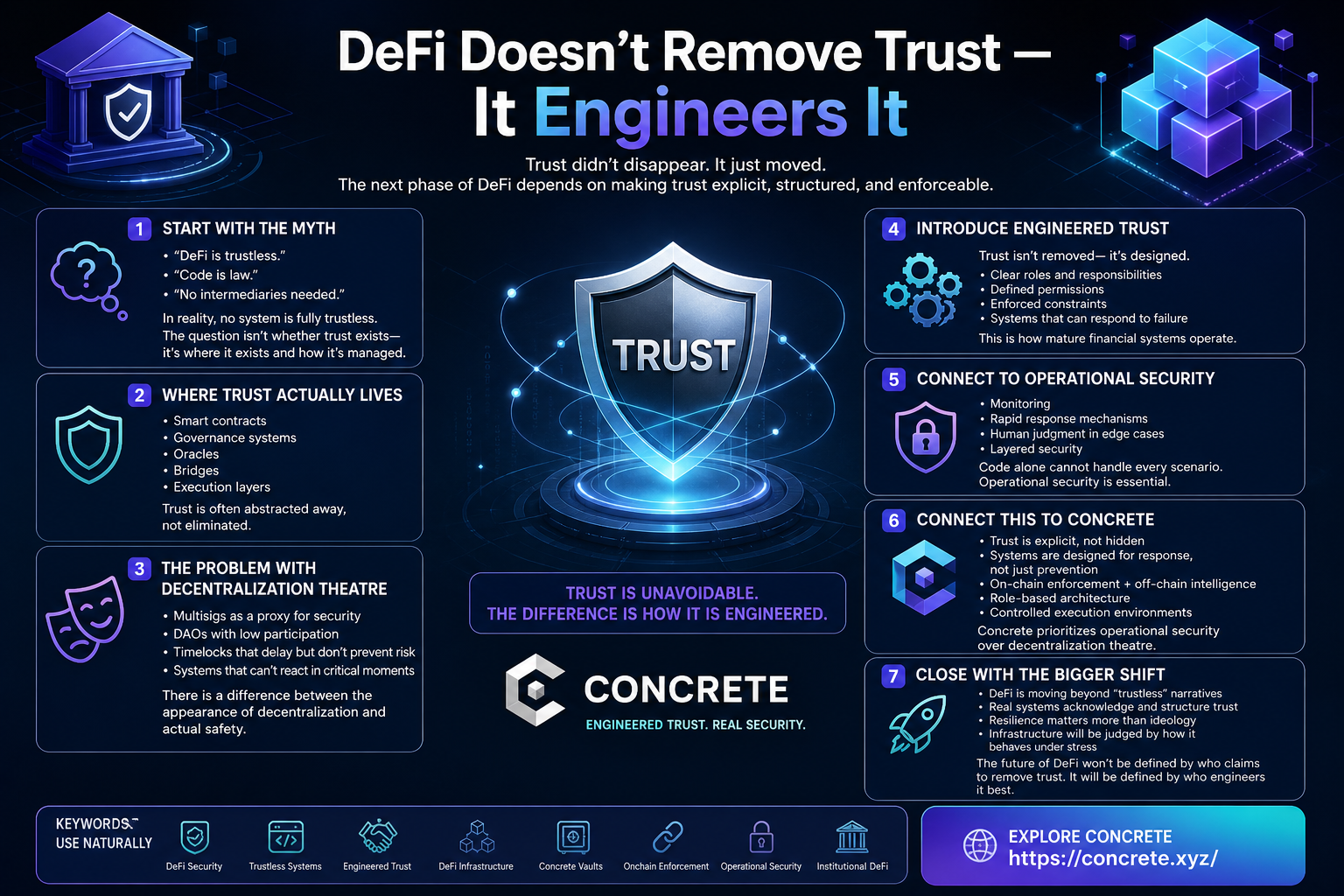
DeFi was built on a powerful promise: “Don’t trust people — trust code.” The idea of trustless systems reshaped how we think about finance, replacing intermediaries with smart contracts and automation. But as DeFi matured, a hard truth emerged — trust never disappeared. It simply moved.
Today, trust in DeFi lives in multiple layers: smart contracts that must be bug-free, governance systems that depend on participation and incentives, oracles that feed external data, and bridges that connect ecosystems. Each of these components introduces assumptions. The system isn’t trustless — it’s a network of distributed trust.
The problem is that much of this trust is hidden. Projects often lean on the narrative of decentralization while relying on multisigs, inactive DAOs, or delayed safeguards that cannot respond in real time. This creates what can be called decentralization theatre — the appearance of safety without true resilience.
A more mature approach is emerging: engineered trust. Instead of pretending trust doesn’t exist, systems are designed to make it explicit, structured, and enforceable. This means defining roles, setting clear permissions, and building constraints that actively protect the system. It also means preparing for failure — not just trying to prevent it.
Real-world financial systems don’t rely on code alone. They use monitoring, rapid response mechanisms, and human judgment in edge cases. DeFi is now moving in that direction, recognizing that operational security is just as important as decentralization.
This is where Concrete introduces a different model. Rather than hiding trust assumptions, Concrete makes them explicit. Its architecture combines onchain enforcement with off-chain intelligence, enabling systems to respond dynamically to threats. Through role-based permissions, controlled execution environments, and secure vault design, Concrete prioritizes resilience over ideology.
In this model, security is not passive — it is operational. Systems are not just decentralized; they are designed to act under stress.
The future of DeFi won’t be defined by who claims to eliminate trust. It will be defined by who engineers it best — building infrastructure that is transparent, enforceable, and resilient when it matters most.
Explore Concrete at https://concrete.xyz/