Echobit AMA Recap: Symbiosis & Synergy — How AI Projects and Exchanges Co-build the Intelligent Trading Ecosystem
 Echobit Labs5 min read·Just now
--
Echobit AMA Recap: Symbiosis & Synergy — How AI Projects and Exchanges Co-build the Intelligent Trading Ecosystem
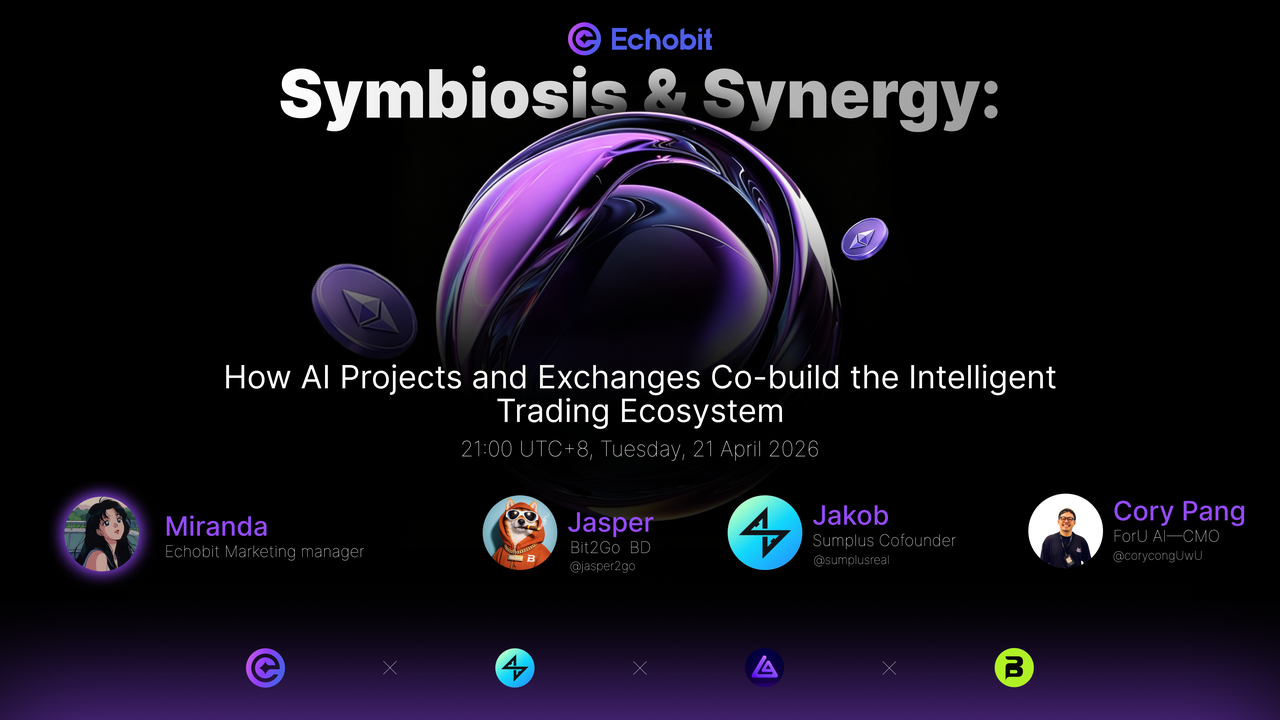
On April 21, 2026, Echobit hosted an X Spaces AMA titled “Symbiosis & Synergy: How AI Projects and Exchanges Co-build the Intelligent Trading Ecosystem.” The discussion brought together three guests from different corners of the AI and crypto space to explore what AI Agents can actually do for traders today, how exchanges and AI projects can work together, and what the next 12 months might look like.
As AI Agents become a dominant narrative in 2026, the conversation moved beyond hype to focus on real use cases, responsibility, and the structural shifts happening beneath the surface.
Guests
- Bayu — ForU AI (product & ecosystem)
- Jasper — Bit2Go (AI trading infrastructure)
- Jakob — SumPlus (AI agent execution)
What Can AI Agents Actually Do in Trading? Real vs. Hype
The AMA opened with a grounded question: what works today, and what is still mostly noise?
Jakob (SumPlus) noted that agents are already reliable at monitoring markets 24/7, executing rule‑based strategies, and handling multi‑step DeFi operations like swapping, bridging, and rebalancing. “If you can define the logic, an agent will run it more patiently than any human.” However, he cautioned that the idea of an “AGI portfolio manager that mints money while you sleep” is pure hype. “Execution is maturing fast. Judgment is not.”
Jasper (Bit2Go) offered a different angle. He argued that the question isn’t whether AI can make trading decisions — it’s whether it should. “Once you move into the asset layer, it stops being a technical problem and becomes a question of responsibility. If an AI makes a trade and loses money, who takes responsibility?” Under current regulatory conditions, most projects deliberately avoid touching the final decision layer. They can analyze and suggest, but they won’t press the button for you.
Both guests agreed that execution can be automated, but the boundary of judgment and accountability remains blurry — a tension that shaped much of the conversation.
The Relationship Between AI Projects and Exchanges: Partnership, Competition, or Parallel Tracks?
Bayu (ForU AI) gave a candid assessment. He described the current relationship as a mix of alignment, dependency, and underlying tension. “On the surface, it looks like a partnership — AI projects need liquidity and distribution, exchanges need the AI narrative to drive activity. But most interactions are still transactional: listings, campaigns, short‑term growth.”
He also pointed to a structural tension forming. As AI agents become more capable of executing trades and interacting directly with on‑chain systems, they begin to reduce reliance on traditional exchange interfaces. “Will exchanges remain the main gateway, or become just one layer in a broader automated system?” What’s clearly missing, Bayu said, is a shared layer of trust and coordination. Exchanges need a way to evaluate which agents are reliable and which behaviors are safe. Without that, both ecosystems face the same bottleneck.
Developer‑First or Consumer‑First?
The discussion then turned to a strategic question: Are exchanges like Binance and OKX right to go developer‑first, or is the real opportunity on the consumer side?
Bayu said both directions make sense, but for different reasons. Developer‑first is logical for the current phase — if the future is driven by AI agents and automated strategies, developers are the ones building those systems. Exchanges that attract developers position themselves as the infrastructure layer. “It’s about owning the rails, not just the interface.”
However, he noted that the real bottleneck is not access to infrastructure — it’s decision‑making at scale. “As more agents and users interact, the challenge becomes how to choose what to trust, what to use, and what to act on. That’s a consumer‑side problem.” The winning position, he suggested, lies in between: strong developer infrastructure plus a solution for trust and selection on the consumer side. “It’s not ‘what can I do’ — it’s ‘what should I trust, and why’.”
What Would Seamless AI + Exchange Collaboration Feel Like Day to Day?
The host, Miranda, noted that Echobit recently launched EchoAgent, a feature that allows users to trade simply by chatting — “open 10 ETH long, 10x leverage” and the system executes after confirmation. “That might be one real‑world version of the seamless collaboration we’re talking about today.”
Jasper described the shift as moving from operating to expressing intent. “You tell your agent your goals, risk tolerance, and triggers — and she gets to work. No more squinting at candlesticks at midnight.” He maintained a clear line: when money actually moves, the user still confirms. Automation stops at the final decision layer.
Jakob painted a more vivid picture: “It feels like having a very patient, very sober operator working for you around the clock. You get pinged when something meaningful happens, not when you need to act. Less trading app, more autopilot with P&L notifications.” He added that the cognitive cost of “being in the market” drops close to zero.
Both agreed that the future is not about fully autonomous trading without human oversight — but about compressing the manual work and letting users focus on outcomes, not operations.
12 Months from Now: What Does AI Agent Trading Look Like for a Normal User?
Jakob predicted that the interface disappears. “Today people still chat with agents or poke at dashboards. In 12 months, the dominant pattern will be agents calling agents — your personal agent quietly delegates financial execution to a specialist, and you never see the transaction. You set parameters once. You check in occasionally like a landlord checking on a well‑managed property.”
Jasper offered a structural prediction: entry points disappear. “You won’t need to open multiple apps or switch between platforms. You just express an outcome — for example, achieving returns under a certain risk profile — and the system handles the rest.” However, he reiterated that at the moment money moves, users will still confirm. “The competitive focus shifts from controlling entry points to controlling execution — and execution ultimately ends at money.”
Autonomy vs. Assistance, and Usability for Non‑Coders
The host also raised two common questions from the community.
On the line between AI‑assisted and fully autonomous trading: Jasper reiterated that the key is responsibility. Most projects stop before the final trade because no one wants to take the blame for a loss. Autonomous trading is technically possible, but not structurally ready.
On whether non‑coders can use any of this today: Jakob noted that platforms like EchoAgent already allow natural language trading without any coding. “The barrier is no longer technical — it’s trust and habit.”
Building the Trust Layer — Echobit’s Role in the Agent Era
The AMA made one thing clear: AI execution is ready, but the industry still lacks a shared trust layer between agents, users, and exchanges. Without it, seamless intelligent trading remains incomplete.
At Echobit, we built EchoAgent as our answer to this gap. It’s not an autonomous black box — it’s a transparent, user‑confirmed bridge between natural language and real execution. You say “open 10 ETH long, 10x leverage”; EchoAgent confirms, then executes. That’s the first step toward an ecosystem where humans express intent, agents act efficiently, and trust is built into the infrastructure.
The AI Agent era is here. The question is no longer if, but who you build with — and what kind of trust layer stands behind them. Echobit is committed to being part of that foundation.
🌐 Website: http://echobit.com/
✖ X: https://x.com/EchobitExchange
📹 YouTube: https://www.youtube.com/@Echobit_Exchange
✈ Telegram: https://t.me/EchobitOfficial
🎭 Facebook: https://www.facebook.com/EchobitOffical