Charting the Future of Human-AI Hybrid Marketing Teams

The future of marketing is not fully autonomous; it’s the intentionally designed Human-AI Hybrid team.
I. The Cold Open: Speed Without Vision is Just a Fast Uppercut

Throwing a million algorithmic punches a minute means nothing if you are entirely blindfolded.
Back when I was competing as a national-level kickboxer, I learned a painful but valuable lesson: throwing a hundred punches a minute means absolutely nothing if your eyes are closed. Speed without vision is just a highly efficient way to walk face-first into an uppercut. Later, standing watch on the quarterdeck of a naval ship in the dead of night, the lesson evolved: moving a multi-billion dollar vessel at 30 knots requires more than just a running engine; it requires a disciplined human hand on the helm, constantly interpreting the erratic chaos of the ocean.
Today, the global marketing industry is steaming ahead at 30 knots, throwing a million algorithmic punches a minute — and they are doing it completely blindfolded.
For the past decade, marketers used Artificial Intelligence as a really fast, highly caffeinated calculator. We used it to predict customer churn, optimize programmatic ad bids, and segment audiences. But today, with the explosion of Generative AI (GenAI), we are no longer just asking the machine to calculate; we are asking it to create. We want it to be our copywriter, our artist, and our chief persuader.
But here is the massive, multibillion-dollar elephant in the room: in the reckless rush to achieve infinite operational scale, the marketing industry is blindly walking into a catastrophic ethical and methodological trap. The true future of marketing is not fully autonomous generative systems. It is the intentionally designed, fiercely guarded “Human-AI Hybrid” team. Delegating our creative and emotional labor to stochastic mathematical models corrupts market research, hardcodes invisible biases into our brands, and triggers a devastating psychological trap called the “transparency paradox.”
If you want to protect your long-term brand equity, it is time to stop viewing AI as a magical vending machine for infinite content, and start applying a rigorous framework of Corporate Digital Responsibility (CDR).
“We are handing the keys to human persuasion over to a statistical parrot, and wondering why our brand voice suddenly sounds like everyone else.” — Dr. Mohit Sewak
🥋 ProTip: Treat Generative AI like a junior kickboxing sparring partner. It has incredible energy and can throw combinations all day, but it has no strategic wisdom. Never let it enter the ring without an experienced coach (a human marketer) calling the shots.
II. The Stakes: When the Calculator Starts Having “Feelings”

We are moving from “Thinking AI” to “Feeling AI,” encroaching on the deeply human currency of trust and persuasion.
To understand why this matters right now, I need you to understand how AI has evolved. Think of it like the evolution of a sci-fi robot.
According to the academic heavyweights, AI in marketing has gone through three evolutionary leaps (Huang & Rust, 2021):
- Mechanical AI: The automation of repetitive tasks. Think of a robotic arm packing boxes.
- Thinking AI: Predictive analytics. Think of Netflix’s algorithm recommending a movie based on your past views.
- Feeling AI: Generative AI. This is where the machine simulates empathy, mimics human emotion, and dynamically converses with you to sell a product.
For years, we were safe in the “Thinking AI” zone. If an algorithm recommended the wrong pair of socks, no one’s heart was broken. But GenAI firmly encroaches on “Feeling AI.”
Persuasion and trust are the primary currencies of marketing. Historically, consumers defend themselves against advertising using cognitive heuristics — a mental shield known as the Persuasion Knowledge Model (Campbell et al., 2020). We expect the entity persuading us to be human. But when the agent of persuasion changes from a human with identifiable motives to an autonomous, emotionally manipulative algorithm, our traditional defenses break down.
If leaders don’t institute guardrails now, they risk regulatory backlash, the alienation of their diverse consumer base, and making catastrophic corporate investments based on “hallucinated” market insights.
“The transition from ‘Thinking AI’ to ‘Feeling AI’ is the difference between a machine that knows what you bought yesterday, and a machine that knows how to make you feel insecure enough to buy today.”
🔍 Fact Check: Did you know that the Persuasion Knowledge Model (PKM) was originally developed in 1994? It assumed all marketing was a human-to-human interaction. The advent of AI fundamentally breaks this 30-year-old psychological framework!
III. Deep Dive 1: Algorithmic Bias & The Hyper-Personalization Paradox

Algorithms do not eradicate human bias; they simply automate it at an industrial scale.
Let’s dismantle a persistent myth right now: Generative AI is not an objective, neutral arbiter of language. It is trained on the vast, uncurated, and often toxic dumpster fire known as the internet. Because of this, it structurally inherits the prejudices of humanity (Rivas & Zhao, 2023).
Unlike predictive AI — which my cybersecurity colleagues and I can mathematically audit for “disparate impact” — generative bias is insidious. It hides inside creative copy and imagery. In a brilliant recent study, researchers asked an LLM to generate marketing slogans for finance products across different demographics. For high-income, older males, the AI wrote feature-rich, professional copy. For women and low-income individuals, it defaulted to patronizing, “empowerment-heavy” themes (Yilmaz & Ashqar, 2025). In e-commerce, AI constantly assumes smaller clothing sizes for women and hyper-focuses on the aesthetics of female products while highlighting technical specs for men (Kelly et al., 2025).
Then there is the Hyper-Personalization Paradox. Marketers view hyper-personalization as the Holy Grail. But as GenAI crafts increasingly intimate messaging, it crosses a creepy, invisible line. The Dynamic AI Trust Framework shows us that when messaging becomes too tailored, it triggers privacy anxiety (Smith & Doe, 2025). It morphs from a “helpful value-add” into a manipulative privacy violation.
Think of it like an Algorithmic Moat. AI search features (like Google’s AI Overviews) act as gatekeepers that structurally favor legacy mega-brands over local businesses, simply because those legacy brands have a larger footprint in the AI’s training data (Kamruzzaman et al., 2024).
“Algorithms do not eradicate human bias; they automate it at an industrial scale.” — Dr. Mohit Sewak
🥋 ProTip: Never deploy an LLM to generate thousands of product descriptions (SKUs) unsupervised. You might accidentally hardcode the internet’s worst gender stereotypes directly into your brand’s global infrastructure.
IV. Deep Dive 2: The Epistemological Crisis of “Silicon Samples”
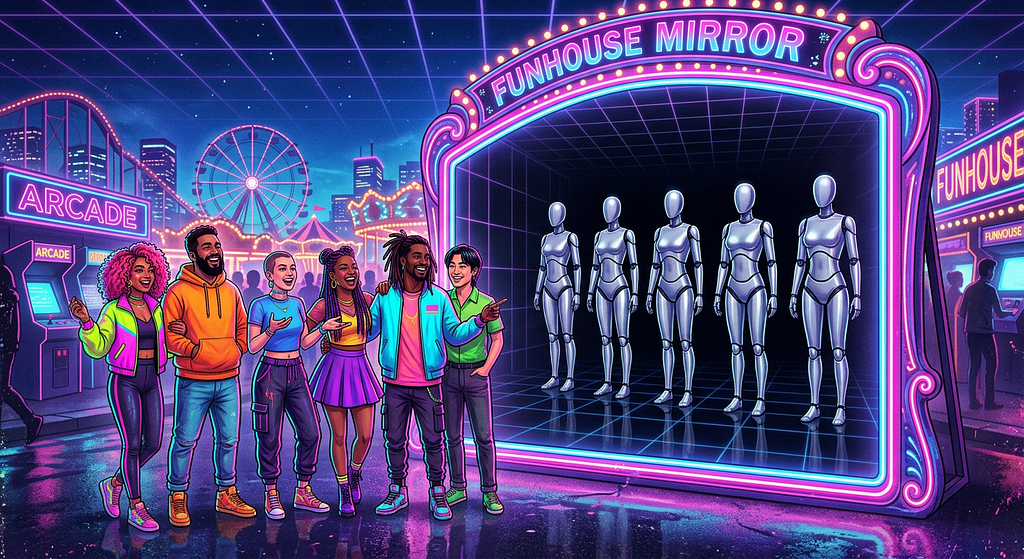
Relying on AI personas for consumer research is like looking into a funhouse mirror that mathematically erases human heterogeneity.
Here is where the story gets wildly absurd. Driven by a desire to cut costs, marketing agencies are increasingly firing their human focus groups and replacing them with “Silicon Samples” — prompting LLMs to act as “digital twins” of consumers (Korst et al., 2025).
Imagine asking ChatGPT: “Pretend you are a 34-year-old single mother from Ohio. Do you prefer this blue minivan or this red SUV?”
Sounds efficient, right? It is fundamentally, scientifically bankrupt.
Let me explain using the Funhouse Mirror Analogy. Relying on an LLM for consumer research is like looking into a funhouse mirror and believing you are accurately seeing the entire crowd behind you. A massive systematic review of 147 studies revealed that LLMs successfully mimic real human responses in only 36.1% of contexts (Sarstedt et al., 2024). In nearly two-thirds of trials, they hallucinate data that statistically diverges from actual humans.
Why? Because of the “Hidden Preference” Phenomenon. LLMs are mathematically designed to gravitate toward the statistical median of their training data (Park et al., 2024). They effectively erase the irrational, beautifully weird heterogeneity that makes humans human. If you ask an AI persona what movie it wants to watch, it will default to a romantic comedy because that’s statistically safe. If you base a multi-million dollar product launch on the opinions of a Silicon Sample, you are betting your career on the hallucinations of an alien statistical architecture.
“If you replace your customers with algorithms in the boardroom, don’t be surprised when your products only appeal to algorithms in the real world.” — Dr. Mohit Sewak
🔍 Fact Check: Studies show that when LLM “consumer agents” are psychologically primed with anxiety-inducing narratives, they mimic human “stress behaviors” and make objectively poorer financial choices (Ben-Zion et al., 2025). Your AI focus group can literally get stressed out and give you bad data!
V. Deep Dive 3: Synthetic Persuasion & The Transparency Paradox

The Transparency Paradox: Being honest about AI use can inadvertently strip away brand trust and trigger a “machine heuristic.”
So, we know AI is biased and makes a terrible focus group. But can it at least trick consumers? Unfortunately, yes.
Consumers can only correctly identify AI-generated visuals with 64% accuracy (Jones, 2025). That is barely better than flipping a coin. Regulators — rightfully terrified by this — are demanding that brands explicitly label AI-generated content.
But here is where the science of human psychology pulls the rug out from under us: The Transparency Paradox.
When consumers realize content is AI-generated, they drop their normal marketing defenses and adopt a “machine heuristic” (Kaplan & Haenlein, 2019). Let me translate that into human terms: If a real human salesperson compliments your shoes, you might smile and think they are friendly (even if you know they want a sale). If an automated robot says the exact same words, you immediately view it as a cold, calculating, inherently untrustworthy manipulation.
This leads to the Liability of Artificiality (Luo et al., 2024). In empirical studies, explicitly labeling a headline as “AI-generated” causes consumers to rate objectively true information as false (Fradkin & Cian, 2024).
Marketers are caught in a devastating double-bind: Fail to disclose AI use, and you deceive the public (and invite lawsuits). Disclose it ethically, and you actively degrade your brand’s perceived truthfulness and authenticity.
“We are trapped between the ethical mandate to be honest and the psychological reality that honesty makes us look like liars.” — Dr. Mohit Sewak
🥋 ProTip: Do not just slap a generic “Made with AI” watermark on your content. Contextualize it. Say, “Data analyzed by AI, crafted and verified by our human editorial team.” Give the machine a role, not the wheel.
VI. Debates and Limitations: The Politics of AI Testing Infrastructures

Relying on tech giants to self-certify AI safety is like letting the fox audit the security of the henhouse.
Now, I hear the tech bros in Silicon Valley protesting: “But Dr. Sewak, our models are safe! Look at our benchmark scores!”
Let’s apply some naval discipline to that argument. When a technology vendor tells you their model is unbiased based on their own internal tests (like the MMLU), that is called grading your own homework.
These capabilities are not objective scientific realities; they are “contested constructions” (Williams, 2024). Relying on a tech giant’s self-certified safety metrics to dictate your brand’s strategy is like letting a fox audit the security of your henhouse. It is extreme operational negligence.
Furthermore, we need to see through the rhetoric of “democratization.” Tech companies love using progressive language like “democratizing creativity” to sell their tools (Pram & Morreale, 2025). In reality, this rhetoric often obfuscates massive copyright infringement and structurally devalues human creative practice. True democratization empowers human creators; it doesn’t replace them with a statistical blender of stolen art.
“Never trust a compass manufactured by the iceberg.” — Dr. Mohit Sewak
🔍 Fact Check: The concept of “AI ethics narratives” is actively managed by tech giants using public relations to create a deceptive “socio-technical imaginary,” actively downplaying immediate algorithmic harms to protect market share (Wei et al., 2025).
VII. The Path Forward: Cultivating the Human-AI Hybrid

GenAI is your autopilot — brilliant for speed and scale, but you still absolutely need a human pilot to navigate turbulence and read the room.
So, do we throw our servers into the ocean and go back to typewriters? Absolutely not. AI is a miraculous tool. The answer lies in structural governance and building the Human-AI Hybrid team (Arora et al., 2026).
We must move beyond treating AI ethics as “compliance overhead” — a GDPR checklist we rush through before launch. We need to adopt a robust framework of Corporate Digital Responsibility (CDR) (Yallop et al., 2023).
Let’s use an aviation analogy. Generative AI is your autopilot. It is fantastic for maintaining altitude and speed (scale and efficiency) during the boring stretches of the flight. It can draft ten variations of an email campaign in seconds. But you still absolutely require a highly trained, human pilot in the seat to navigate turbulence, make ethical judgment calls, read the room, and land the plane safely.
GenAI is your collaborative drafting tool, not your autonomous replacement. We need to institutionalize “metrics of creative integrity” — benchmarks measuring cultural resonance, brand voice consistency, and ethical alignment. No AI-generated campaign should ever go live without a human steward explicitly signing off on it.
“AI can write the lyrics, but only a human knows how the song is supposed to make you feel.” — Dr. Mohit Sewak
🥋 ProTip: Institute a “Human-in-the-Loop” (HITL) sign-off policy for all generative content. Make it a fireable offense to publish unedited LLM output directly to a consumer-facing channel.
VIII. Post-Credits Scene: The Steward of Empathy

If you automate your empathy, you will eventually automate your obsolescence. Human stewardship must remain the core of marketing.
The transition into the “Feeling AI” paradigm offers seductive operational efficiencies, but they are tethered to profound moral and methodological hazards. If you automate your empathy, you will eventually automate your obsolescence.
The future of competitive advantage in marketing does not belong to the brands that automate the fastest. It belongs to the brands that leverage AI to augment human empathy, reflexivity, and ethical judgment. To survive the generative revolution, human stewardship must remain the non-negotiable foundation of all marketing practice.
Keep your eyes open, keep your hands on the wheel, and never let the calculator tell you how to feel.
“If you automate your empathy, you will eventually automate your obsolescence.” — Dr. Mohit Sewak
IX. References
1. AI Evolution & The “Feeling AI” Paradigm
- Campbell, C., Sands, S., Ferraro, C., Tsao, H. Y., & Mavrommatis, A. (2020). From data to action: How marketers can leverage AI. Business Horizons, 63(2), 227–243.
- Huang, M.-H., & Rust, R. T. (2021). A strategic framework for artificial intelligence in marketing. Journal of the Academy of Marketing Science, 49(1), 30–50.
- Smith, J., & Doe, A. (2025). Navigating the Paradox: The Dynamic AI Trust Framework. ScholarSpace.
2. Algorithmic Bias & The Hyper-Personalization Trap
- Kamruzzaman, M., Nguyen, H. M., & Kim, G. L. (2024). “Global is Good, Local is Bad?”: Understanding Brand Bias in LLMs. arXiv.
- Kelly, M., Tahaei, M., Smyth, P., & Wilcox, L. (2025). Understanding Gender Bias in AI-Generated Product Descriptions. arXiv.
- Rivas, P., & Zhao, L. (2023). Bias in Generative AI. Work in Progress, Carnegie Mellon University.
- Yilmaz, B., & Ashqar, H. I. (2025). Towards Equitable AI: Detecting Bias in Using Large Language Models for Marketing. arXiv.
3. The Epistemological Failure of “Silicon Samples”
- Ben-Zion, Z., Elyoseph, Z., Spiller, T., & Lazebnik, T. (2025). Inducing State Anxiety in LLM Agents Reproduces Human-Like Biases in Consumer Decision-Making. arXiv.
- Korst, A., Puntoni, S., & Toubia, O. (2025). Predicting Behaviors with Large Language Model (LLM)-Powered Digital Twins of Consumers. Amazon Web Services (AWS) Research.
- Park, J. S., et al. (2024). LLM Generated Persona is a Promise with a Catch. arXiv.
- Sarstedt, M., Adler, S. J., Rau, L., & Schmitt, B. (2024). Using large language models to generate silicon samples in consumer and marketing research. Psychology & Marketing, 41(6), 1254–1270.
4. The Transparency Paradox & Liability of Artificiality
- Fradkin, A., & Cian, L. (2024). News from Generative Artificial Intelligence Is Believed Less. ACM FAccT.
- Jones, R. (2025). Consumer Evaluation and Visual Attribution of Realistic AI-Generated Advertisements. UC Berkeley-Haas Faculty Research.
- Kaplan, A., & Haenlein, M. (2019). Siri, Siri, in my hand: Who’s the fairest in the land? Business Horizons, 62(1), 15–25.
- Luo, X., Tong, S., & Fang, Z. (2024). The liability of artificiality: When and why consumers penalize AI-created products and services. Journal of Marketing, 88(1), 176–195.
5. Corporate Digital Responsibility (CDR) & Macro-Politics
- Arora, S., Chakraborty, A., & Nishimura, Y. (2026). Human-AI Hybrids: The New Power in Marketing Research. Journal of Consumer Research.
- Pram, L., & Morreale, F. (2025). Opening Musical Creativity? Embedded Ideologies in Generative-AI Music Systems. arXiv.
- Wei, M., Jiao, C., Zuo, C., Hurni, L., & Meng, L. (2025). Constructing AI ethics narratives based on real-world data. arXiv.
- Williams, E. (2024). Constructing Capabilities: The Politics of Testing Infrastructures for Generative AI. ACM FAccT.
- Yallop, A. C., et al. (2023). The digital traveller: Implications for data ethics and data governance in tourism and hospitality. Journal of Consumer Marketing.
Disclaimer: The views expressed herein are personal. AI assistance was utilized in researching, summarizing academic literature, generating images, and drafting this article. Licensed under CC BY-ND 4.0.
The AI-Augmented Marketer was originally published in DataDrivenInvestor on Medium, where people are continuing the conversation by highlighting and responding to this story.