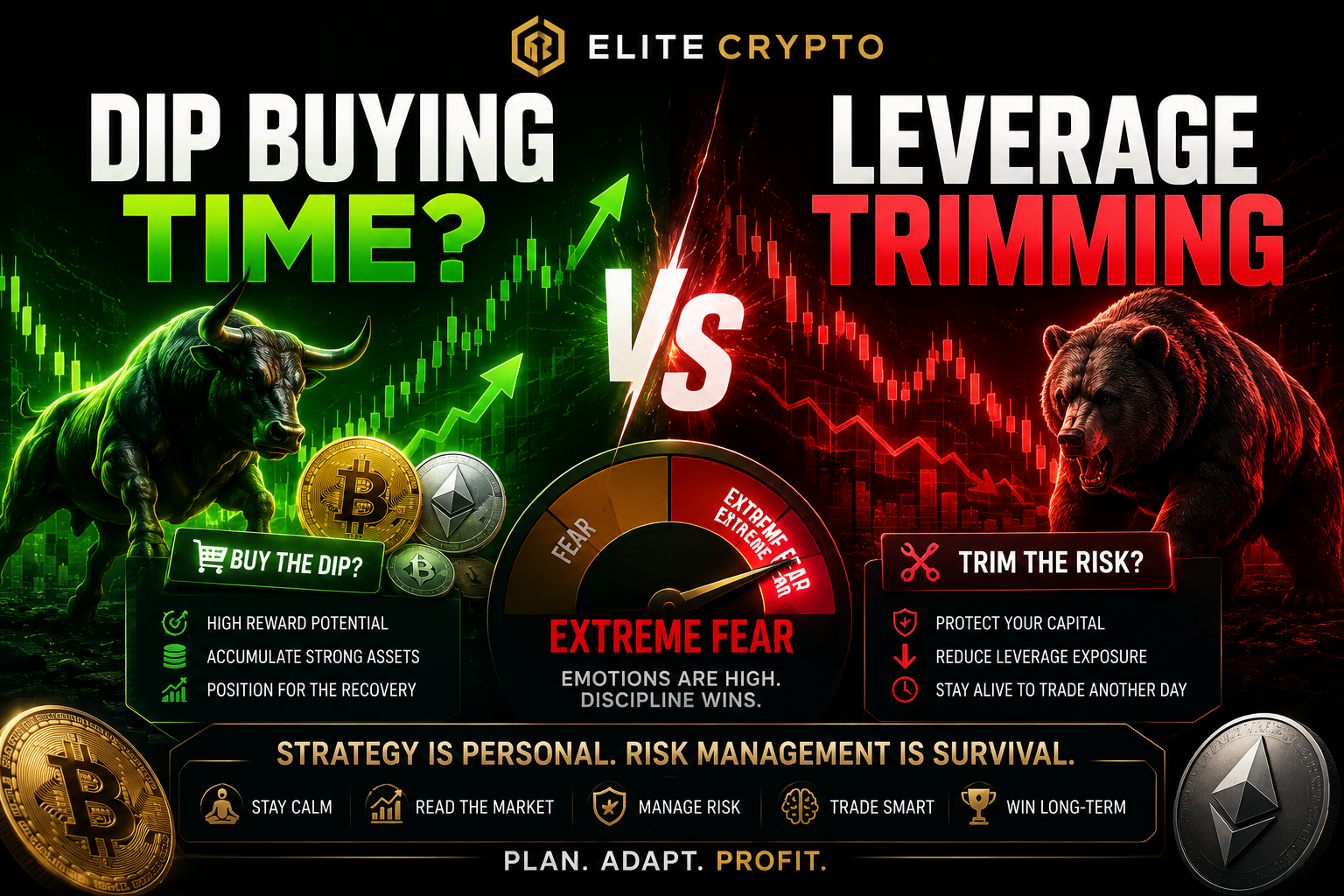
Dip Buying Time?” vs. “Leverage Trimming” in Extreme Fear: The Definitive Trader’s Guide
 charlie evans25 min read·Just now
--
The Fear & Greed Index just hit 8. Your portfolio is bleeding red. Your leveraged positions are flashing margin warnings. Every financial headline screams disaster.
And in that exact moment, you face the most expensive decision a trader can make: do you buy the dip — or do you trim your leverage?
Get it right and you capture a career-defining entry point. Get it wrong and you blow up your account at the single worst moment in market history.
This isn’t a theoretical debate. In early 2026, markets lived through exactly this scenario. 10The Fear & Greed Index dropped to 8 for 46 straight days, while $336 million was liquidated in a single session. Retail traders panicked in both directions — some went all-in buying the dip, others desperately cut leverage. Most of both groups made costly mistakes.
This guide cuts through the noise. We’ll look at the real data, the historical playbook, the psychological traps, and the frameworks professional traders actually use to navigate extreme fear — so you’re never caught flat-footed again.
Home
Looking for reliable crypto signals? Elite Crypto Signal delivers real-time trading alerts, market insights, and expert…
elitecryptosignal.com
What Is “Extreme Fear” and How Is It Measured?
Before making any tactical decision, you need a precise understanding of what “extreme fear” actually means quantitatively — not just emotionally.
13 The Fear & Greed Index is a way to gauge stock market movements and whether stocks are fairly priced. The theory is based on the logic that excessive fear tends to drive down share prices, and too much greed tends to have the opposite effect.
But it’s more sophisticated than a simple sentiment poll.
How the Fear & Greed Index Is Calculated
13 The Fear & Greed Index is a compilation of seven different indicators that measure some aspect of stock market behavior. They are market momentum, stock price strength, stock price breadth, put and call options, junk bond demand, market volatility, and safe haven demand. The index tracks how much these individual indicators deviate from their averages compared to how much they normally diverge. The index gives each indicator equal weighting in calculating a score from 0 to 100, with 100 representing maximum greediness and 0 signaling maximum fear. 15 Scores below 25 indicate extreme fear, often seen during panic selling and near market bottoms.
In simple terms, extreme fear means:
- Stock momentum has broken below its 125-day moving average
- 52-week highs vs. lows are severely skewed to new lows
- Put/call ratios are at elevated bearish levels
- VIX is spiking well above its historical average
- Junk bond spreads are widening sharply
- Safe haven demand (Treasuries vs. stocks) is surging
The Crypto Version
6 The Crypto Fear and Greed Index condenses volatility, volume, social sentiment, dominance, and trend data into a single score ranging from 0 (Extreme Fear) to 100 (Extreme Greed). Unlike price-based indicators, it measures psychology, which is usually the real driver of tops and bottoms. Historically, Extreme Fear has coincided with forced selling, capitulation, and long-term opportunity, while Extreme Greed has aligned with leverage, complacency, and eventual drawdowns.
Both indices are separate tools — but they often move in the same direction during macro-driven selloffs, as 2026 proved repeatedly.
The 2026 Extreme Fear Episodes: What Actually Happened
To make this debate real — not academic — let’s ground it in what actually happened in 2026.
Episode 1: January 2026 — The Leverage Shock
5 The relative calm of financial markets at the beginning of 2026 was shattered, triggered by tensions between the United States and Europe over Greenland and fears of widening budget deficits. US equities dropped sharply, wiping out year-to-date gains, and forty-year Japanese government bond yields rose above 4 percent.
The catalyst wasn’t earnings or fundamentals. It was leverage meeting macro uncertainty — a combination that creates cascading, non-linear selling pressure.
Episode 2: March 2026–46 Days of Extreme Fear
10 As of March 24, 2026, the index dropped to 8 — deep within extreme fear territory. This marked the 46th straight day below 25, the longest sustained fear reading since the FTX collapse shook markets in late 2022.
What was driving it?
10 Brent crude oil’s breach above $114 per barrel — fueled by escalating Iran-U.S. tensions — was compounding the inflation narrative that kept the Fear & Greed Index pinned at 8 for over six weeks.
During this episode, the dip-buying instinct was severely tested. 17With the war in Iran raging on, and questions abounding about whether the market is in an AI infrastructure bubble, investors became increasingly nervous. The CNN Fear and Greed Index moved from a rating of 44, indicating slight fear, to 15, representing extreme fear.
Episode 3: The Reversal — April to May 2026
Here’s what made 2026 so instructive. 16Investor sentiment rapidly shifted. One month after the market was extremely fearful, the market turned greedy — according to CNN’s Fear & Greed Index, a tool that has become a somewhat reliable way for investors to gauge sentiment and anticipate where the wind may start blowing next.
16 Following an extreme fear reading, S&P 500 returns over the next three months averaged 8.6% since 2019, according to an analysis by Nationwide Financial.
Those who bought the dip correctly — without over-leveraging — captured that 8.6%+ move. Those who had too much leverage during the extreme fear period got margin-called out of their positions before the recovery arrived.
That contrast is the entire lesson of this article.
https://in.pinterest.com/charlieevans380/
The Case FOR Dip Buying in Extreme Fear
Let’s be honest: the historical evidence for buying extreme fear is genuinely compelling. Dismissing it entirely would be intellectually dishonest.
Data Point 1: The Fear Index as a Contrarian Buy Signal
17 The Fear and Greed Index is an interesting tool with regard to market sentiment. It’s noteworthy that the two times in the past year when the index plunged into the single digits were great buying opportunities. 10 Historical data compiled by Glassnode reveals that entries made when the index dips below 25 have produced an average 30-day return of +18%, vastly outperforming the +2.3% average from purchases during extreme greed above 75.
An 18% average 30-day return vs. 2.3% during greed. That’s not a marginal edge — that’s a structural advantage available to traders who can stay emotionally calibrated.
Data Point 2: Missing the Best Days Is Catastrophic
1 Since daily total return data started in 1994, the MSCI Canada Index returned an annualized 10% through March’s end. But if you missed the 10 best days in that span, your annualized return fell to 6.5%. Miss the 20 best? Just 4.2% — less than half. 1 Similar results hold worldwide. The MSCI World Index returned an annualized 8.1% in that span. Miss the 10 best days and your return falls to 5.8%. Miss the 20 best and it is just 4.1%.
And here’s the uncomfortable truth: most of the best days happen within or immediately after the worst fear periods. If you’re sitting on the sidelines during extreme fear, you risk missing the violent snap-back rallies that mathematically define long-term compounding.
Data Point 3: Institutions Know Something You Don’t
2 The gap between fear and opportunity becomes clearer when you look at how different investor groups react. While retail investors reduce their exposure, whales and institutions move in the opposite direction. Strategy continued to build its Bitcoin position, holding over 766,970 Bitcoin after adding more than 85,000 BTC in the first quarter of 2026 alone. 2 Spot Bitcoin ETFs recorded $1.32 billion in net inflows in March, marking the first positive month after a string of outflows. This shows that when fear reaches this level, the question usually shifts from whether to act to what to buy — extreme fear readings usually mark the lowest entry points before the market recovers.
When institutions are loading up quietly while retail runs for the exits, that’s information. Not a guarantee — but meaningful signal.
Data Point 4: The COVID Case Study
10 During the COVID crash of March 2020, the index hit 8 when Bitcoin was trading near $4,900 — six months later, BTC had rallied 133% to $11,400. 6 In the 2018 Bear Market, Extreme Fear dominated as Bitcoin collapsed from $20,000 to the $3,000 range. Those who accumulated during peak pessimism were rewarded massively in the next cycle.
The Contrarian Advantage — Buffett’s Rule Applied
19 “Be fearful when others are greedy, and greedy when others are fearful,” Warren Buffett was fond of saying. The aphorism was completely consistent with Buffett’s investing strategy. As the ultimate value investor, he looked for stocks trading below their intrinsic value — stocks that are undervalued by the market. Buffett avoided chasing stocks during market rallies, instead hoarding cash while others jumped in. 8 A contrarian response to fearful sentiment would be to buy the dip in the event of a stock market sell-off. The logic here is straightforward: Even when the S&P 500 is at all-time highs, the index is far more likely to move higher decades from now than it is where it sits today — making now an interesting time to capitalize on the fearful dynamics permeating through the market.
The Case AGAINST Dip Buying (When It Turns Into a Trap)
Now for the side of the argument that gets less attention — but destroys more accounts.
The “Buy the Dip” Fallacy in Real Bear Markets
1 In bear markets, the only dip-buying that “works” is the last one. But in normal, big, nasty bear markets, the road to the bottom has many potholes, with the most terrifying coming last. Headlines often tout buying dips all the way down, burning through cash — until the bottom, when huge swings scare you from stocks — or trigger margin calls.
This is the dip-buying trap in its rawest form. You catch what looks like the dip. Then price falls another 15%. You’re underwater. You buy more (average down). Price falls another 20%. Now you’re in trouble. Margin calls arrive. You’re forced out at the absolute bottom.
9 The decline in stock prices was in response to obvious bad news, and there’s no particular reason to think prices will snap back. It can get very bad. During the Depression, the U.S. stock market had drawdowns of more than 80%. We saw drawdowns of more than 50% in 2009 and more than 40% in both 1974 and 2002.
The Critical Timing Problem
4 The strategy “sounds great, but timing it is really hard” since no one can predict future market moves. If you’re experiencing “FOMO” about buying opportunities during the current downturn, keep in mind that “missing one dip won’t hurt you, but making an emotional decision might.”
That’s certified financial planner Joon Um speaking with CNBC during the 2026 selloff. And the point stands: emotional dip-buying — buying because you feel like the bottom is in — is entirely different from systematic dip-buying backed by rules and risk management.
Valuation Matters — It’s Not Always Cheap
9 The U.S. stock market is not always cheap, either relative to trailing fundamentals or forward fundamentals. In March 2025, Shiller’s CAPE was 35 — that’s very expensive. In March 2009, CAPE was 13 — that’s cheap.
The Fear Index hitting 8 does not mean stocks are cheap. It means sentiment is extreme. Those are very different things.
9 Just because the expected return on U.S. stocks has risen, that doesn’t mean you should be buying stocks, because risk has also risen. If the annualized expected return doubled from 10% to 20%, but the volatility tripled from 20% to 60%, a risk averse investor should be selling stocks, not buying.
The Prerequisite Nobody Talks About
9 Both Buffett and target date funds follow contrarian strategies that do not involve one-time impulse buying, but are implemented over long timeframes. Buffett came into 2025 holding high amounts of cash, ready to deploy his dry powder. Target date funds had been selling equity as the market rose in 2024. So for them, buying the dip makes sense. But if you weren’t selling the rip in 2024, you shouldn’t be buying the dip in 2025.
This is the most honest statement in this entire article. The ability to buy the dip successfully presupposes that you didn’t go all-in at the top.
What Is Leverage Trimming and Why Does It Matter?
Let’s define the alternative clearly, because “trimming leverage” gets treated as a defeat when it’s often the smartest move available.
Leverage trimming is the proactive reduction of borrowed exposure — either by closing leveraged positions, reducing position size, or adding cash — before or during a market drawdown, specifically to preserve capital, avoid margin calls, and maintain optionality.
This is entirely different from panic-selling. It’s strategic position management.
Types of Leverage to Trim
1. Margin Debt Borrowed funds from your brokerage to hold stock or crypto positions. 21A margin call happens when your account equity drops below the required margin level. Your broker will ask you to add more money to keep your trades open. If you don’t, they’ll close your positions automatically. You lose control of your trades, often at the worst time.
2. Leveraged ETFs
5 Leveraged ETFs reset their exposure daily to maintain their target leverage. In volatile markets, this practice causes the fund’s value to erode over time — making leveraged ETFs a risky instrument for investors with holding periods longer than a single day. In essence, the high degree of leverage embedded in these retail investments can multiply both gains and losses.
3. Derivatives (Options, Futures) Deep-in-the-money puts and long futures carry delta and leverage that compounds during volatility spikes. As the VIX explodes, options premium decays non-linearly — working against buyers and amplifying losses for leveraged futures holders.
4. Crypto Leverage
10 24-hour liquidation volume stood at $336 million, with $1.27 billion in short liquidations queued above $71,421 and $758 million in long liquidations below $64,705 — creating a highly volatile liquidation cascade zone.
These liquidation cascades represent the mechanistic, automatic version of leverage trimming — except it’s done for you by the exchange at the worst possible price. The goal is to trim voluntarily before this happens.
Why Trimming Is the Underrated Skill
Most trading education focuses on entries. The greatest professional traders focus on survival first, returns second.
10 For leveraged traders, the convergence of compressed funding rates, massive asymmetric liquidation walls, and macro headwinds creates a powder keg: the next decisive move — in either direction — could generate outsized, violent volatility that punishes the underprepared.
Being “underprepared” in this context means holding maximum leverage when fear spikes. Trimming leverage isn’t admitting defeat — it’s buying yourself time and optionality to participate in the eventual recovery on your own terms, not the market’s.
The $1.2 Trillion Problem: How Leverage Poisons Dip Buying
Here’s the structural issue that makes this debate so high-stakes in 2026 specifically.
5 The amount of margin debt in the United States reached a record $1.2 trillion by late December 2025. At the same time, investors added another $250 billion in leveraged exchange-traded funds (ETFs).
Think about what that means. At peak leverage, the entire system is fragile. And when fear spikes:
22 The issue with margin debt is that the unwinding of leverage is NOT at the investor’s discretion. That process is at the discretion of the broker-dealers that extended that leverage in the first place. In other words, if you don’t sell to cover, the broker-dealer will do it for you. When lenders fear they may not recoup their credit lines, they force the borrower to put in more cash or sell assets to cover the debt. The problem is that “margin calls” generally happen simultaneously, as falling asset prices impact all lenders simultaneously. 22 Every time margin debt spikes sharply, markets don’t keep rising — they top out or crash. 26 Investor leverage, measured by the margin debt to free credit balances ratio, reached an unprecedented 6.0, amplifying downside risk. Hedge fund borrowing doubled in three years to $6.8 trillion, with gross leverage at all-time highs across multiple strategies. Historical precedents show that rapid margin debt growth outpacing equities often precedes sharp market downturns, intensifying regulatory concerns.
This is the systemic context in which your individual dip-buying or leverage-trimming decision lives. When the whole system is over-leveraged, extreme fear events don’t just reflect sentiment — they trigger mechanical selling cascades that can turn a 10% dip into a 30% collapse.
5 Elevated leverage increases the fragility of financial institutions and markets and amplifies the severity of potential market corrections. The Federal Reserve concluded in its November 2025 Financial Stability Report that “when taken together, the overall level of vulnerability due to financial sector leverage was notable.”
The Fed itself was warning about this. That’s not noise — that’s signal.
Dip Buying vs. Leverage Trimming: The Head-to-Head Comparison
FactorDip BuyingLeverage TrimmingBest used whenUnleveraged, cash available, valuation attractiveLeveraged positions at risk of margin callPrimary goalCapture recovery upsidePreserve capital and optionalityRiskCatching a falling knife, averaging into a bear marketMissing the recovery rallyHistorical edge+18% avg 30-day return below Fear 25Avoids forced liquidation at the worst priceRequiresDry powder + emotional disciplineHonest assessment of position fragilityWorks bestBull market corrections, sentiment-driven panicsStructural bear markets, leverage-driven cascadesBiggest mistakeBuying leveraged into fearTrimming unleveraged quality positions in a bull correctionBuffett approachAccumulate quality at discountAlready in cash — no leverage to trimInstitutional behaviorAccumulating during fearPre-trimmed leverage before the event
The honest verdict: These two strategies are not mutually exclusive. They apply to different parts of your book. You can trim your leveraged exposure and deploy fresh cash into unlevered dip buys simultaneously.
The fatal error is applying the wrong strategy to the wrong position — holding full leverage through an extreme fear cascade because you “believe in the dip,” or selling quality unlevered positions in a panic that turns out to be a routine correction.
The Decision Framework: How to Choose the Right Response
Here’s the practical decision tree used by institutional risk managers. Adapt it to your own situation.
Step 1: Assess Your Leverage Status
Ask yourself honestly:
- Am I currently using margin debt, leveraged ETFs, or leveraged crypto positions?
- What percentage of my total portfolio value is borrowed?
- How far does the asset need to fall before I receive a margin call?
Rule: If you have any leveraged position where a 15–20% further decline would trigger a margin call — trim that leverage first. No exceptions.
21 Margin calls cause stress and panic. They force fast decisions. And if markets are volatile, you may get closed out even if your long-term view was right.
Step 2: Diagnose the Type of Fear
Not all extreme fear is equal. There are two fundamentally different kinds:
Type A — Sentiment-Driven Fear (Correction)
- Fundamentals remain intact
- Institutional earnings estimates still positive
- The selloff is driven by geopolitical news, rate fear, or short-term macro shock
- Markets are pricing in an extreme scenario that doesn’t materialize
Appropriate response: Deploy pre-existing cash into unleveraged quality positions
Type B — Structural Fear (Bear Market)
- Earnings revisions turning negative broadly
- Credit spreads widening rapidly (not just in junk)
- Economic data deteriorating
- Leverage unwind creating forced selling cascades
Appropriate response: Trim leverage aggressively, preserve cash, and wait for forced selling to exhaust itself before deploying
Step 3: Check the Valuation Context
10 Every historical extreme fear precedent carried its own unique risk profile, and the current macro backdrop adds a layer of complexity that pure sentiment metrics cannot capture.
Run these checks:
- Shiller CAPE Ratio: Is the market cheap historically or just less expensive than it was?
- Forward P/E vs. 10-year average: Are earnings estimates still rising or being cut?
- Credit spreads: Are investment-grade and high-yield spreads blowing out?
- VIX level: Above 40 suggests structural fear; 25–35 is elevated but tradeable correction territory
Step 4: Determine Your Time Horizon
16 Long-term investors don’t need to do anything to their positions because the index reflects and foreshadows shorter-term trends and moves. Still, understanding this tool and monitoring it will keep investors more informed, calmer, and better positioned to make rational investment decisions.
This is critical. Your response to extreme fear should be calibrated to your time horizon, not your current emotional state:
Time HorizonLeverage ResponseDip Buying Response<1 week (scalper)Cut all leveraged losers immediatelyOnly buy with tight stops, small size1–3 months (swing)Reduce leverage to 50% maxDeploy 30–50% of reserved cash6–24 months (position)Maintain some leverage if well-securedSystematic deployment over 4–6 weeks3+ years (investor)Eliminate leverage entirelyDollar-cost average aggressively
5 Rules Professional Traders Follow in Extreme Fear
These aren’t feel-good platitudes. These are operationalized risk disciplines.
Rule 1: Never Dip Buy with Leverage
This sounds obvious. It isn’t — because when price falls dramatically, the temptation to “get it back fast” with leverage becomes overwhelming.
21 Leverage gives the feeling of power. But a serious risk associated with high leverage trading is overconfidence. It’s easy to feel in control when a small deposit gives you access to big trades. But that feeling can be dangerous.
Professional rule: Dip buys are executed with unleveraged capital — cash you genuinely don’t need for months. Never borrow to buy a dip.
Rule 2: Position Size Inversely to Volatility
When the VIX spikes from 15 to 45, the appropriate position size for the same trade shrinks by approximately two-thirds.
9 Just because expected return has risen, that doesn’t mean you should be buying stocks, because risk has also risen. If the annualized expected return doubled from 10% to 20%, but the volatility tripled from 20% to 60%, a risk averse investor should be selling stocks, not buying.
Professional rule: Scale position size to keep dollar-value-at-risk constant. A $10,000 position in normal conditions becomes a $3,000–4,000 position at 3x volatility.
Rule 3: Trim in Tranches, Buy in Tranches
Neither trimming nor buying should be done all at once during extreme fear.
- For leverage trimming: Reduce 25% immediately, then reassess. Don’t dump everything in a panic.
- For dip buying: Deploy 20–25% of reserved cash per tranche, spaced at least 5–7 days or 5% price moves apart.
2 While most people are focusing on avoiding more losses, smart money is quietly positioning at lower prices in anticipation of a recovery.
“Quietly positioning” means systematic, measured, tranche-based buying — not a single panic-induced market order.
Rule 4: Protect the Right to Play Another Day
1 The stock market is The Great Humiliator — a nefarious beast that seeks to impoverish as many investors as possible. Emotions are its primary tools.
Extreme fear is precisely when the market extracts maximum damage from emotionally reactive traders. The professional’s primary objective in these periods isn’t to maximize gain — it’s to survive with capital and optionality intact.
A trimmed leveraged position that costs you 10% still leaves you 90% whole and able to buy the eventual bottom unlevered. A held leveraged position that triggers a margin call at the worst level costs you everything.
Rule 5: Know What Kind of Fear You’re In
7 For contrarian investors, the key is to distinguish between “healthy fear” and “irrational panic.” The 2025 fear cycle falls into the former category: it’s driven by real but temporary factors like leverage washouts and regulatory uncertainty.
Ask: Is this fear driven by temporary factors (news events, geopolitics, sentiment overshooting) or by structural deterioration (earnings collapses, credit crises, economic recession)?
Temporary fear = lean toward buying. Structural fear = lean toward trimming.
Historical Extreme Fear Case Studies: Dip Buyers Who Won — and Lost
Case Study 1: COVID Crash (March 2020) — Dip Buyers Won
Fear hit single digits. The S&P 500 fell 34% in 33 days. Every signal screamed sell.
The unleveraged investors who deployed cash during peak fear in March 2020 saw a full recovery within 5 months and a 90%+ gain over the following 18 months. This is the quintessential example of extreme fear as a buying opportunity.
Key condition that made it work: The selloff was externally driven (a pandemic), not a fundamental collapse in earnings capacity. Monetary and fiscal support was unprecedented. Margin calls happened, but the underlying businesses survived.
Case Study 2: 2022 Crypto Bear Market — Leverage Trimming Was Correct
15 The crypto Fear and Greed Index reached 84 on November 9, 2021, one day before Bitcoin peaked at $69,044. The lowest recorded reading was 6 on June 19, 2022, during the crypto bear market.
Here’s what’s critical: extreme fear at 6 in June 2022 was not a bottom. Bitcoin continued falling from ~$23,000 to ~$16,000 over the next 6 months.
6 Bitcoin’s brief drop below $69,000 and the broader market’s multi-day liquidation cascade wiped out billions in leveraged positions. The first bounce, as always at Extreme Fear, was uneven, selective, and revealing.
Traders who trimmed leverage at the first extreme fear signal (June 2022) avoided the FTX collapse that drove prices to the true bottom in November 2022. Dip buyers at the June 2022 extreme fear got hurt badly before eventually being right.
Lesson: Not all extreme fear is equal. In a genuine structural bear market, extreme fear reads multiple times on the way down.
Case Study 3: April–May 2025 Tariff Shock — Mixed Results
9 In April 2025, VIX spiked to an extremely high level over 50. While observations of historical periods when VIX is elevated are limited, those that exist suggest that high VIX leads to high future returns. In other words, when fear is high and there’s blood in the streets, that’s a good time to buy equities if you are risk neutral.
However, the same analyst noted that risk-adjusted analysis tells a different story for leveraged traders:
9 Just because the expected return on U.S. stocks has risen, that doesn’t mean you should be buying stocks, because risk has also risen. If the annualized expected return doubled from 10% to 20%, but the volatility tripled from 20% to 60%, a risk averse investor should be selling stocks, not buying.
The April 2025 dip did recover. Unlevered buyers were rewarded. But levered buyers who caught a margin call on the initial leg down were wiped before they could see the recovery.
Case Study 4: March 2026–46-Day Fear Streak
10 Historically, liquidation cascades of this magnitude during extreme fear periods have marked pivotal inflection points. For leveraged traders, the convergence of compressed funding rates, massive asymmetric liquidation walls, and macro headwinds created a powder keg: the next decisive move could generate outsized, violent volatility that punished the underprepared.
The traders who survived and thrived: those who had trimmed leverage in January and February, leaving themselves with cash to deploy during the March low. Then rode the April–May recovery as the Fear Index swung from 8 all the way to 70+ in under six weeks.
Mistakes to Avoid in Extreme Fear Markets
Mistake 1: Averaging Down with Leverage
The most expensive mistake in trading history. Increasing your leveraged position as price falls feels logical — you’re getting a “better average price.” But leverage transforms a drawdown into a potential wipeout.
21 Open a $20,000 position in gold with only $1,000 using 20:1 leverage. If the price moves just 2.5% against you, that’s a $500 loss — half your margin. Your broker may issue a margin call. If you can’t add funds fast, your position is closed. The market might bounce right after, but it’s too late.
Mistake 2: Treating All Dips as Equal
2 Not every dip is worth buying.
A blue-chip stock down 15% because of a market-wide selloff is a completely different animal from a speculative growth stock down 40% because its earnings just collapsed. The Fear Index doesn’t distinguish between them. Your analysis must.
Mistake 3: Holding Leveraged ETFs Long-Term Through Volatility
5 Leveraged ETFs reset their exposure daily to maintain their target leverage. In volatile markets, this practice causes the fund’s value to erode over time — making leveraged ETFs a risky instrument for investors with holding periods longer than a single day.
Holding a 3x leveraged ETF through a volatile sideways market can result in significant losses even if the underlying index ends up flat — a phenomenon called “volatility decay” or “beta slippage.”
Mistake 4: Selling Quality Unleveraged Positions
4 During a market drawdown, some investors panic-sell, while others seek discounted assets. If you fall into the latter category, it may be tempting to quickly dump cash into investments for longer-term goals, such as your retirement.
Ironically, fear makes retail investors sell their best unleveraged holdings (which they should keep) while holding their worst leveraged positions (which they should trim). This inversion destroys long-term wealth.
Mistake 5: Going All-In on the First Bounce
6 A Fear-6 rally is often a dead-cat bounce unless specific conditions follow. The market has seen this movie before.
The first violent bounce after extreme fear is often not the real bottom. Institutions call this “selling into strength.” Wait for confirmation — sustained breadth improvement, VIX returning below 25, value area re-acceptance in the Volume Profile — before committing full capital.
The Retail vs. Institutional Divide in Extreme Fear
Understanding why institutions consistently outperform retail traders in fear environments reveals everything about why strategy matters more than instinct.
How Retail Traders Behave
1 Most people buy stocks when they feel good about their prospects, like in 2000. They sell when they feel fearful — after a drop, such as in 2009. The bigger the dip, the bigger the fear. Poor timing is hugely costly. 22 As Howard Marks put it: “Fear of missing out has taken over from the fear of losing money. If people are risk-tolerant and afraid of being out of the market, they buy aggressively, in which case you can’t find any bargains.”
The retail pattern in extreme fear: buy at the top on greed → hold through the decline on hope → sell at the bottom on panic → re-enter after the recovery on FOMO.
This is the cycle that transfers wealth from retail to institutional hands, systematically and relentlessly.
How Institutions Behave
2 While retail investors reduce their exposure, whales and institutions move in the opposite direction. Strategy continued to build its Bitcoin position, adding more than 85,000 BTC in Q1 2026. Spot Bitcoin ETFs recorded $1.32 billion in net inflows in March, marking the first positive month after a string of outflows.
Institutions don’t “buy the dip” emotionally. They follow pre-set accumulation rules — when an asset class drops X%, add Y% exposure. When the Fear Index hits Z, deploy tranche #2 of the pre-committed capital.
9 Contrarian investing is often a good idea, especially when implemented in a rules-based investment program. For example, the typical target date fund has a policy of rebalancing to fixed portfolio weights. When the stock market falls, the fund buys stocks. This type of systematic dip-buying makes sense as it sells stocks when they get expensive and buys them back when they get cheap.
The key word is systematic. Rules-based. Emotionless.
19 Berkshire’s cash pile recently climbed to its highest level ever — $397 billion — after it sold a net $8.1 billion of stocks in the first quarter.
Berkshire wasn’t panic-buying the fear. It was maintaining cash and selectivity — precisely because leverage-free investors can afford to wait for the best extreme fear entries, not just the first one.
Frequently Asked Questions (FAQ)
What is the Fear & Greed Index and what does “extreme fear” mean?
The CNN Fear & Greed Index measures stock market sentiment using seven indicators: market momentum, stock price strength, stock price breadth, put/call options, junk bond demand, market volatility (VIX), and safe haven demand. A score below 25 indicates extreme fear — meaning the market is experiencing peak pessimism, often characterized by panic selling, elevated VIX, and widening credit spreads. Extreme fear does not automatically mean it’s time to buy or sell.
Is “buying the dip” a reliable strategy in extreme fear?
Historically, it has produced above-average returns. Entries made when the Fear Index drops below 25 have produced an average 30-day return of +18%, compared to just +2.3% during extreme greed periods. However, reliability depends critically on whether you’re buying unlevered, whether valuations support the case, and whether the fear is sentiment-driven (corrective) or structural (bear market).
When should I trim leverage during extreme fear?
Trim leverage immediately when: (1) a 15–20% additional price decline would trigger a margin call, (2) you’re holding leveraged ETFs in a high-volatility environment, (3) the Fear Index has been in extreme territory for more than two consecutive weeks, suggesting structural — not just sentiment — fear, or (4) your position size means a further adverse move would force involuntary liquidation at the worst price.
What is the difference between a dip and a bear market?
A dip is a short-term pullback (typically 5–15%) within an ongoing bull market, driven primarily by sentiment, news, or sector rotation. A bear market is a sustained decline of 20%+ from the high, typically associated with deteriorating fundamentals — falling earnings, rising unemployment, contracting credit, or systemic financial stress. Buying the dip works reliably in bull corrections; it can be catastrophic in genuine bear markets where extreme fear readings occur repeatedly on the way down.
How much of my portfolio should I deploy during extreme fear?
Most professional traders deploy cash in tranches — typically 20–25% of reserved dry powder per tranche, spaced by either time (5–7 days between buys) or price (-5% increments). Never deploy all reserved cash in a single purchase during fear, because you eliminate your ability to average down further if the selloff continues.
Can you buy the dip AND trim leverage at the same time?
Absolutely — and this is often the most sophisticated response. Trim leveraged positions that are at risk of margin calls, then redeploy the freed capital into unleveraged spot positions at cheaper prices. This preserves your market exposure while eliminating the forced-exit risk that leverage creates. The net effect is you rotate from fragile, leveraged positions to robust, unleveraged ones during the fear event.
What are the biggest mistakes traders make during extreme fear?
The five most costly mistakes are: (1) averaging down with leverage, (2) holding leveraged ETFs through volatility decay, (3) panic-selling quality unleveraged long-term holdings, (4) going all-in on the first bounce assuming it’s the bottom, and (5) confusing sentiment-extreme with valuation-cheap — the Fear Index at 8 tells you psychology is extreme, not that assets are necessarily undervalued.
What is “volatility decay” in leveraged ETFs?
Volatility decay (also called beta slippage) is the mathematical erosion of leveraged ETF value that occurs in sideways or oscillating markets due to daily rebalancing. For example, if a 3x ETF’s underlying index falls 10% then rises 10%, the ETF doesn’t return to its starting point — it’s down approximately 9%. This effect compounds over time and makes leveraged ETFs unsuitable for anything other than intraday or short-term tactical positions.
Conclusion: The Answer Isn’t Binary
The debate between dip buying and leverage trimming in extreme fear has a deceptively simple answer that most traders never reach.
It’s not either/or. It’s about what kind of position you’re in.
Leveraged positions during extreme fear are existential risks — they can and will be liquidated against your will at the worst moment unless you manage them proactively. 5Elevated leverage increases the fragility of financial institutions and markets and amplifies the severity of potential market corrections. Financial authorities must adopt measures to reduce the vulnerability of the financial system.
Unleveraged cash positions during extreme fear are potential opportunities — if you’ve done the fundamental work, identified the type of fear, sized appropriately, and deployed in tranches with discipline.
6 Extreme Fear doesn’t mean “buy everything.” It means buy quality, while others are indiscriminate sellers.
The traders who consistently profit from extreme fear aren’t the ones who bravely buy everything that’s fallen. They’re the ones who:
- Protected capital before the fear event by maintaining manageable leverage
- Held dry powder that was ready to deploy systematically
- Distinguished between types of fear — sentiment vs. structural
- Sized positions to volatility — smaller in chaos, not larger
- Acted without emotion — based on pre-set rules, not real-time panic
16 The Fear & Greed index has historically shown a knack for predicting market turning points. It soared past 80 in 2017 during a strong tech rally, and the market had a tough year in 2018. It fell below 10 during the COVID-19 Pandemic in 2020, and the market went on a big run in late 2020 and 2021. Essentially, an extreme fear reading can signal that a market-wide sell-off may be coming to an end, while an extreme greed reading can signal the opposite.
The Fear Index at its extremes is one of the market’s most reliable context signals. But context alone doesn’t make a trade. Your leverage situation, available cash, time horizon, and risk tolerance determine the appropriate response to that context.
Know your position before fear strikes. Trim leverage when it threatens your survival. Buy quality when fear overshoots. Do both systematically — never emotionally.
That’s not a trading strategy. That’s financial survival — and the foundation of every durable trading career.
Home
Looking for reliable crypto signals? Elite Crypto Signal delivers real-time trading alerts, market insights, and expert…
elitecryptosignal.com
Call to Action (CTA)
Your Fear & Greed Checklist Starts Now
Before the next extreme fear event hits — and it will — build your response plan in advance:
✅ Calculate your exact margin call level on every leveraged position
✅ Identify what percentage of your portfolio is in cash or liquidatable reserves
✅ Decide your tranche deployment plan (what you’ll buy, at what Fear Index level)
✅ Set your leverage trim trigger (e.g., “if Fear drops below 20, I reduce margin by 50%”)
✅ Bookmark your highest-conviction unleveraged buy list for when blood hits the streets
The market rewards the prepared and punishes the reactive. Be prepared.
Disclaimer: This article is for educational and informational purposes only. Nothing in this article constitutes financial advice, investment recommendations, or trading guidance. All investing involves risk, including the potential loss of principal. Always consult a qualified financial professional before making investment decisions.
📩 Join Investor’s Handbook Digest — get the best investing, markets, and wealth-building insights each week.