DeFi Isn’t Trustless — It Engineers Trust
--
DeFi was built on a powerful narrative:
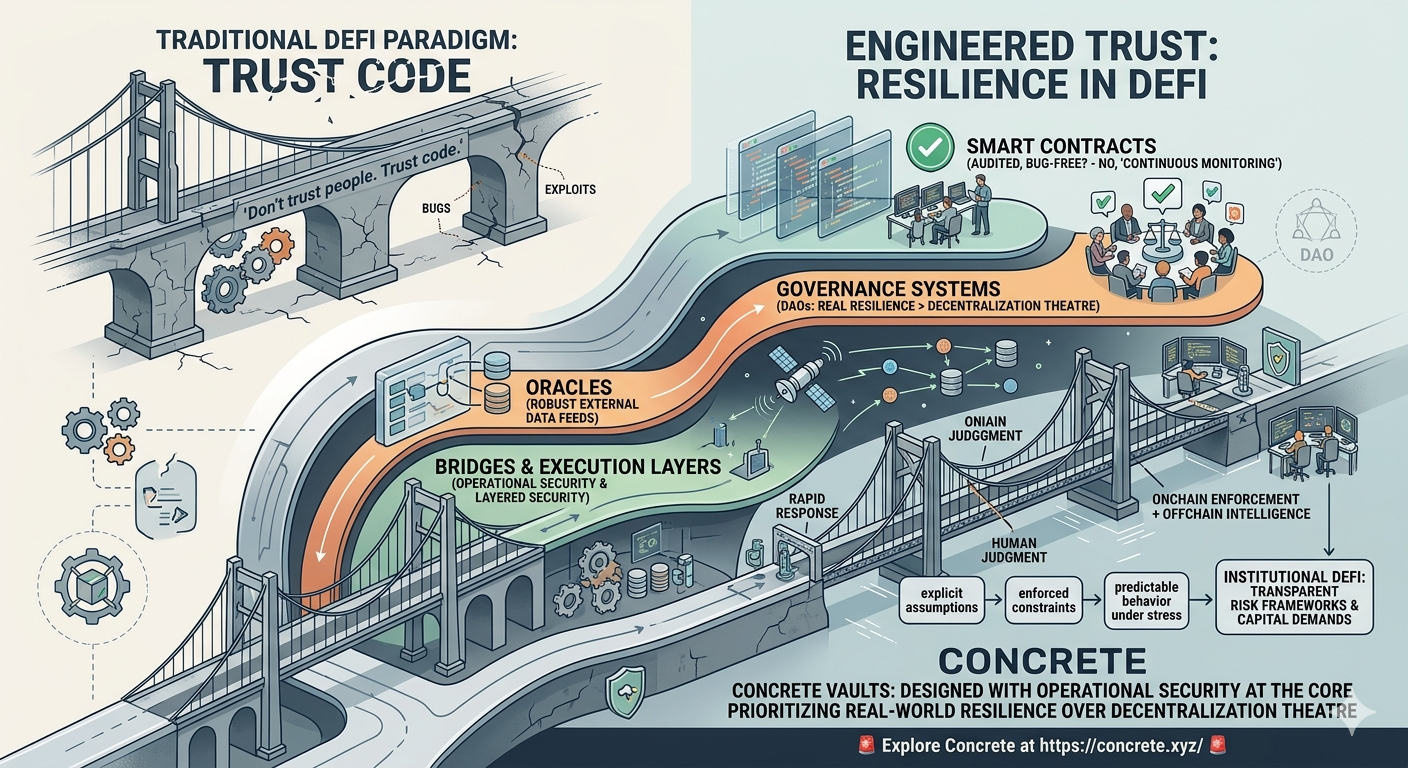
“Don’t trust people. Trust code.”
For a while, that idea felt revolutionary.
Smart contracts replaced intermediaries. Protocols ran autonomously. Trustless systems became the foundation of an entirely new financial paradigm.
But as DeFi evolved, something became clear:
Trust didn’t disappear. It just moved.
The Myth of “Trustless”
The industry loves to say:
- DeFi is trustless
- Code is law
- No intermediaries needed
But in reality, no system is fully trustless.
Even in DeFi, users still place trust — just in different places:
- Smart contracts
- Governance systems
- Oracles
- Bridges
- Execution layers
The real question isn’t whether trust exists.
It’s where it exists — and how it’s managed.
Where Trust Actually Lives
Let’s break it down.
Smart contracts
You trust that the code is bug-free, audited, and behaves exactly as intended. But history has shown that even audited systems can fail — making DeFi security a constantly evolving challenge.
Governance systems
DAOs promise decentralization, yet often suffer from low participation and concentrated voting power.
Oracles
Protocols rely on external data feeds. If the oracle fails or is manipulated, the entire system can break.
Bridges
Cross-chain infrastructure has become one of the largest attack surfaces in DeFi.
Execution layers
MEV, ordering, and validator behavior all introduce hidden trust assumptions.
So no — trust wasn’t removed.
It was abstracted.
The Problem With “Decentralization Theatre”
Some systems look decentralized on the surface — but lack real resilience underneath.
This is what many call “decentralization theatre.”
Examples:
- Multisigs acting as a weak proxy for security
- DAOs that exist in name but not in participation
- Timelocks that delay risk but don’t prevent it
- Systems that fail to respond during critical moments
There’s a difference between:
- Appearing decentralized
vs - Actually being safe and resilient
And in high-stakes financial systems, that difference matters.
Introducing Engineered Trust
Here’s the shift:
Trust isn’t removed. It’s designed.
Engineered trust means:
- Clear roles and responsibilities
- Defined permissions
- Enforced constraints
- Systems that can respond to failure — not just prevent it
This is how mature financial systems operate.
And increasingly, this is what DeFi needs to adopt.
Because reality is messy. Edge cases happen. Markets break.
Code alone cannot handle everything.
Why Operational Security Matters
If DeFi wants to scale, it needs more than static code.
It needs operational security:
- Continuous monitoring
- Rapid response mechanisms
- Human judgment in extreme scenarios
- Layered security models
Pure automation sounds elegant — but fragile systems collapse under stress.
Resilient systems adapt.
The Role of DeFi Infrastructure in the Next Phase
As the industry matures, the focus is shifting toward DeFi infrastructure and scalable DeFi security.
This becomes especially important for institutional DeFi, where capital demands:
- transparent risk frameworks
- strong onchain enforcement
- robust operational design
In this environment, trustless systems are no longer enough.
What institutions need is engineered trust — systems where assumptions are explicit, constraints are enforced, and behavior is predictable under stress.
How Concrete Approaches This Differently
This is where Concrete stands out.
Instead of hiding trust assumptions, Concrete makes them explicit — and designs systems around them.
Key principles:
- Trust is explicit, not hidden
- Systems are built for response, not just prevention
- Onchain enforcement + offchain intelligence
- Role-based architecture with clear accountability
- Controlled execution environments
Concrete vaults are designed with operational security at the core — prioritizing real-world resilience over decentralization theatre.
This isn’t about abandoning decentralization.
It’s about making it work under pressure.
The Bigger Shift
DeFi is evolving.
The narrative is moving beyond “trustless systems” toward something more grounded:
- Trust will always exist
- What matters is how it’s structured
- Resilience matters more than ideology
- Systems will be judged by performance under stress
The future of DeFi won’t be defined by who claims to eliminate trust.
It will be defined by who engineers it best.
🚨 Explore Concrete at https://concrete.xyz/ 🚨