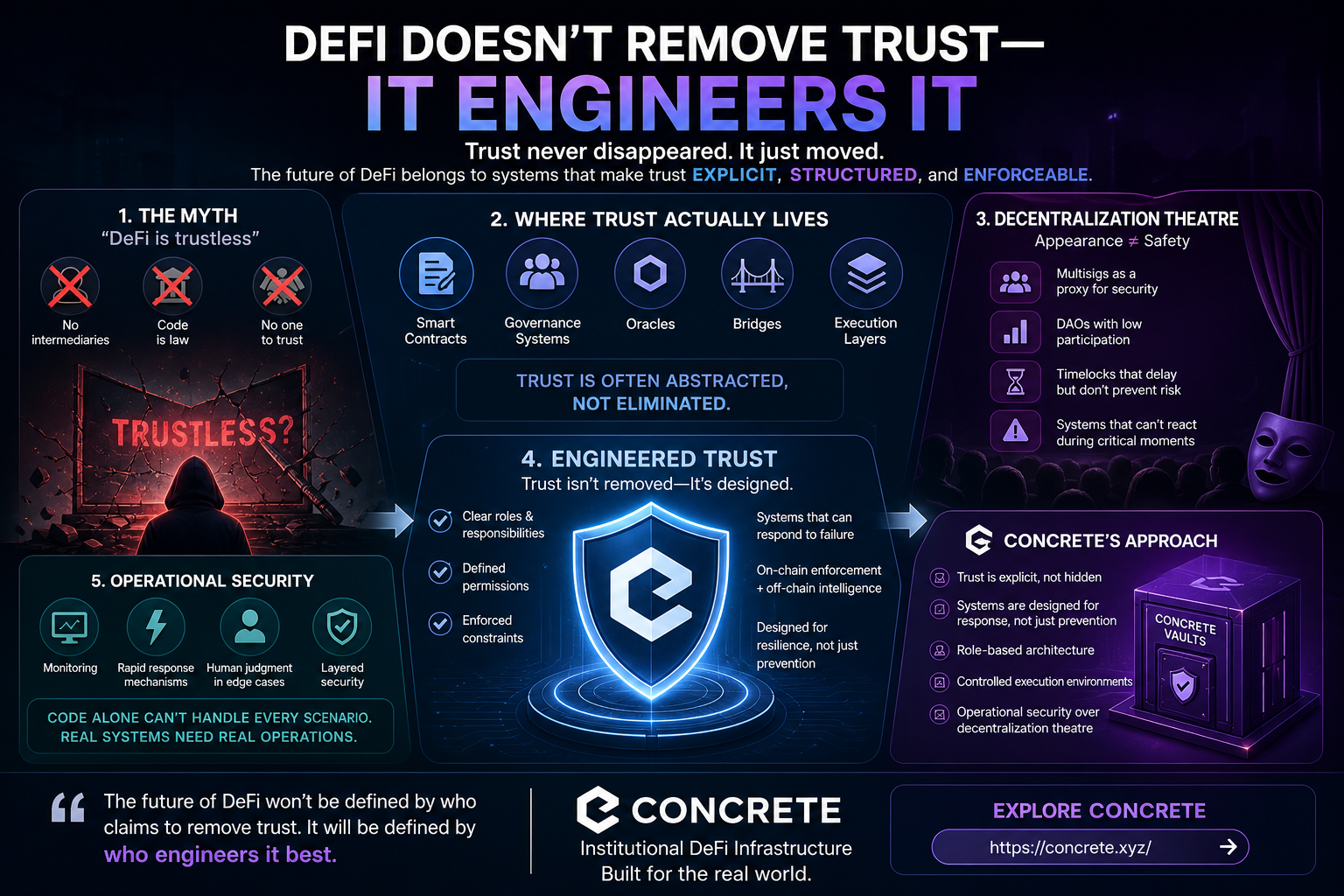
DeFi Doesn’t Remove Trust It Engineers It
 Jalakdewata3 min read·Just now
--
1. The Myth: Trustless Systems
DeFi was built on a powerful idea: don’t trust people, trust code.
“Code is law.”
“No intermediaries.”
“Everything is transparent on-chain.”
In its early phase, this felt revolutionary. Smart contracts executed automatically, transactions were immutable, and anyone could participate without permission.
But as the system matured, one thing became undeniable:
No system is fully trustless.
The more relevant question is no longer whether trust exists, but where it exists and how it is managed.
2. Where Trust Actually Lives
If you deconstruct DeFi down to its core layers, trust is distributed, not eliminated.
Smart contracts
We assume the code is flawless. In reality, audits reduce risk but never eliminate it. Edge cases always exist.
Governance systems
Token-based voting appears democratic, but token distribution is often uneven and participation is low. Decision-making power concentrates.
Oracles
External data feeds determine on-chain behavior. This introduces dependency on off-chain truth sources.
Bridges
Cross-chain bridges connect different systems with complex security assumptions. Many of the largest exploits in DeFi have originated here.
Execution layers
MEV, sequencing, and transaction ordering introduce actors with significant influence over outcomes.
The conclusion is straightforward: trust hasn’t disappeared. It has been relocated and abstracted.
3. The Problem With “Decentralization Theatre”
Many systems appear decentralized on the surface, but lack real resilience.
This is decentralization theatre.
Multisigs as a proxy for security
Better than a single key, but still controlled by a small group.
Low-participation DAOs
Governance is open, but only a minority actively participates.
Timelocks
They delay execution but do not eliminate risk. A bad decision remains bad, just slower.
Inability to respond in real time
Overly rigid systems cannot react effectively during critical failures.
This reveals a critical distinction:
The appearance of decentralization is not the same as actual safety.
4. Engineered Trust: A Better Model
If trust cannot be removed, the next step is to design it deliberately.
Engineered trust means:
clearly defined roles
explicit permissions
enforced constraints
systems capable of responding to failure
This is not new. Traditional financial systems have long operated this way. The difference is that DeFi can make these structures transparent and verifiable.
Instead of hiding trust, engineered trust exposes and structures it.
5. Why Operational Security Matters
At this point, it becomes clear: code alone is not sufficient.
Real systems require:
Monitoring
Understanding system behavior in real time, not after losses occur.
Rapid response
The ability to act immediately when anomalies are detected.
Human judgment
Not every scenario can be encoded. Edge cases require discretion.
Layered security
No single mechanism is enough. Security must be compositional.
DeFi security is not just about audits. It is about how systems behave under stress.
6. Concrete: Trust, Made Explicit
A more mature approach is emerging, and Concrete is one example.
Explore Concrete at https://concrete.xyz/
Concrete does not attempt to eliminate trust. It makes trust explicit and structured.
Key principles include:
Trust is explicit, not hidden
Assumptions are visible and can be evaluated.
Designed for response, not just prevention
Systems are built to react, not just to avoid failure.
Onchain enforcement + off-chain intelligence
A hybrid model that enables adaptability without sacrificing transparency.
Role-based architecture
Responsibilities are clearly assigned. Access is not universal.
Controlled execution environments
Execution is bounded to maintain safety constraints.
In the context of institutional DeFi, this approach is more aligned with real-world requirements than purely ideological decentralization.
Concrete vaults and infrastructure prioritize operational security over narrative.
7. The Bigger Shift
The industry is transitioning from idealism to realism.
The “trustless systems” narrative weakens under real-world complexity.
The next phase is clearer:
trust will be acknowledged, not denied
systems will be designed for resilience, not simplicity
DeFi infrastructure will be judged by performance under stress, not under ideal conditions
The winners will not be those who claim to remove trust.
They will be those who engineer it effectively.
Because ultimately, DeFi is not about eliminating trust.
It is about designing it with precision.