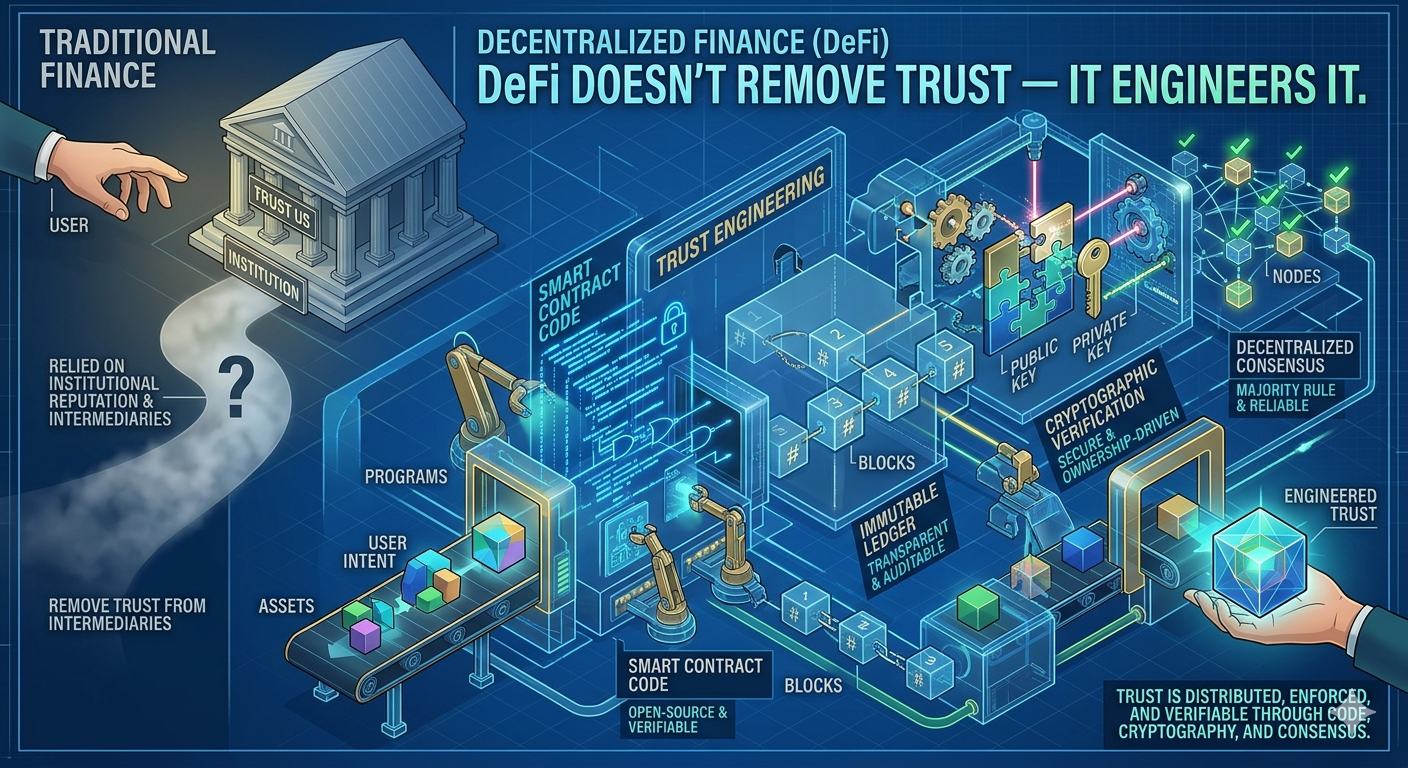
DeFi Doesn’t Remove Trust — It Engineers It
 Kavitha5 min read·Just now
--
For years, DeFi sold the world a powerful idea:
“Don’t trust people. Trust code.”
It was the perfect counterweight to traditional finance a system where intermediaries controlled access, opaque institutions managed risk, and users had little visibility into what happened behind closed doors.
In DeFi, the promise was different:
- transparent systems
- immutable smart contracts
- trustless systems
- permissionless participation
Code would replace institutions.
But as the industry matured, a harder truth emerged:
Trust never disappeared.
It simply moved.
Today, every serious DeFi protocol depends on layers of trust that users rarely think about from smart contracts and governance systems to oracle feeds, bridges, validators, and execution infrastructure.
The real question is no longer:
“Can DeFi eliminate trust?”
The real question is:
“How is trust engineered, enforced, and managed?”
And that distinction will define the future of DeFi infrastructure.
The Myth of “Trustless” Systems
The phrase “trustless” became one of the defining narratives of crypto.
The idea was simple:
- no banks
- no intermediaries
- no centralized operators
- no human discretion
Only code.
In theory, this creates systems where rules are enforced automatically and transparently.
But in practice, no financial system can operate without trust assumptions.
Users still trust:
- developers to write secure contracts
- governance participants to act responsibly
- validators to execute honestly
- oracle providers to deliver accurate data
- bridge operators to secure assets
- infrastructure providers to remain operational
Even Bitcoin often considered the purest decentralized system depends on social coordination, miner incentives, and community consensus during moments of crisis.
The illusion was never that trust disappeared.
The illusion was that trust became invisible.
Where Trust Actually Lives in DeFi
Smart Contracts
Smart contracts are often treated as objective and infallible.
But contracts are written by humans.
That means every protocol inherits assumptions about:
- logic correctness
- upgradeability
- permissions
- dependencies
- edge-case behavior
Audits reduce risk, but they do not eliminate it.
Every exploit in DeFi history proves the same thing:
Code is only as reliable as the assumptions behind it.
Governance Systems
DAOs are frequently presented as decentralized governance structures.
But many governance systems suffer from:
- low voter participation
- concentrated token ownership
- governance apathy
- delayed coordination during emergencies
In reality, governance power often accumulates around a small number of actors.
The system appears decentralized, while operational control remains highly centralized.
Oracles
DeFi protocols rely heavily on external price feeds.
Without oracles, lending markets, derivatives, and stablecoins cannot function.
But this introduces a major trust dependency:
Who provides the data?
If oracle feeds fail, lag, or become manipulated, entire protocols can collapse.
The protocol itself may be decentralized, but the data layer becomes a central point of trust.
Bridges and Cross-Chain Infrastructure
Bridges are among the largest attack surfaces in crypto.
Most rely on multisigs, validator sets, or relayer assumptions.
Users often believe they are interacting with decentralized infrastructure while critical security depends on a relatively small group of operators.
Billions of dollars in bridge exploits have demonstrated a painful reality:
Cross-chain systems are trust-heavy systems.
The Problem With Decentralization Theatre
One of the biggest issues in modern DeFi is what can be called decentralization theatre.
Systems are marketed as decentralized because they check certain boxes:
- multisigs
- governance tokens
- timelocks
- DAO voting
But appearance is not the same as resilience.
A protocol may technically distribute authority while still failing operationally under stress.
For example:
- A multisig may reduce unilateral control, but it can still become compromised.
- A DAO may appear democratic, but inactive governance creates security paralysis.
- Timelocks may improve transparency, but they cannot stop damage once malicious actions begin.
- Fully immutable systems may prevent abuse, but they may also prevent recovery during catastrophic failures.
This creates a dangerous mismatch between perception and reality.
Users believe decentralization automatically creates safety.
But decentralized systems can still be fragile.
Operational resilience matters more than ideological purity.
Trust Isn’t Removed — It’s Engineered
The next evolution of institutional DeFi will not be built around eliminating trust.
It will be built around engineering trust intentionally.
Engineered trust means designing systems where:
- responsibilities are explicit
- permissions are constrained
- risks are observable
- actions are enforceable
- failures are manageable
Traditional financial infrastructure already operates this way.
Banks, clearing systems, and institutional custodians are not secure because humans are removed.
They are secure because responsibilities, controls, and operational procedures are clearly defined.
DeFi is moving toward the same reality.
The strongest systems are not those pretending trust does not exist.
They are the systems making trust visible, measurable, and enforceable.
Why Operational Security Matters
Code alone cannot handle every scenario.
Markets are unpredictable.
Attack vectors evolve.
Infrastructure fails.
Human judgment becomes necessary during edge cases and emergencies.
That is why operational security is becoming one of the defining layers of next-generation DeFi security.
Real-world resilience requires:
- continuous monitoring
- rapid response systems
- layered defense models
- controlled execution environments
- fallback mechanisms
- human oversight when necessary
Pure automation sounds elegant in theory.
But resilient infrastructure requires adaptability.
The future of DeFi infrastructure will depend on systems that can respond intelligently under stress ,not simply systems that refuse intervention entirely.
How Concrete Approaches Engineered Trust
This is where Concrete takes a fundamentally different approach.
Instead of hiding trust assumptions behind decentralization narratives, Concrete makes trust explicit and operationally enforceable.
Its architecture prioritizes:
- operational security
- controlled execution
- role-based permissions
- onchain enforcement
- off-chain intelligence
- rapid response capability
Rather than relying on decentralization theatre, Concrete vaults are designed around the reality that secure systems require active operational design.
This means:
- roles and responsibilities are clearly defined
- permissions are intentionally constrained
- execution environments are controlled
- systems are built to react during abnormal conditions
- security is treated as an operational discipline, not just a code property
Concrete recognizes an important truth:
Prevention alone is not enough.
Modern DeFi systems must also be capable of response.
This is especially critical for institutional DeFi, where capital efficiency must coexist with strong operational guarantees.
Instead of pretending trust can be eliminated, Concrete engineers trust into enforceable infrastructure.
And that may be one of the most important shifts happening in crypto today.
The Future of DeFi Will Be Built on Structured Trust
The industry is slowly moving beyond simplistic “trustless” narratives.
Not because decentralization failed.
But because mature systems require more nuance.
The next generation of DeFi security will focus on:
- resilience over ideology
- operational safety over optics
- enforceable controls over vague assumptions
- engineered trust over hidden trust
Infrastructure will not be judged by how aggressively it claims decentralization.
It will be judged by how reliably it behaves under pressure.
Because in the end, trust is unavoidable.
The real innovation is not removing trust.
It is engineering it better.