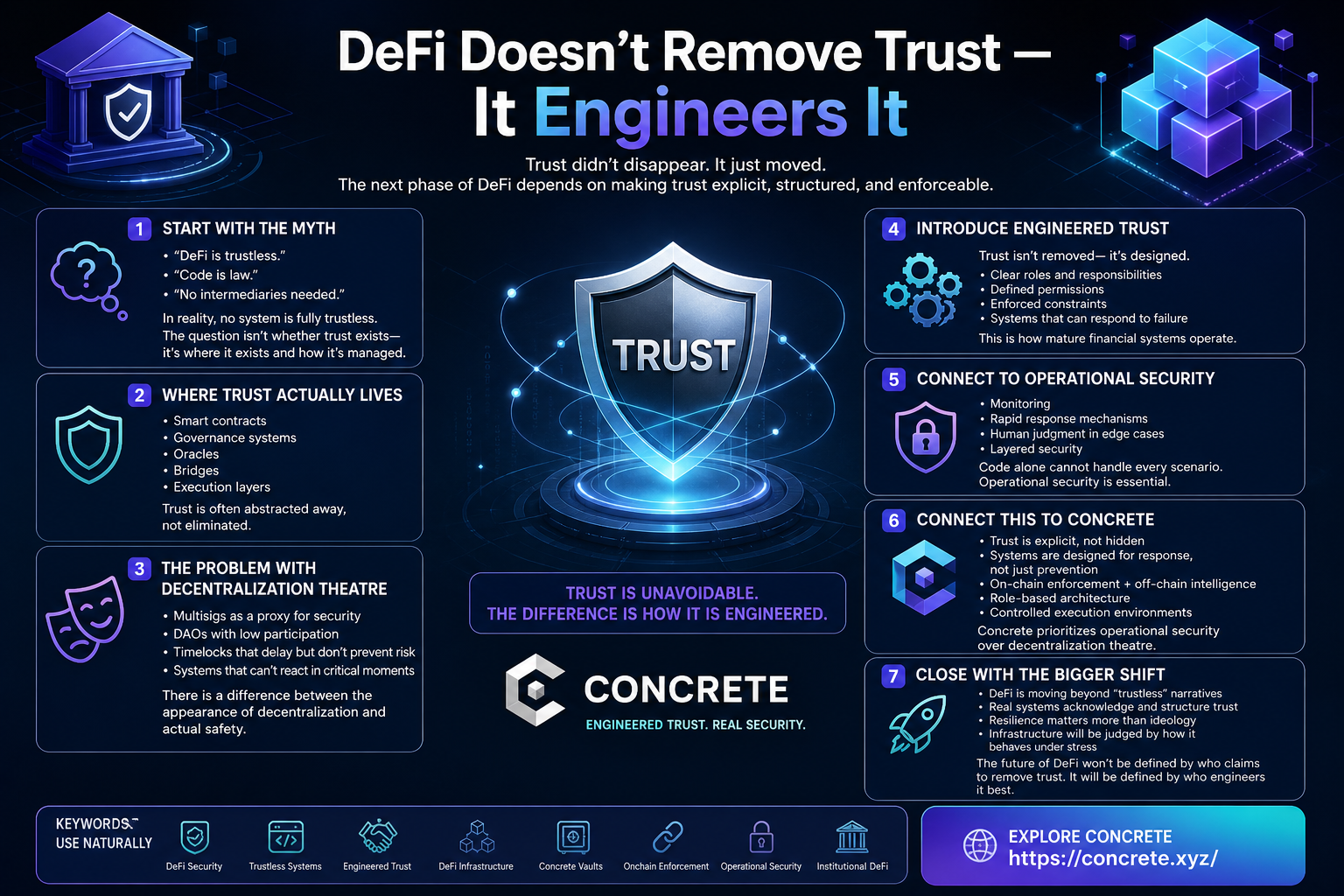
DeFi Doesn’t Remove Trust It Engineers It
 GITS s3 min read·Just now
--
“Don’t trust people. Trust code.”
That was one of the founding ideas of DeFi.
No intermediaries.
No centralized control.
No need to rely on human judgment.
Just smart contracts executing exactly as written.
For a while, that narrative held.
But as DeFi evolved, something became clear:
Trust didn’t disappear. It just moved.
The Myth of “Trustless” Systems
DeFi is often described as trustless.
The idea is simple:
- code replaces institutions
- automation replaces discretion
- rules replace judgment
In theory, this removes the need for trust.
But in practice, no system is fully trustless.
Every system has assumptions.
Every system has dependencies.
The real question isn’t whether trust exists.
It’s:
Where does it exist — and how is it managed?
Where Trust Actually Lives in DeFi
Even in fully onchain environments, trust is still present.
It just becomes less visible.
Users place trust in:
- smart contracts — that the code is secure and behaves as expected
- governance systems — that decisions are made responsibly
- oracles — that external data is accurate and timely
- bridges — that assets move safely across chains
- execution layers — that transactions are processed reliably
Each of these layers introduces its own risks.
And each requires some level of trust.
DeFi doesn’t eliminate trust.
It distributes it.
The Problem With Decentralization Theatre
As DeFi grew, another issue emerged:
Not all decentralization is meaningful.
Some systems appear decentralized, but lack real resilience.
This is often called decentralization theatre.
Examples include:
- multisigs presented as full security models
- DAOs with low participation or concentrated control
- timelocks that delay decisions but don’t prevent risk
- systems that cannot react quickly during critical failures
These structures create the appearance of safety.
But under stress, their limitations become clear.
There is a difference between:
looking decentralized
and
being secure
From Trustless to Engineered Trust
Instead of pretending trust doesn’t exist, a better approach is to design it deliberately.
This is where the idea of engineered trust comes in.
Engineered trust means:
- defining clear roles and responsibilities
- assigning explicit permissions
- enforcing constraints at the system level
- building mechanisms to respond to failure
This is how mature financial systems operate.
Not by eliminating trust —
but by structuring it.
Why Operational Security Matters
Real-world systems must handle more than ideal conditions.
They must handle edge cases.
Unexpected events.
Market stress.
System failures.
This requires:
- continuous monitoring
- rapid response capabilities
- human judgment when needed
- layered security models
Code is powerful.
But code alone cannot anticipate every scenario.
Operational security bridges that gap.
How Concrete Approaches Trust
This is where Concrete takes a different approach.
Instead of hiding trust behind “trustless” narratives, it makes trust explicit and structured.
Concrete is designed around:
- onchain enforcement combined with off-chain intelligence
- role-based architecture with clearly defined responsibilities
- systems that can respond to risk, not just prevent it
- controlled execution environments
- a focus on DeFi security and resilience
This approach prioritizes how systems behave under real conditions.
Not just how they are described in theory.
In this model, Concrete vaults are not just yield tools.
They are part of a broader DeFi infrastructure designed for operational security.
The Shift Toward Realism in DeFi
DeFi is maturing.
The early narrative focused on removing trust entirely.
But the next phase is more pragmatic.
It recognizes that:
- trust is unavoidable
- systems must be designed around it
- resilience matters more than ideology
As institutional DeFi grows, expectations will change.
Capital will flow toward systems that are:
- transparent about their assumptions
- structured in their design
- reliable under stress
Final Thought
The future of DeFi will not be defined by systems that claim to eliminate trust.
It will be defined by systems that manage it intelligently.
Because in the end:
Trust is not the problem.
Unstructured trust is.
And the strongest systems will be the ones that engineer it — deliberately, transparently, and securely.
Explore Concrete at https://concrete.xyz/ 🚀