DeFi Doesn’t Remove Trust — It Engineers It
 MiTi3 min read·Just now
--
For a long time, DeFi has sold us a simple idea:
“Don’t trust people. Trust code.”
It sounds clean. No banks, no middlemen, no human decisions, just smart contracts doing exactly what they’re programmed to do.
And honestly, that idea helped DeFi grow fast.
But the more you actually spend time in the space, the more you realize something:
Trust never went away. It just moved to different places.
The “Trustless” Idea Isn’t the Full Story
We’ve all heard it:
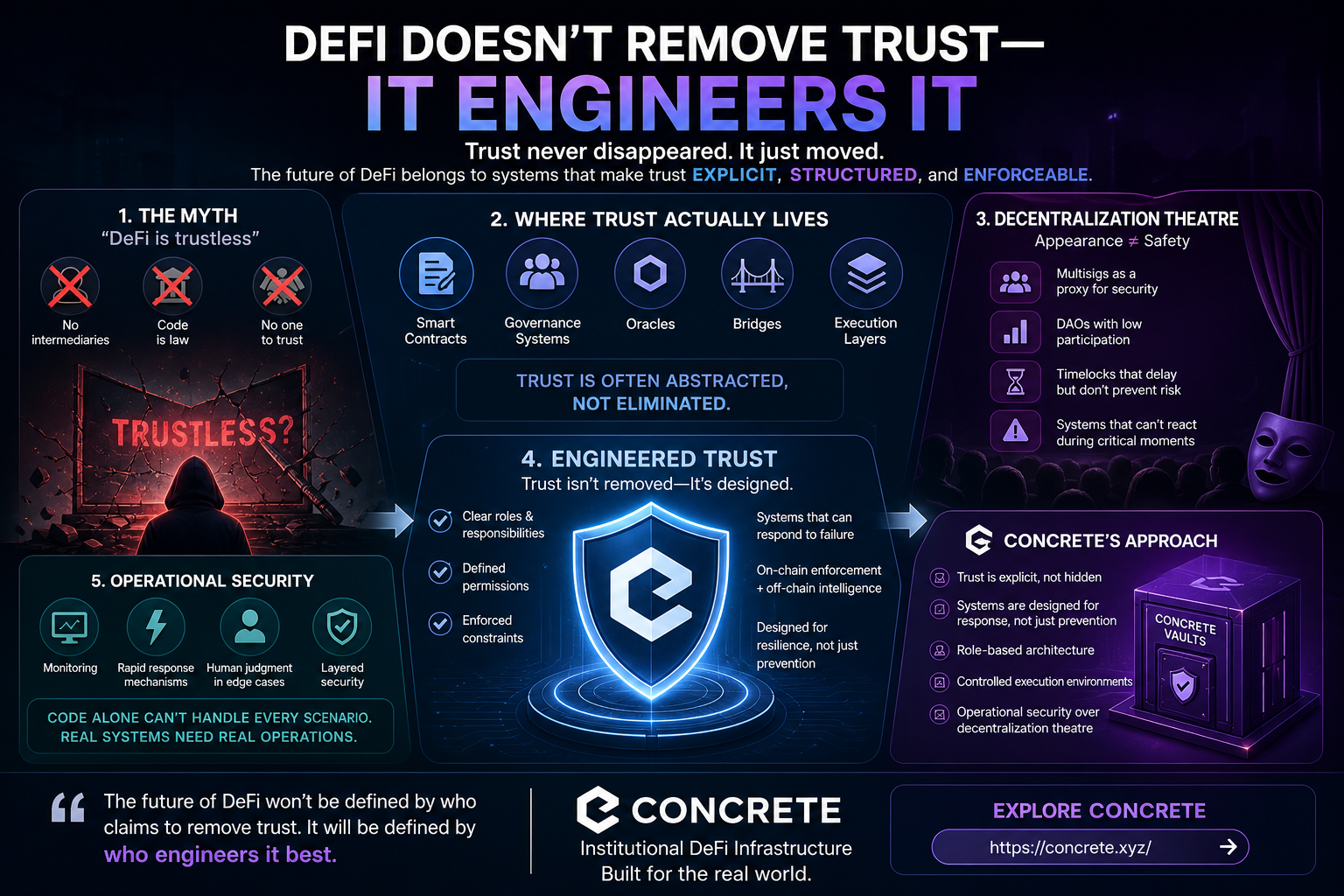
- “DeFi is trustless”
- “Code is law”
- “No intermediaries needed”
But in reality, no system works without some level of trust.
Even in DeFi, you’re still trusting things, you just might not notice it right away.
So the real question isn’t “Is this trustless?”
It’s:
👉 Where does the trust exist, and how is it being handled?
Where You’re Actually Trusting in DeFi
If you break things down, you’ll see trust everywhere:
- Smart contracts — You trust the code is secure and won’t break or get exploited
- Governance — Someone can change parameters or upgrade the system
- Oracles — You rely on external data being accurate (like price feeds)
- Bridges — Moving assets across chains is often one of the riskiest parts
- Execution layers — Validators or sequencers still control what gets processed
So yeah, DeFi isn’t “trustless.”
It just hides trust in more technical layers.
The Problem: “Decentralization Theatre”
This is where things get a bit uncomfortable.
Some projects look decentralized, but aren’t really that safe or resilient.
You’ll see things like:
- A multisig controlled by a small group of people
- DAOs where barely anyone votes
- Timelocks that delay actions but don’t actually prevent bad ones
- Systems that freeze when something unexpected happens
It creates the feeling of decentralization, but not necessarily real protection.
And when money is involved, that gap matters.
A Better Way: Engineered Trust
Instead of pretending trust doesn’t exist, a better approach is to design it properly.
That’s what “engineered trust” means.
It’s about being clear and intentional:
- Who has control?
- What can they do?
- What are the limits?
- What happens if something goes wrong?
This is how real financial systems work.
Not by removing trust, but by structuring it in a way that’s transparent and enforceable.
Why Code Alone Isn’t Enough
Smart contracts are powerful, but they’re not magic.
They can’t:
- Predict every edge case
- React instantly to new threats
- Make judgment calls in messy situations
That’s why operational security matters so much:
- Monitoring systems in real time
- Being able to respond quickly
- Having humans involved when needed
- Building layers of protection, not just one
The idea that everything can run perfectly on autopilot just doesn’t hold up anymore.
Where Concrete Fits In
This is exactly the problem Concrete is trying to solve.
Instead of hiding trust, Concrete makes it explicit and structured.
Here’s how it’s different:
- Trust isn’t vague, it’s clearly defined
- Systems are built to respond, not just sit there
- It combines onchain enforcement with offchain intelligence
- Uses role-based architecture so responsibilities are clear
- Provides controlled execution environments to reduce risk
- And builds Concrete vaults designed with real world use in mind
The focus isn’t on looking decentralized.
It’s on actually being secure and reliable in practice.
👉 Explore Concrete at https://concrete.xyz/
The Bigger Shift Happening in DeFi
DeFi is growing up.
We’re moving away from slogans like “trustless systems” and toward something more realistic:
- Trust is acknowledged, not ignored
- Security is about real-world performance
- Systems are judged by how they handle stress not how they market themselves
In the end, the future of DeFi won’t be about who claims to remove trust.
It’ll be about who designs it best.