 ₿ALLOH✩4 min read·Just now
--
DeFi Doesn’t Remove Trust — It Engineers It
DeFi was built on a powerful, almost rebellious idea:
“Don’t trust people. Trust code.”
For a moment, that felt like a breakthrough. Smart contracts replaced intermediaries. Protocols replaced institutions. The promise was clear — a financial system where trust was no longer a requirement, but an outdated dependency.
But as DeFi matured, reality caught up with the narrative.
Trust didn’t disappear.
It simply moved.
And now, the real question is no longer whether DeFi is trustless — but where trust lives, and how intentionally it is designed.
---
1️⃣ Start With the Myth
At its core, DeFi emerged with three defining beliefs:
- “DeFi is trustless”
- “Code is law”
- “No intermediaries needed”
These ideas reshaped how people thought about financial systems. Instead of relying on banks or institutions, users could interact directly with protocols governed by immutable smart contracts.
But this framing carries a hidden assumption — that code can fully replace trust.
It can’t.
No system operating in the real world is entirely trustless. Every system depends on assumptions, dependencies, and human decisions at some layer.
So the real issue isn’t whether trust exists.
It’s whether that trust is visible, structured, and enforceable — or hidden behind the illusion of decentralization.
---
2️⃣ Where Trust Actually Lives
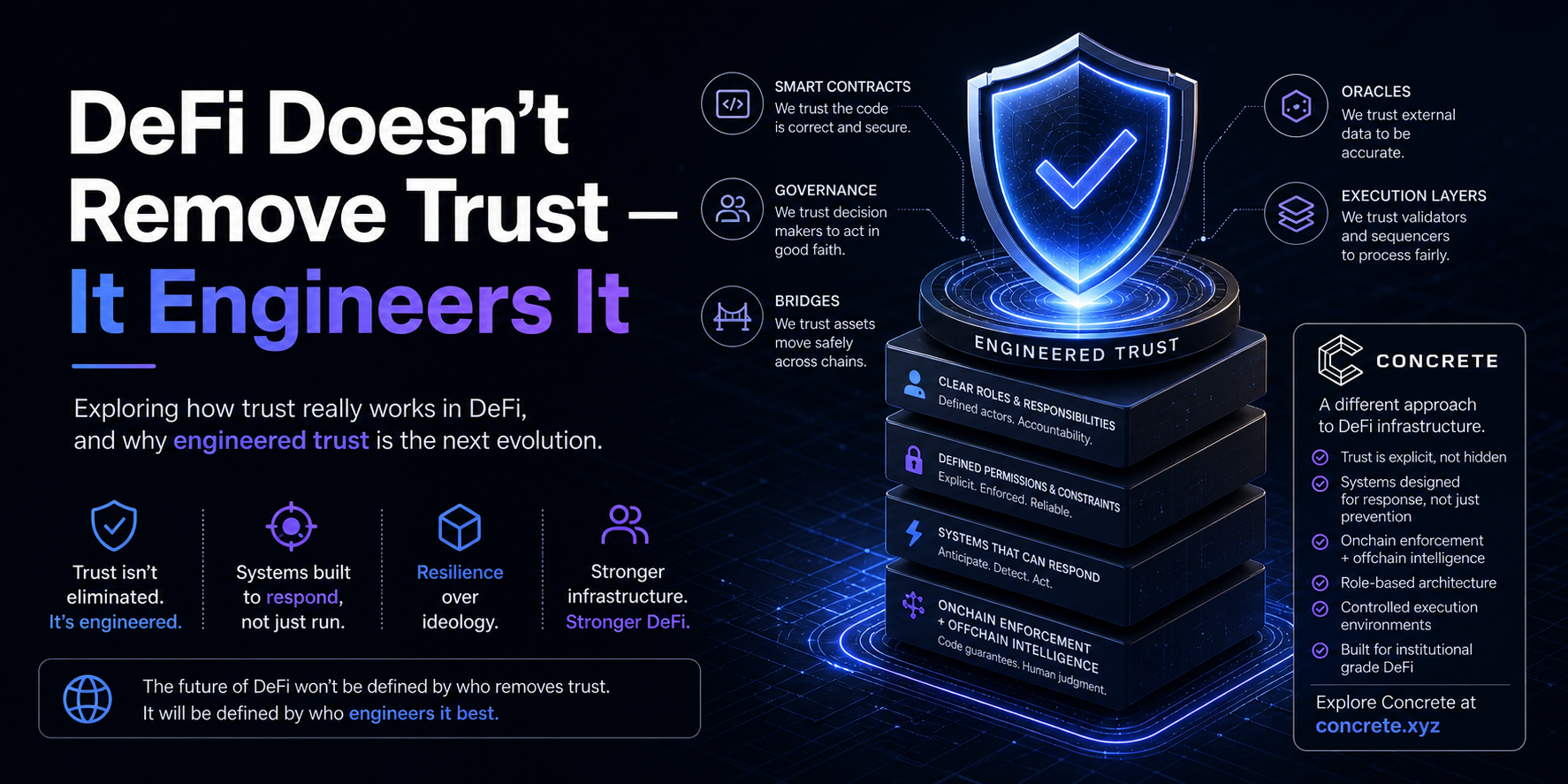
In practice, DeFi systems are built on multiple layers of trust — many of which are abstracted away from the user.
Let’s break it down:
Smart Contracts
Users trust that contracts are correctly written, audited, and free of exploitable bugs. Even audited code has failed under unexpected conditions.
Governance Systems
Token holders or multisigs often control upgrades, parameters, or emergency actions. This introduces human decision-making into “autonomous” systems.
Oracles
Protocols depend on external data feeds for pricing and events. If an oracle fails or is manipulated, the entire system can behave incorrectly.
Bridges
Cross-chain infrastructure introduces some of the highest-risk trust assumptions in DeFi. Many of the largest exploits have occurred at this layer.
Execution Layers
Validators, sequencers, and block producers influence transaction ordering, inclusion, and finality — all of which affect user outcomes.
In each case, trust is not removed.
It is redistributed and obscured.
---
3️⃣ The Problem With “Decentralization Theatre”
As DeFi grew, a new pattern emerged — systems that look decentralized, but lack real resilience.
This is what can be described as decentralization theatre.
Examples include:
- Multisigs as security theater — A handful of signers controlling critical functions, often without transparency or accountability
- DAOs with low participation — Governance structures that exist in theory but are inactive in practice
- Timelocks — Delays that signal safety, but don’t actually prevent malicious or flawed actions
- Rigid systems — Protocols that cannot adapt or respond during crises
These designs create the appearance of decentralization without delivering meaningful safety or reliability.
The key distinction is this:
«Decentralization is not the same as security.»
A system can be decentralized and still fragile.
It can distribute control — but fail under stress.
---
4️⃣ Introducing Engineered Trust
If trust cannot be removed, then the next evolution of DeFi is clear:
Trust must be engineered.
Engineered trust means designing systems where:
- Roles and responsibilities are clearly defined
- Permissions are explicit and enforceable
- Constraints are built into the system architecture
- Failure scenarios are anticipated and handled
This is how mature financial systems operate.
They don’t pretend trust doesn’t exist.
They structure it carefully, monitor it continuously, and enforce it rigorously.
In DeFi, this approach transforms infrastructure from static code into adaptive, resilient systems.
---
5️⃣ Why This Matters for Operational Security
Real-world systems don’t fail because of simple, predictable conditions.
They fail at the edges — during volatility, exploits, or unexpected interactions.
That’s why operational security is critical in DeFi.
Robust systems require:
- Continuous monitoring of on-chain activity
- Rapid response mechanisms during anomalies
- Human judgment in edge cases
- Layered security models across contracts, infrastructure, and operations
Code alone cannot anticipate every possible scenario.
A purely “set-and-forget” system may work in ideal conditions — but markets are not ideal.
Resilience comes from the ability to respond, not just prevent.
---
6️⃣ How Concrete Approaches Engineered Trust
This is where a new model begins to take shape — one that prioritizes explicit, structured trust over hidden assumptions.
Concrete represents this shift.
Instead of relying on the illusion of trustless systems, Concrete designs infrastructure where trust is visible, controlled, and enforceable.
Key principles include:
- Explicit trust design — Trust assumptions are clearly defined rather than abstracted away
- Systems built for response — Not just prevention, but the ability to act during critical moments
- Onchain enforcement + off-chain intelligence — Combining deterministic execution with adaptive oversight
- Role-based architecture — Defined actors with scoped permissions and responsibilities
- Controlled execution environments — Reducing unpredictability while maintaining flexibility
This approach is particularly important for institutional DeFi, where capital requirements, compliance expectations, and risk tolerance demand higher standards.
Concrete vaults embody this philosophy — combining programmable infrastructure with operational safeguards to create systems that behave predictably under stress.
In this model, DeFi security is not assumed — it is actively engineered.
Explore Concrete at https://concrete.xyz/
---
7️⃣ The Bigger Shift
DeFi is entering a new phase.
The early narrative of “trustless systems” is giving way to something more grounded — and more powerful.
The future will not be defined by who claims to eliminate trust.
It will be defined by who designs it best.
Because in real systems:
- Trust is unavoidable
- Resilience matters more than ideology
- Infrastructure is judged by how it performs under pressure
The next generation of DeFi infrastructure will be built on engineered trust — systems that acknowledge reality, embrace complexity, and deliver reliability.
And in that world, the winners won’t be those who hide trust.
They’ll be the ones who make it explicit, structured, and enforceable.