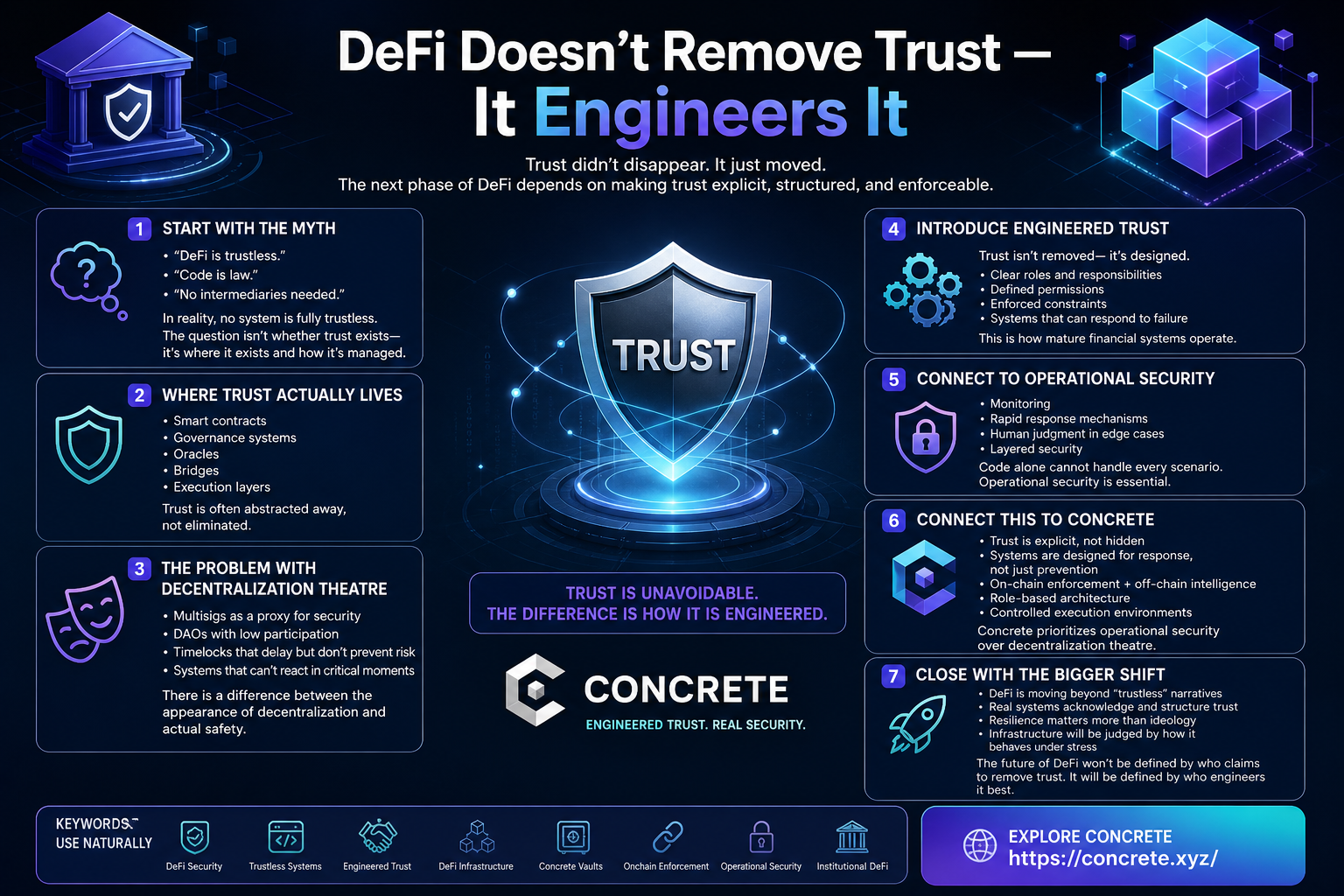
DeFi Doesn’t Remove Trust — It Engineers It
--
DeFi Doesn’t Remove Trust — It Engineers It
DeFi was built on a powerful, almost rebellious idea:
“Don’t trust people. Trust code.”
It was a response to the failures of traditional finance — opaque institutions, hidden risks, and centralized control. Smart contracts promised something radically different: systems that execute automatically, transparently, and without human bias.
For a while, that narrative held.
“Trustless systems.”
“Code is law.”
“No intermediaries needed.”
But as DeFi matured, cracks began to show — not in the technology itself, but in the assumptions behind it.
Because in reality, no system is ever truly trustless.
The real shift isn’t the removal of trust.
It’s the relocation and redesign of trust.
And increasingly, the success of DeFi systems depends on one thing:
How well that trust is engineered.
The Myth of Trustless Systems
The idea of a trustless system is elegant. It suggests a world where rules are enforced purely by code, eliminating the need for human discretion or institutional authority.
In theory:
- Smart contracts execute deterministically
- Outcomes are predictable
- No one can intervene or manipulate the system
But this vision depends on a critical assumption:
That code alone can account for all real-world complexity.
It can’t.
Markets are dynamic. Edge cases are inevitable. Adversaries are creative. And infrastructure is layered with dependencies that extend far beyond a single smart contract.
So while DeFi reduces some forms of trust — particularly in centralized intermediaries — it doesn’t eliminate trust entirely.
Instead, it redistributes it.
The real question becomes:
Where does trust live now?
Where Trust Actually Lives in DeFi
If you look closely, trust in DeFi hasn’t disappeared — it has simply moved into different layers of the stack.
1. Smart Contracts
At the base level, users trust that:
- The code is written correctly
- There are no hidden vulnerabilities
- Audits are thorough and meaningful
But smart contracts are created by humans. Bugs exist. Audits miss things. And once deployed, immutable code can become a liability if conditions change.
Trust here is not eliminated — it’s shifted to developers and auditors.
2. Governance Systems
DAOs were meant to decentralize decision-making.
In practice, users trust that:
- Governance participants act in good faith
- Token distribution isn’t overly concentrated
- Proposals are reviewed carefully
But many governance systems suffer from low participation, voter apathy, or dominance by a small group of actors.
This introduces a different form of trust:
trust in collective human behavior.
3. Oracles
Smart contracts cannot access external data on their own.
They rely on oracles to provide:
- Price feeds
- Market data
- Real-world information
This creates a dependency on:
- Oracle design
- Data sources
- Update mechanisms
If an oracle fails or is manipulated, the entire system can behave incorrectly.
So again, trust isn’t removed — it’s placed in data integrity and oracle infrastructure.
4. Bridges
Cross-chain bridges enable assets to move between ecosystems.
But they are also one of the most exploited components in DeFi.
Users implicitly trust that:
- Bridge validators are secure
- Message verification is robust
- Funds are properly custodied
History has shown that these assumptions often break.
Here, trust is concentrated in security models that are often opaque and complex.
5. Execution Layers
Even if everything above is sound, transactions still rely on:
- Block producers
- Sequencers
- MEV dynamics
Users trust that:
- Transactions are executed fairly
- Front-running is minimized
- Network behavior remains predictable
This layer introduces trust in infrastructure operators and economic incentives.
The Problem With Decentralization Theatre
As DeFi evolved, a new phenomenon emerged:
Systems that appear decentralized — but aren’t necessarily safe.
This is what we can call “decentralization theatre.”
It includes patterns like:
- Multisigs presented as security guarantees
(when in reality, a small group still controls critical functions) - DAOs with minimal active participation
(where governance exists in theory, but not in practice) - Timelocks that delay risk but don’t eliminate it
(giving the illusion of safety without true protection) - Rigid systems that cannot react during crises
(because “code is law,” even when conditions demand intervention)
These designs optimize for optics:
- Decentralization as a narrative
- Trustlessness as branding
But they often fail under stress.
Because real resilience isn’t about removing control entirely — it’s about designing control responsibly.
Engineered Trust: A Better Model
If trust is unavoidable, then the goal should not be to eliminate it.
The goal should be to engineer it deliberately.
Engineered trust means designing systems where:
- Roles are clearly defined
- Permissions are explicitly scoped
- Constraints are enforced onchain
- Responses to failure are built into the architecture
This is how mature financial systems operate.
They don’t pretend trust doesn’t exist.
They structure it, monitor it, and enforce it.
In DeFi, this translates to:
- Transparent governance mechanisms
- Layered security models
- Controlled execution environments
- Systems that can adapt to unexpected conditions
It’s a shift from ideology to practicality.
From “trustless” to trust-aware.
Why Operational Security Matters
One of the biggest misconceptions in early DeFi was that prevention alone is enough.
Write perfect code. Audit it. Deploy it. Done.
But real systems don’t work that way.
They require:
- Monitoring to detect anomalies
- Alerting systems for early warning signals
- Rapid response mechanisms to contain damage
- Human judgment for edge cases that code cannot anticipate
This is where operational security becomes critical.
Because even the most secure system can face:
- Market shocks
- Oracle failures
- Unexpected user behavior
- Coordinated attacks
Code can enforce rules — but it cannot interpret intent or context.
And when things go wrong, the ability to respond matters just as much as the ability to prevent.
Concrete: Designing for Real-World Resilience
This is where a new generation of DeFi infrastructure is emerging — one that acknowledges the realities of trust instead of denying them.
Concrete is built around this philosophy.
Rather than hiding trust behind narratives, it makes trust:
- Explicit
- Structured
- Enforceable
At its core, Concrete focuses on operational security and engineered trust.
1. Trust Is Explicit
Instead of pretending systems are fully trustless, Concrete defines:
- Who has control
- What actions they can take
- Under what conditions
This removes ambiguity and aligns expectations with reality.
2. Designed for Response, Not Just Prevention
Concrete systems are built to:
- Detect issues in real time
- Respond to changing conditions
- Mitigate risks before they escalate
This reflects how real financial systems operate — not as static code, but as adaptive infrastructure.
3. Onchain Enforcement + Offchain Intelligence
Purely onchain systems are powerful, but limited.
Concrete combines:
- Onchain enforcement for transparency and immutability
- Offchain intelligence for monitoring, analysis, and decision-making
This hybrid model allows for both:
- Trust minimization
- Practical responsiveness
4. Role-Based Architecture
Not all participants should have the same permissions.
Concrete introduces:
- Clearly defined roles
- Scoped access controls
- Separation of responsibilities
This reduces risk while maintaining flexibility.
5. Controlled Execution Environments
Rather than open-ended execution, systems operate within:
- Defined constraints
- Verified pathways
- Guardrails that prevent unintended behavior
This ensures that even when actions are taken, they remain within safe and predictable boundaries.
6. Built for Institutional DeFi
As DeFi evolves, it is increasingly attracting institutional participants.
These actors require:
- Reliability
- Risk management
- Accountability
Concrete aligns with this shift by providing infrastructure that prioritizes:
- DeFi security
- Operational integrity
- Resilience under stress
This is not about abandoning decentralization — it’s about making it usable at scale.
The Bigger Shift in DeFi
DeFi is entering a new phase.
The early era was defined by:
- Ideology
- Experimentation
- Rapid innovation
But the next phase will be defined by:
- Stability
- reliability
- infrastructure quality
The narrative is changing.
From:
- “Who can remove trust?”
To:
- “Who can design trust systems that actually work?”
Because in the end:
- Trust is not the enemy
- Hidden trust is
The systems that will succeed are those that:
- Acknowledge trust openly
- Structure it intelligently
- Enforce it transparently
And most importantly:
Perform reliably when it matters most.
Conclusion: Engineering the Future of Trust
DeFi didn’t eliminate trust.
It exposed it.
It broke apart traditional systems and redistributed trust across new layers — smart contracts, governance, oracles, bridges, and execution environments.
Now, the challenge is no longer to pretend trust doesn’t exist.
The challenge is to engineer it better.
Because the future of DeFi won’t be defined by narratives of trustlessness.
It will be defined by:
- Systems that are secure
- Infrastructure that is resilient
- Architectures that can handle real-world complexity
In short:
The winners will not be those who claim to remove trust.
They will be those who design it best.
🚨 Explore Concrete at https://concrete.xyz/ 🚨