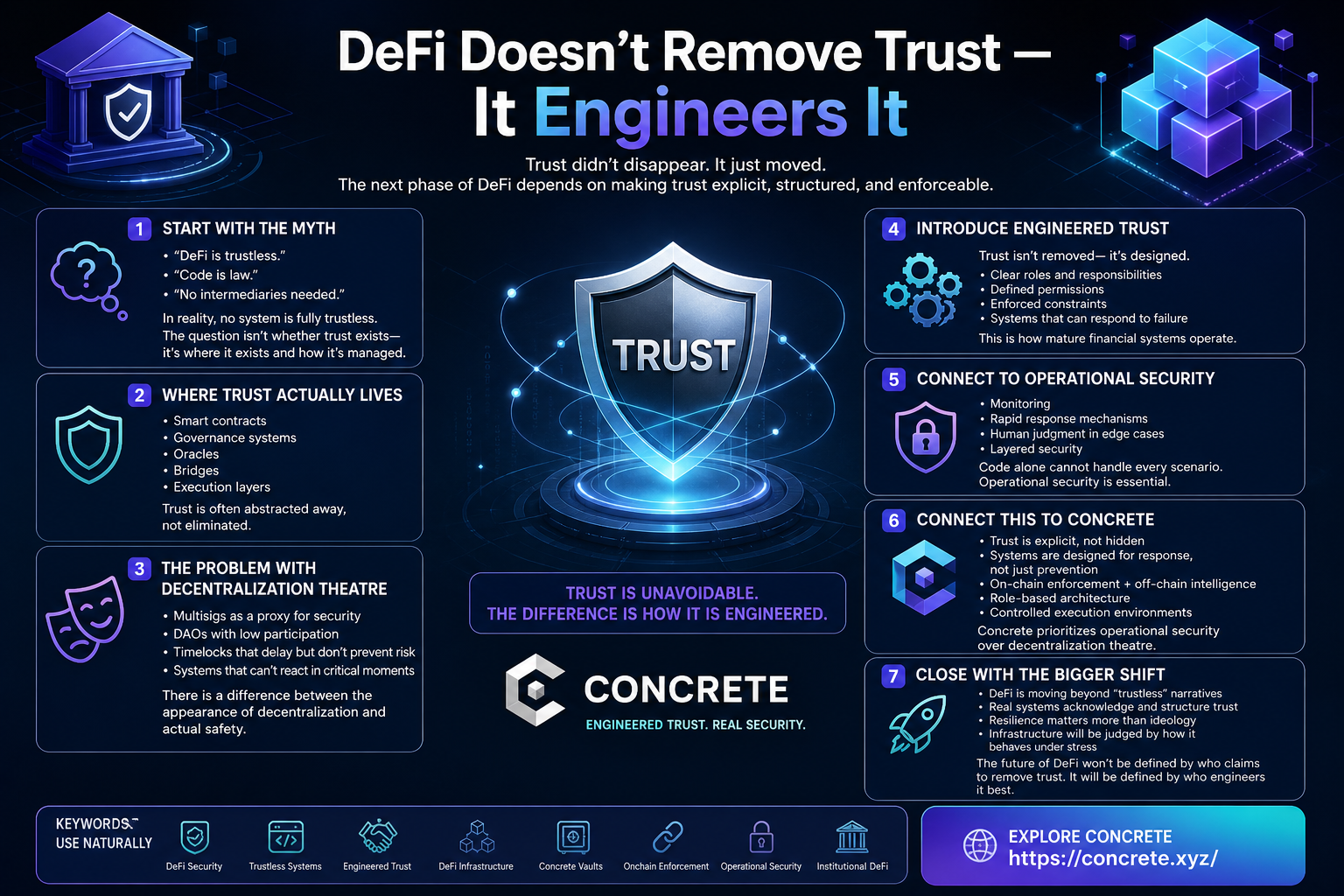
DeFi Doesn’t Remove Trust — It Engineers It
--
For years, DeFi has been built around one powerful promise:
“Don’t trust people. Trust code.”
It became the foundation of the entire movement.
A new financial system where intermediaries disappear, trust is removed, and execution becomes purely mathematical.
At first glance, it sounds like the perfect solution.
No banks.
No gatekeepers.
No human discretion.
Just immutable smart contracts running exactly as written.
But as DeFi has matured, a deeper truth has emerged:
Trust was never removed. It was relocated.
And understanding where trust actually lives is one of the most important shifts happening in DeFi infrastructure today.
The next evolution of decentralized finance will not come from pretending trust no longer exists.
It will come from engineering trust deliberately.
The Myth of Trustless Systems
“Trustless” became one of crypto’s most repeated ideas.
The logic was straightforward:
If code is transparent and immutable, then participants no longer need to trust people or institutions.
Instead, they trust deterministic execution.
This framing helped DeFi grow rapidly because it solved a real problem:
Traditional finance often relies on opaque decision-making, centralized authority, and systems users cannot verify.
DeFi offered the opposite.
Everything visible.
Everything programmable.
Everything enforceable onchain.
But over time, cracks appeared in the narrative.
Because no real system operates without trust.
The question was never whether trust exists.
The real question is:
Where does trust live, and how is it structured?
That distinction changes everything.
Where Trust Actually Exists in DeFi
The idea of trustless systems often abstracts away the dependencies users rely on every day.
Even the most decentralized protocols require trust assumptions across multiple layers.
Smart Contract Assumptions
Users trust that contracts were written correctly.
This includes:
- secure logic design
- complete testing coverage
- proper auditing
- no undiscovered vulnerabilities
Code may be immutable, but bugs are too.
History has repeatedly shown that smart contract risk remains one of the biggest threats to DeFi security.
Governance Systems
Many protocols market decentralization through governance.
But governance itself introduces trust.
Users trust:
- voter participation remains healthy
- governance power is distributed
- proposals are reviewed carefully
- malicious coordination is prevented
A DAO with low engagement can become less resilient than a centralized but actively managed system.
Oracle Dependencies
Protocols depend heavily on external data.
Prices, rates, collateral valuations, and market signals often come from oracle networks.
This means users implicitly trust:
- data accuracy
- update reliability
- manipulation resistance
- liveness during volatility
Without reliable oracles, onchain enforcement breaks.
Bridge Security
Cross-chain interoperability introduces another major trust layer.
Bridges often depend on:
- validator assumptions
- multisig signers
- relayer coordination
- external consensus verification
Some of DeFi’s largest exploits came from bridge infrastructure.
The system may appear decentralized, but hidden trust assumptions remain.
Execution Layers
Transaction ordering, block inclusion, and execution sequencing all introduce trust dependencies.
Users often trust that:
- execution is fair
- MEV exposure is controlled
- transactions settle predictably
These operational assumptions shape user outcomes.
And they are rarely discussed when people describe DeFi as trustless.
The Problem With Decentralization Theatre
This is where DeFi often falls into what can best be described as decentralization theatre.
Systems may appear decentralized on the surface while hiding fragile operational realities underneath.
Examples include:
Multisigs Presented as Security
Multisigs are useful.
But a multisig is not automatically decentralization.
If signers are coordinated informally, concentrated socially, or operationally dependent on a small group, trust remains centralized.
DAOs With Low Participation
Governance mechanisms mean little if only a tiny percentage of token holders participate.
Low engagement creates concentrated decision-making.
The system appears decentralized while operating with limited oversight.
Timelocks as Cosmetic Protection
Timelocks create visibility.
But visibility does not always equal safety.
If users cannot respond meaningfully during a critical window, timelocks may only delay inevitable failure.
Inability to Respond During Stress
Pure immutability sounds ideal until unexpected events occur.
Markets move.
Oracles fail.
Dependencies break.
Liquidity evaporates.
Systems without operational response mechanisms often become most vulnerable exactly when resilience matters most.
Why Engineered Trust Is the Better Model
This is the shift DeFi infrastructure is moving toward.
Not removing trust.
Engineering it.
Engineered trust means designing systems where trust assumptions are:
- explicit
- constrained
- enforceable
- transparent
- operationally resilient
This is how mature financial systems work.
Roles are defined.
Permissions are structured.
Actions are bounded by rules.
Response mechanisms exist for exceptional circumstances.
The goal is not blind decentralization.
The goal is resilient coordination.
That distinction is critical for institutional DeFi adoption.
Because institutions do not need ideological purity.
They need operational certainty.
Operational Security Is Non-Negotiable
Code alone cannot handle every scenario.
Real financial systems require active operational security.
That includes:
Continuous Monitoring
Infrastructure must detect anomalies before they become failures.
Rapid Response Mechanisms
When conditions change unexpectedly, systems need the ability to react.
Not after collapse.
During the event itself.
Human Judgment for Edge Cases
No smart contract can anticipate every possible market condition.
Exceptional circumstances require structured human oversight.
Layered Security Design
Resilience comes from multiple defensive layers working together.
Not from relying on a single immutable assumption.
This is where many trustless narratives fall short.
They assume prevention is enough.
In practice, resilience requires response.
How Concrete Approaches Engineered Trust
This is where Concrete introduces a fundamentally different model for DeFi infrastructure.
Rather than hiding trust assumptions behind decentralization rhetoric, Concrete makes trust explicit and enforceable.
Its architecture reflects a more mature understanding of DeFi security.
Explicit Trust Design
Concrete clearly defines where authority exists and how it operates.
Nothing is obscured behind vague decentralization claims.
Systems Designed for Response
Prevention matters.
But response matters just as much.
Concrete infrastructure is designed to react intelligently when conditions deviate from expectations.
Onchain Enforcement + Offchain Intelligence
This hybrid approach combines deterministic onchain guarantees with operational intelligence capable of adapting to live conditions.
This is essential for real-world institutional DeFi.
Role-Based Architecture
Permissions are structured deliberately.
Responsibilities are assigned clearly.
Execution authority is bounded by enforceable constraints.
Controlled Execution Environments
Rather than exposing critical systems to unnecessary operational chaos, Concrete creates environments optimized for resilience.
This is what institutional-grade DeFi infrastructure requires.
Not decentralization theatre.
Operational precision.
Concrete prioritizes DeFi security, onchain enforcement, and operational security in ways aligned with how robust financial systems actually function.
This is why Concrete vaults represent an important step forward for institutional DeFi.
The Bigger Shift Ahead
DeFi is entering a new phase.
The early narrative focused on eliminating trust.
The next phase will focus on structuring it.
Infrastructure will no longer be judged by abstract claims of trustlessness.
It will be judged by:
- how clearly trust assumptions are defined
- how effectively systems respond under pressure
- how resilient they remain during failure scenarios
- how confidently institutions can rely on them
The future belongs to systems that acknowledge reality.
Trust exists.
Complex financial coordination requires it.
The winners will not be those who claim to remove trust.
They will be the ones who engineer it best.
That is the direction DeFi infrastructure is heading.
And it is exactly why platforms like Concrete matter.
Explore Concrete at https://concrete.xyz/