Hoangan14013 min read·Just now
--
DeFi Doesn’t Remove Trust — It Engineers It
DeFi was built on a powerful idea:
Don’t trust people. Trust code.
For a while, that narrative made sense. Smart contracts replaced intermediaries. Transactions became transparent. Systems appeared autonomous.
It felt like trust had been removed entirely.
But as DeFi evolved, something became clear:
Trust didn’t disappear. It just moved.
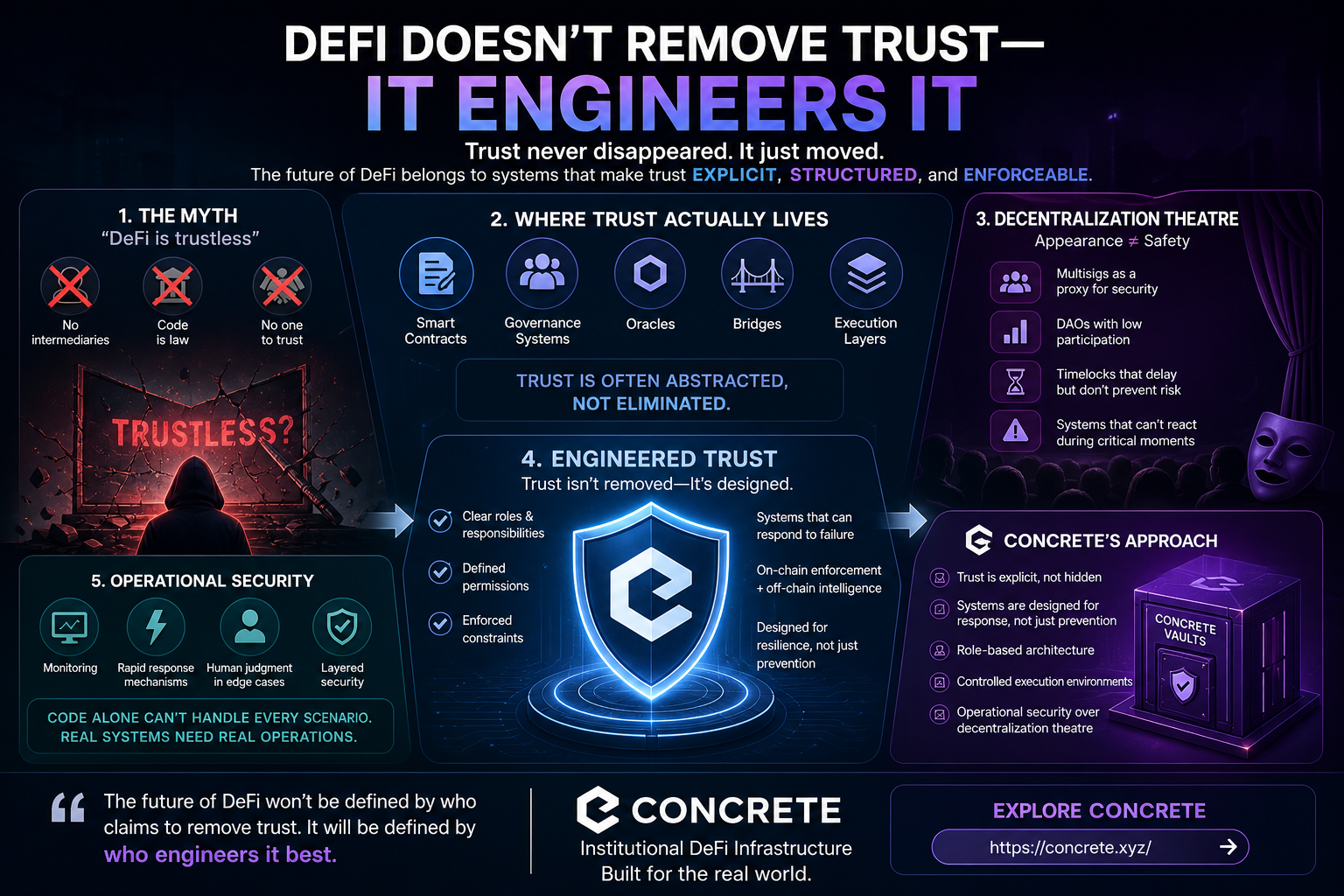
The Myth of “Trustless” Systems
The industry often describes DeFi as trustless.
Code is law.
No intermediaries.
No human discretion.
But in reality, no financial system is completely free of trust.
Even in DeFi, users still rely on assumptions:
That smart contracts behave as expected.
That governance acts responsibly.
That infrastructure functions correctly.
The real question is not whether trust exists.
It’s where it exists—and how it is managed.
Where Trust Actually Lives
In practice, DeFi depends on multiple layers of trust:
+ Smart contracts must be written correctly and free of critical bugs
+ Governance systems make decisions that affect capital allocation
+ Oracles provide external data that protocols rely on
+ Bridges connect liquidity across chains
+ Execution layers process transactions and maintain state
Each layer introduces its own assumptions.
Trust is not eliminated.
It is distributed—and often hidden behind abstraction.
The Problem With Decentralization Theatre
Many systems appear decentralized on the surface, but are not necessarily resilient.
This creates what can be called decentralization theatre.
Examples include:
+ Multisigs presented as security, but still reliant on a small group of signers
+ DAOs with low participation, where decisions are effectively centralized
+ Timelocks that delay changes, but do not prevent poor decisions
+ Systems that lack the ability to respond during critical failures
In these cases, decentralization becomes more of a narrative than a guarantee of safety.
There is a difference between:
appearing decentralized
and
being operationally secure
Trust as a Designed System
A more mature perspective is to treat trust as something that must be engineered.
Engineered trust is not about removing trust—it is about structuring it.
This includes:
+ Clear roles and responsibilities
+ Defined permissions
+ Enforced constraints
+ Systems capable of responding to failure
This is how traditional financial systems operate.
And increasingly, it is how serious DeFi infrastructure must operate as well.
Why Operational Security Matters
Real systems do not rely on static code alone.
They require:
+ Continuous monitoring
+ Rapid response mechanisms
+ Human judgment in edge cases
+ Layered security models
Smart contracts are powerful, but they cannot anticipate every possible scenario.
When something unexpected happens, systems must be able to react—not just exist.
This is where DeFi security moves beyond code into operational security.
How Concrete Engineers Trust
This is where Concrete vaults take a different approach.
Instead of hiding trust behind the label of “trustless systems,” Concrete makes trust explicit and structured.
Key principles include:
+ Trust is acknowledged, not abstracted away
+ Systems are designed for response, not just prevention
+ Onchain enforcement works alongside off-chain intelligence
+ Role-based architecture defines who can do what
+ Execution environments are controlled and observable
This is not decentralization theatre.
It is engineered trust within DeFi infrastructure.
By combining structure, constraints, and operational awareness, Concrete prioritizes resilience over ideology.
The Bigger Shift
DeFi is entering a new phase.
The early narrative focused on removing trust.
The next phase focuses on designing it properly.
In this future:
+ Trust is explicit, not hidden
+ Security is layered, not assumed
+ Systems are judged by how they behave under stress
+ Infrastructure matters more than ideology
The question is no longer:
“Is this trustless?”
But:
“Is this system designed to handle reality?”
Because trust is unavoidable.
The difference is whether it is engineered deliberately—or left as an invisible risk.
The future of institutional DeFi will not be defined by who claims to remove trust.
It will be defined by who engineers it best.
🔗 Explore Concrete at https://concrete.xyz/