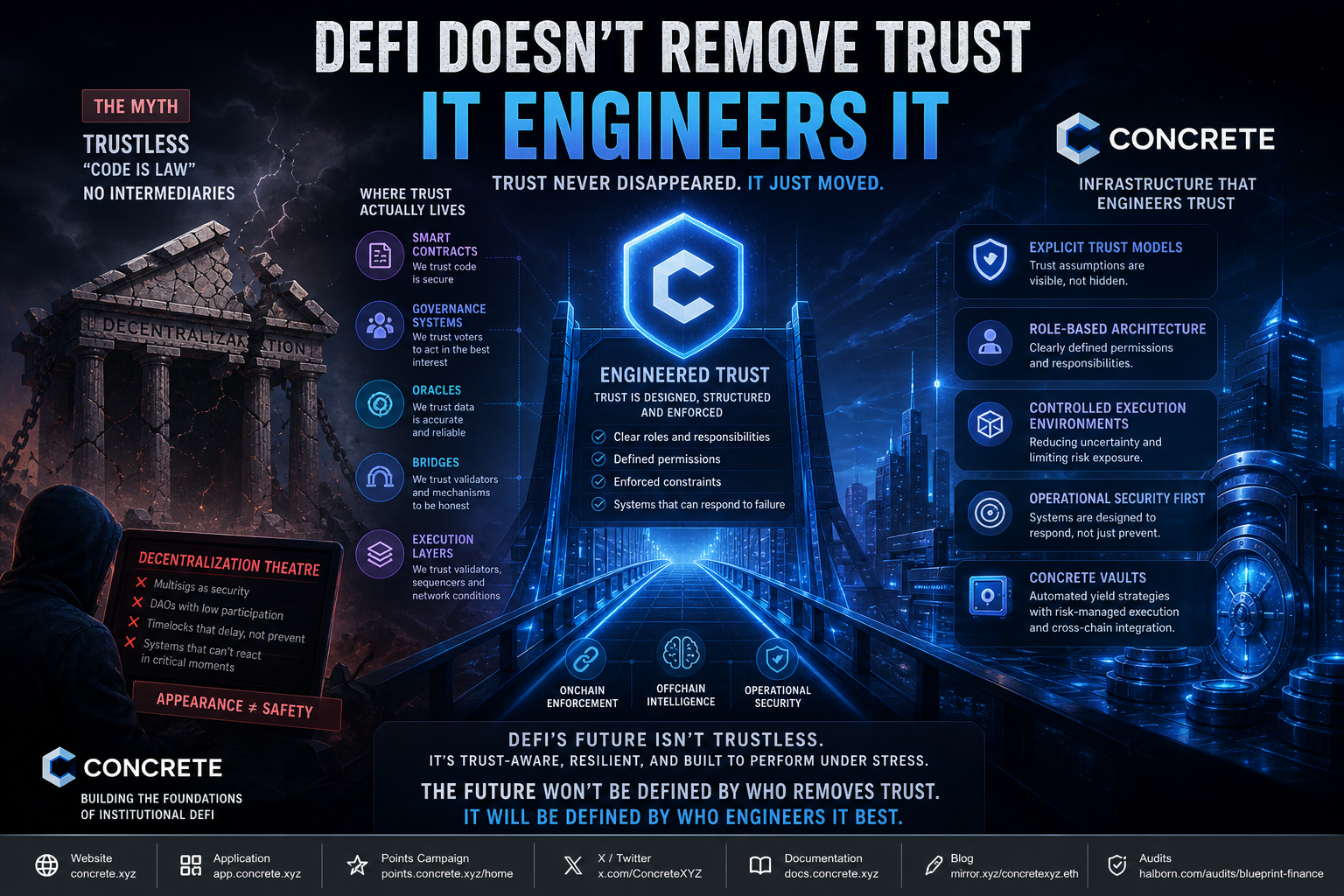
DeFi Doesn’t Remove Trust — It Engineers It
DeFi was born from a bold promise:
“Don’t trust people. Trust code.”
For a time, that narrative held strong. Smart contracts replaced intermediaries, and “trustless systems” became the industry’s identity.
But as DeFi matured, a more nuanced reality emerged:
Trust never disappeared. It simply moved.
The real question today isn’t whether trust exists in DeFi — it’s where it exists, how it’s structured, and whether it’s engineered deliberately or hidden behind complexity.
1. The Myth of “Trustless” Systems
At its core, DeFi promotes three key beliefs:
Code is law
Systems are trustless
Intermediaries are unnecessary
These ideas are powerful, but incomplete.
In practice, every system embeds assumptions. Code is written by humans. Governance is influenced by stakeholders. External data feeds introduce dependencies.
No system is truly trustless.
Instead, trust is redistributed across layers — often invisibly.
2. Where Trust Actually Lives in DeFi
To understand modern DeFi infrastructure, we need to examine where trust operates beneath the surface:
Smart Contracts
Users trust that contracts are:
Bug-free
Secure
Properly audited
Yet exploits continue to prove that code is not infallible.
Governance Systems
Token-based governance assumes:
Active participation
Rational decision-making
Alignment of incentives
In reality, voter apathy and concentrated power are common.
Oracles
Protocols depend on external data feeds. This introduces trust in:
Data accuracy
Oracle providers
Update mechanisms
Bridges
Cross-chain systems rely on:
Validator honesty
Security assumptions
Complex verification mechanisms
Bridges have historically been one of the most vulnerable points in DeFi security.
Execution Layers
Even transaction execution depends on:
Validators
Sequencers
Network conditions
Each layer introduces its own trust assumptions.
The conclusion is simple:
Trust isn’t removed — it’s abstracted.
3. The Problem With “Decentralization Theatre”
Many systems appear decentralized, but lack real resilience.
This creates what can be called decentralization theatre — the illusion of safety without the substance.
Examples include:
Multisigs acting as centralized control under the guise of distribution
DAOs with low voter participation and weak governance
Timelocks that delay risk but don’t eliminate it
Rigid systems that fail under unexpected conditions
These designs often optimize for optics rather than outcomes.
There is a critical difference between:
Looking decentralized
Being secure and resilient
4. From Trustless to Engineered Trust
A more mature approach is emerging:
Engineered trust.
Instead of pretending trust doesn’t exist, engineered systems:
Define clear roles and responsibilities
Establish enforceable permissions
Build structured constraints
Enable controlled responses to failure
This is how traditional financial systems operate — and increasingly, how institutional DeFi must evolve.
Trust becomes:
Explicit, not hidden
Structured, not assumed
Enforceable, not optional
5. Operational Security: The Missing Layer
Code alone cannot handle every scenario.
Real-world systems require operational security, including:
Continuous monitoring
Rapid response mechanisms
Human oversight in edge cases
Layered defense strategies
Without these, even well-designed protocols can fail under stress.
Resilience is not just about prevention — it’s about response capability.
6. How Concrete Engineers Trust
This is where Concrete introduces a fundamentally different model.
Rather than relying on the illusion of trustless systems, Concrete builds infrastructure where trust is deliberately designed and enforced.
Core Principles of Concrete
Explicit Trust Models
Trust assumptions are visible, not hidden.
Onchain Enforcement + Offchain Intelligence
Combining automation with adaptive decision-making.
Role-Based Architecture
Clearly defined permissions and responsibilities.
Controlled Execution Environments
Reducing uncertainty and limiting risk exposure.
Operational Security First
Systems are designed to respond, not just prevent.
Concrete focuses on institutional DeFi, where reliability, transparency, and risk management are non-negotiable.
Its Concrete vaults deliver:
Automated yield strategies
Risk-managed execution
Cross-chain integration
Sustainable, transparent performance
This is not decentralization theatre.
This is engineered resilience.
7. The Bigger Shift in DeFi
The industry is moving beyond simplistic narratives.
The future of DeFi will not be defined by:
Who claims to eliminate trust
But by:
Who structures and engineers trust most effectively
Key shifts include:
From ideology → to infrastructure
From “trustless” → to trust-aware systems
From static code → to adaptive security models
From appearance → to real resilience
In the next phase of DeFi, systems will be judged by one thing:
How they behave under stress.
Explore Concrete
If you want to see how engineered trust is being applied in real DeFi infrastructure:
🔗 Website: https://www.concrete.xyz/�
📺 Application: https://app.concrete.xyz/�
💯 Points Campaign: https://points.concrete.xyz/home�
🐤 X / Twitter: https://x.com/ConcreteXYZ�
📖 Documentation: https://docs.concrete.xyz/�
✍🏻 Blog: https://mirror.xyz/concretexyz.eth�
🤖 Audits: https://www.halborn.com/audits/blueprint-finance�
DeFi didn’t remove trust.
It redesigned where it lives.
The next generation of systems won’t hide that truth.
They will build around it.
--