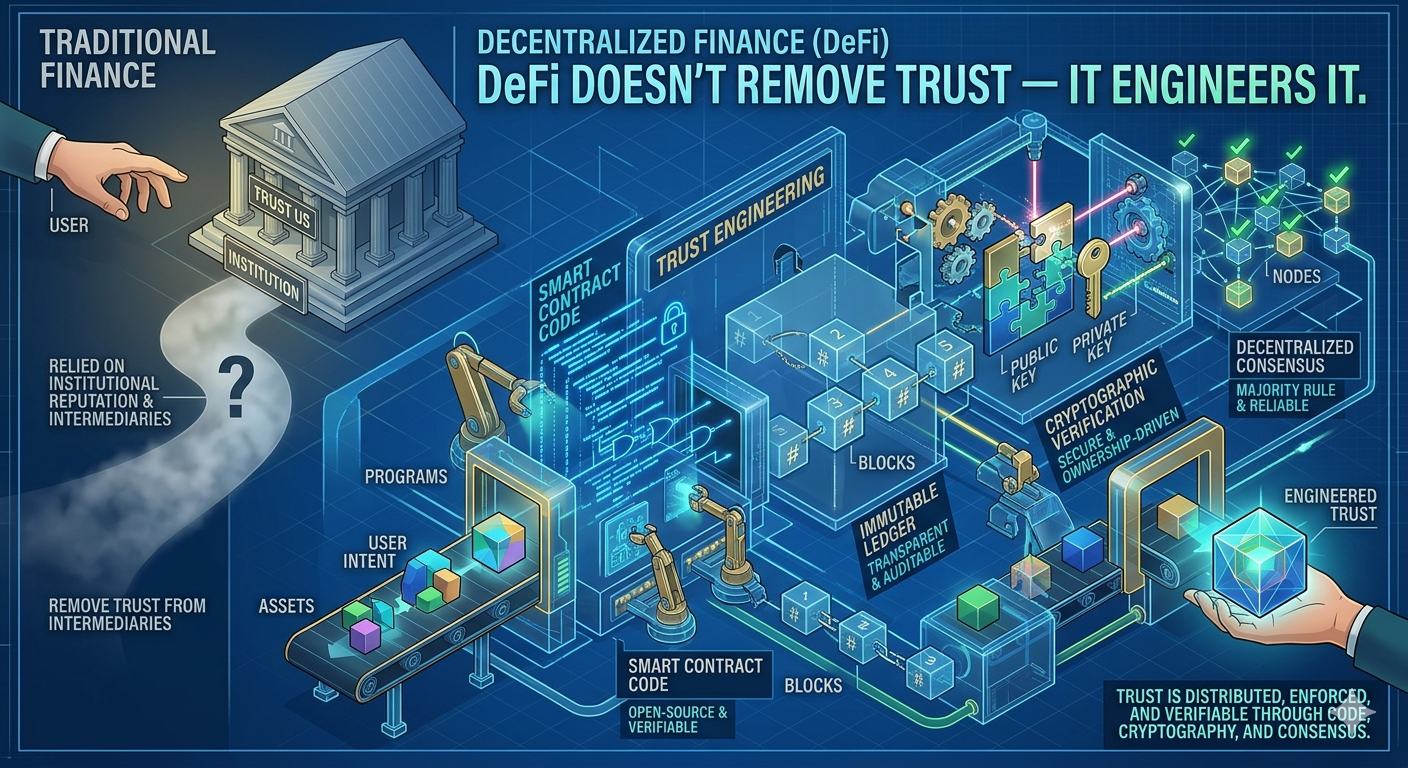
DeFi Doesn’t Remove Trust , It Engineers It
 Eaglecrypto3 min read·1 hour ago
--
DeFi was built on a simple and powerful narrative:
“Don’t trust people. Trust code.”
For a while, this idea defined the entire movement. It suggested a world where intermediaries disappear, where financial systems run purely on deterministic logic, and where trust becomes unnecessary.
But as DeFi matured, a more uncomfortable truth emerged:
trust didn’t disappear — it just shifted layers.
The Myth of “Trustless” Systems
The early promise of DeFi relied on three core beliefs:
- “Code is law”
- “Intermediaries are no longer needed”
- “Trust has been eliminated”
In practice, none of these statements hold in their pure form.
DeFi systems still rely on trust — just in different places:
- smart contracts assume correct design and audits
- governance assumes rational and non-collusive voters
- oracles assume accurate external data feeds
- bridges assume secure cross-chain messaging
- execution layers assume correct sequencing and infrastructure behavior
So the real question is not whether trust exists.
It’s this:
Where does trust live, and how is it structured?
Where Trust Actually Lives in DeFi
Modern DeFi is not trustless — it is distributed trust.
Even in highly decentralized protocols, trust is embedded in multiple layers:
1. Smart Contracts
You trust that the code:
- has no critical vulnerabilities
- was correctly audited
- behaves as intended under all conditions
2. Governance Systems
You trust that:
- voters act in good faith
- governance cannot be captured
- upgrades won’t introduce systemic risk
3. Oracles
You trust external data sources to:
- reflect real-world conditions
- resist manipulation
- remain available under stress
4. Bridges
You trust cross-chain infrastructure to:
- correctly validate messages
- prevent double-spending
- resist exploit vectors
5. Execution Layers
You trust sequencing and infrastructure to:
- process transactions fairly
- remain online
- handle congestion and failure gracefully
At every level, trust still exists — it is just abstracted behind code interfaces.
The Problem With “Decentralization Theatre”
A major issue in DeFi today is what can be called:
decentralization theatre
Systems appear decentralized on paper, but behave differently in practice.
Examples include:
- multisig wallets controlling “decentralized” protocols
- DAOs with extremely low voter participation
- timelocks that delay attacks but do not prevent them
- governance systems that cannot respond quickly during crises
This creates a dangerous illusion:
decentralization as branding, not resilience
A system can look decentralized while still being operationally fragile.
And when stress hits — markets crash, exploits occur, liquidity dries — the gap between appearance and reality becomes obvious.
Introducing Engineered Trust
The next phase of DeFi requires a shift in thinking:
Trust is not removed. It is designed.
Engineered trust means explicitly defining how trust operates inside a system instead of pretending it does not exist.
It includes:
- clear roles and responsibilities
- explicit permissioning models
- enforced constraints on actions
- predictable failure responses
- structured escalation paths
This is how traditional financial systems operate at scale.
And increasingly, it is how next-generation DeFi systems are beginning to evolve.
Trust Is an Operational Problem
At scale, financial systems are not just code — they are operational environments.
That means real systems require:
- continuous monitoring
- rapid response mechanisms
- human judgment in edge cases
- layered security architectures
Pure automation is not sufficient.
Edge cases, exploits, market shocks, and infrastructure failures require response capability, not just prevention logic.
In other words:
Code defines the rules, but operations determine survival.
Where Concrete Fits In
This is where a different design philosophy emerges.
Concrete takes the position that:
- trust is explicit, not hidden
- systems must be designed for response, not just prevention
- security is a combination of on-chain enforcement + off-chain intelligence
- architecture is role-based, not assumption-based
- execution environments are controlled and auditable
Instead of relying on decentralization theatre, Concrete focuses on operational security as a first-class design principle.
In practice, this means systems that can:
- detect abnormal conditions
- enforce constraints dynamically
- coordinate responses across layers
- maintain controlled execution under stress
Explore Concrete at https://concrete.xyz/
The Bigger Shift in DeFi
The narrative of “trustless systems” was powerful because it was simple.
But simplicity does not survive complexity.
As DeFi grows, it is becoming clear that:
- trust cannot be eliminated
- it can only be structured
- resilience matters more than ideology
- systems must behave correctly under stress, not just in theory
The future of DeFi will not be defined by who claims to remove trust.
It will be defined by who understands it well enough to engineer it properly.