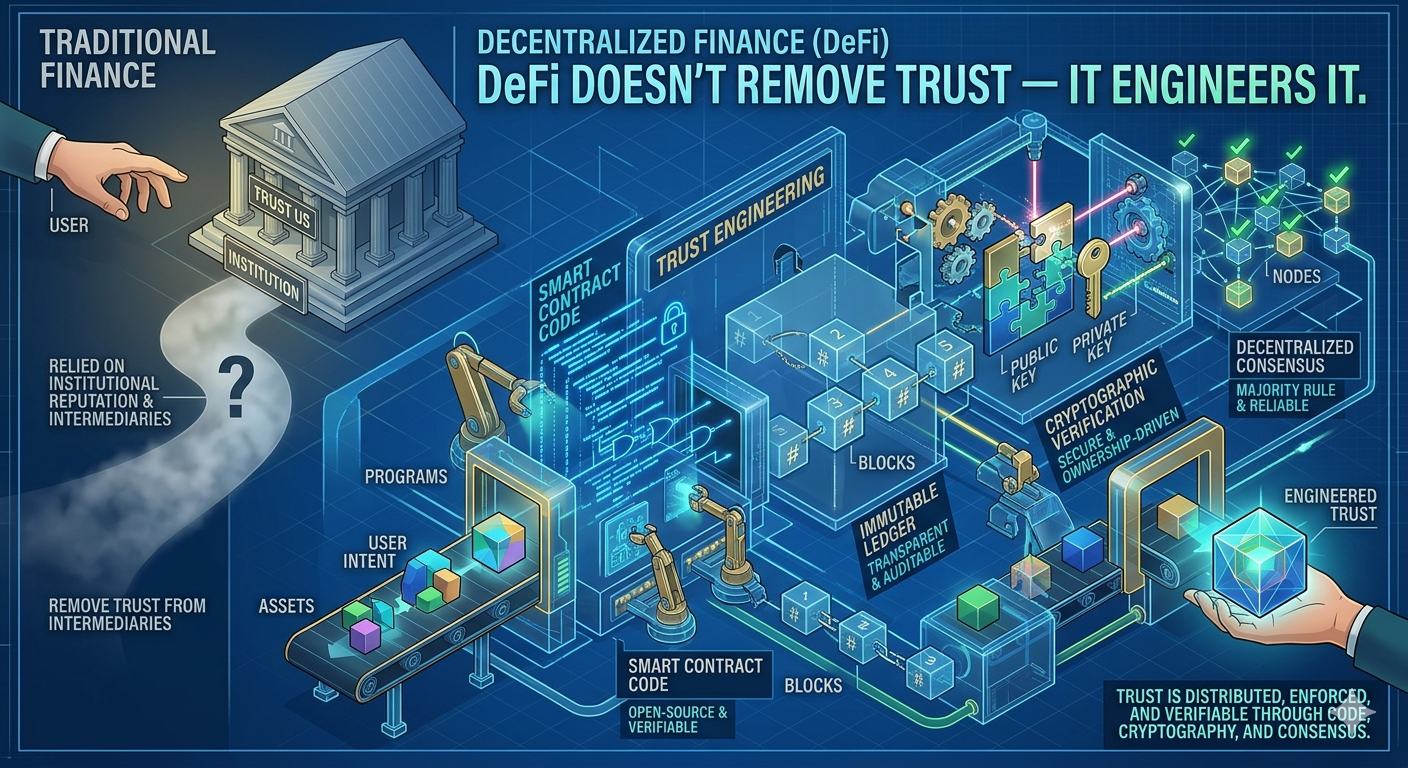
DeFi Doesn’t Remove Trust — It Engineers It
--
DeFi was born from a powerful narrative:
“Don’t trust people. Trust code.”
For years, that idea shaped the entire industry.
Smart contracts replaced institutions.
Protocols replaced intermediaries.
Automation replaced human discretion.
The promise was simple:
A trustless financial system.
But as DeFi matured, reality became harder to ignore.
Trust never disappeared.
It simply moved into different layers of the stack.
Today, every DeFi user still places trust somewhere:
— smart contracts
— governance systems
— validators
— oracles
— bridges
— execution environments
The difference is that these trust assumptions are often hidden behind the language of decentralization.
And that creates a dangerous illusion.
Because no financial system is truly trustless.
The real question is:
Where does trust exist?
Who controls it?
And how is it enforced?
This is the shift DeFi must now confront.
The Myth of Trustlessness
“Code is law” became one of crypto’s defining ideas.
The assumption was that if rules were embedded into immutable smart contracts, human risk could be eliminated.
But code itself is not neutral.
Code is written by humans.
Audited by humans.
Governed by humans.
Upgraded by humans.
Every protocol contains assumptions about:
— market behavior
— security models
— governance participation
— validator honesty
— oracle reliability
Even immutable systems rely on external coordination.
A lending protocol trusts price feeds.
A bridge trusts validator sets.
A DAO trusts voter participation.
A rollup trusts its execution environment.
Trust is everywhere.
It is simply abstracted away.
The Problem With Decentralization Theatre
One of the biggest problems in modern DeFi is the rise of decentralization theatre.
Systems appear decentralized on the surface while remaining operationally fragile underneath.
A protocol may advertise:
— multisig governance
— DAO voting
— timelocks
— distributed infrastructure
But those mechanisms do not automatically create resilience.
In many cases, they create the appearance of safety rather than actual security.
A multisig is only as secure as its signers.
A DAO is only as strong as participation.
A timelock only delays risk — it does not eliminate it.
And during moments of stress, many supposedly decentralized systems reveal the same weakness:
They cannot respond effectively.
Markets move too quickly.
Exploits spread too fast.
Liquidity disappears instantly.
Purely rigid systems struggle under real-world conditions.
Because resilience requires more than ideology.
It requires operational capability.
Trust Is Not Removed — It Is Engineered
This is where DeFi is evolving.
The future is not about pretending trust does not exist.
It is about engineering trust deliberately.
Engineered trust means building systems with:
— explicit permissions
— defined operational roles
— enforceable constraints
— layered defenses
— measurable accountability
— controlled response mechanisms
This is how mature financial infrastructure operates.
Banks do not survive because they are “trustless.”
They survive because risk is monitored, controlled, and managed continuously.
DeFi infrastructure must evolve the same way.
Not by hiding trust assumptions —
but by structuring them transparently.
Why Operational Security Matters
Real systems need more than prevention.
They need response capability.
No smart contract can predict every edge case.
No governance framework can anticipate every exploit.
No immutable system can perfectly adapt to changing market conditions.
That is why operational security matters.
Resilient infrastructure requires:
— active monitoring
— rapid intervention systems
— layered security architecture
— human judgment during abnormal events
— execution environments designed for containment
Code alone is not enough.
The strongest systems combine automation with controlled operational intelligence.
This is not a weakness.
It is maturity.
How Concrete Approaches the Problem
This is where Concrete takes a fundamentally different approach.
Instead of pretending trust does not exist, Concrete makes trust explicit and enforceable.
Its architecture is built around operational security rather than decentralization theatre.
Concrete focuses on:
— explicit trust assumptions
— role-based architecture
— controlled execution environments
— systems designed for response, not just prevention
— on-chain enforcement combined with off-chain intelligence
The goal is not to eliminate coordination.
The goal is to structure it safely.
Concrete recognizes an important reality:
The systems that survive are not the ones claiming perfection.
They are the ones prepared for failure.
That means building infrastructure capable of:
— monitoring risk in real time
— enforcing operational boundaries
— isolating failures
— reacting under stress
— protecting capital during abnormal conditions
This is a more honest model for DeFi.
And ultimately, a more scalable one.
The Bigger Shift Ahead
DeFi is entering a new phase.
The industry is moving beyond simplistic “trustless” narratives toward something more practical:
Engineered resilience.
In the next generation of financial infrastructure, protocols will not be judged by how aggressively they reject trust.
They will be judged by:
— how transparently trust is structured
— how safely systems operate under pressure
— how effectively failures are contained
— how resilient infrastructure remains during stress
Because resilience matters more than ideology.
The future of DeFi will not belong to systems that merely claim decentralization.
It will belong to systems that engineer trust better than everyone else.
Explore Concrete at https://concrete.xyz/