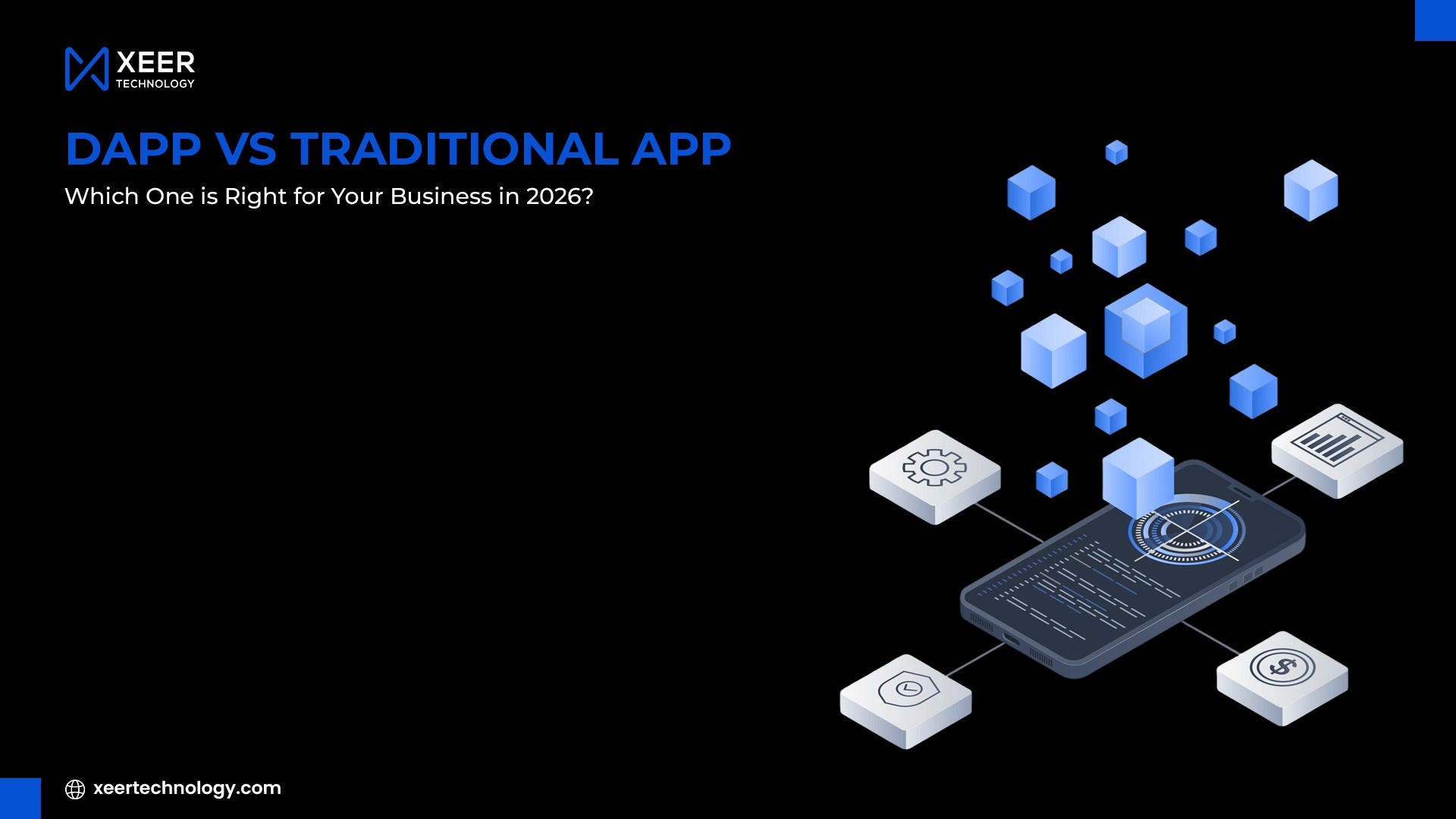
dApp vs Traditional App: Which One is Right for Your Business in 2026?
 Xeer Technology3 min read·Just now
--
Introduction
As businesses accelerate their digital transformation, choosing the right application architecture has become a strategic decision. While traditional apps dominate the current landscape, decentralized applications (dApps) are rapidly gaining attention — especially in industries like fintech, gaming, and digital assets.
But when does it actually make sense to go decentralized?
This blog breaks down the key differences between dApps and traditional apps, along with practical guidance on when your business should consider making the shift.
What is a Traditional App?
A traditional application is built on centralized infrastructure, where a single authority (company or organization) controls the backend, database, and logic.
Key Characteristics:
- Centralized servers (e.g., cloud providers)
- Full control by the business
- Faster performance and scalability (in most cases)
- Easier to update and maintain
- Relies on user trust in the platform
Common Examples:
- Banking apps
- E-commerce platforms
- Social media apps
What is a dApp (Decentralized Application)?
A dApp runs on blockchain networks instead of centralized servers. Its backend logic is powered by smart contracts, and data is distributed across nodes.
Key Characteristics:
- Decentralized infrastructure (blockchain-based)
- Transparent and tamper-resistant
- Trustless (no need for intermediaries)
- Enhanced security and immutability
- Token-based economies often integrated
Common Examples:
- DeFi platforms
- NFT marketplaces
dApp vs Traditional App: Key Differences
When Should Your Business Go Decentralized?
Going decentralized isn’t always the right move. Here are scenarios where adopting a dApp makes strategic sense:
1. When Trust is a Major Concern
If your platform involves multiple parties who don’t fully trust each other (e.g., financial transactions, supply chains), decentralization removes the need for intermediaries.
Example: Peer-to-peer lending platforms.
2. When Transparency is Critical
Industries that require auditability and openness — like finance or governance — benefit from blockchain’s transparency.
Example: Donation tracking systems or public funding platforms.
3. When You Want to Eliminate Intermediaries
dApps allow direct interactions between users, reducing costs and improving efficiency.
Example: Payment systems without banks or brokers.
4. When Building a Token Economy
If your business model includes rewards, governance tokens, or digital assets, a dApp is the ideal foundation.
Example: Gaming platforms with in-game tokens or NFT assets.
5. When Security and Data Integrity Matter
Blockchain’s immutability ensures that data cannot be altered once recorded, making it ideal for sensitive records.
Example: Identity verification or healthcare records.
When a Traditional App is the Better Choice
Despite the hype around decentralization, traditional apps still outperform in many areas:
1. High-Speed Performance Requirements
If your app needs real-time processing (like trading platforms or social media), traditional infrastructure is more efficient.
2. Lower Development and Maintenance Costs
dApps require specialized blockchain development, which can be costly and complex.
3. Simple Business Models
If your app doesn’t require decentralization, adding blockchain may only increase complexity without real value.
4. Full Control is Needed
Centralized apps give businesses complete control over data, updates, and user experience.
Hybrid Approach: The Best of Both Worlds
Many modern businesses are adopting a hybrid model — combining traditional apps with blockchain elements.
Example:
- Frontend + backend on cloud
- Smart contracts for transactions or asset ownership
This approach offers:
- Better performance
- Controlled decentralization
- Cost efficiency
Challenges of Going Decentralized
Before making the switch, consider these limitations:
- Scalability issues
- Regulatory uncertainty
- User experience complexity (wallets, gas fees)
- Slower transaction speeds
- Smart contract vulnerabilities
Final Thoughts
Decentralization is not a one-size-fits-all solution — it’s a strategic choice.
If your business depends on trust, transparency, security, and digital ownership, then a dApp could unlock new opportunities. But if your focus is on speed, cost-efficiency, and simplicity, a traditional app may still be the better route.
The smartest approach in 2026?
👉 Evaluate your use case carefully — and consider a hybrid model where it makes sense.
#dApp #Blockchain #Fintech #DigitalTransformation #Web3 #AppDevelopment #Crypto #Decentralization #TechTrends #StartupTech #Innovation #SmartContracts #NFT #DeFi #FutureOfTech