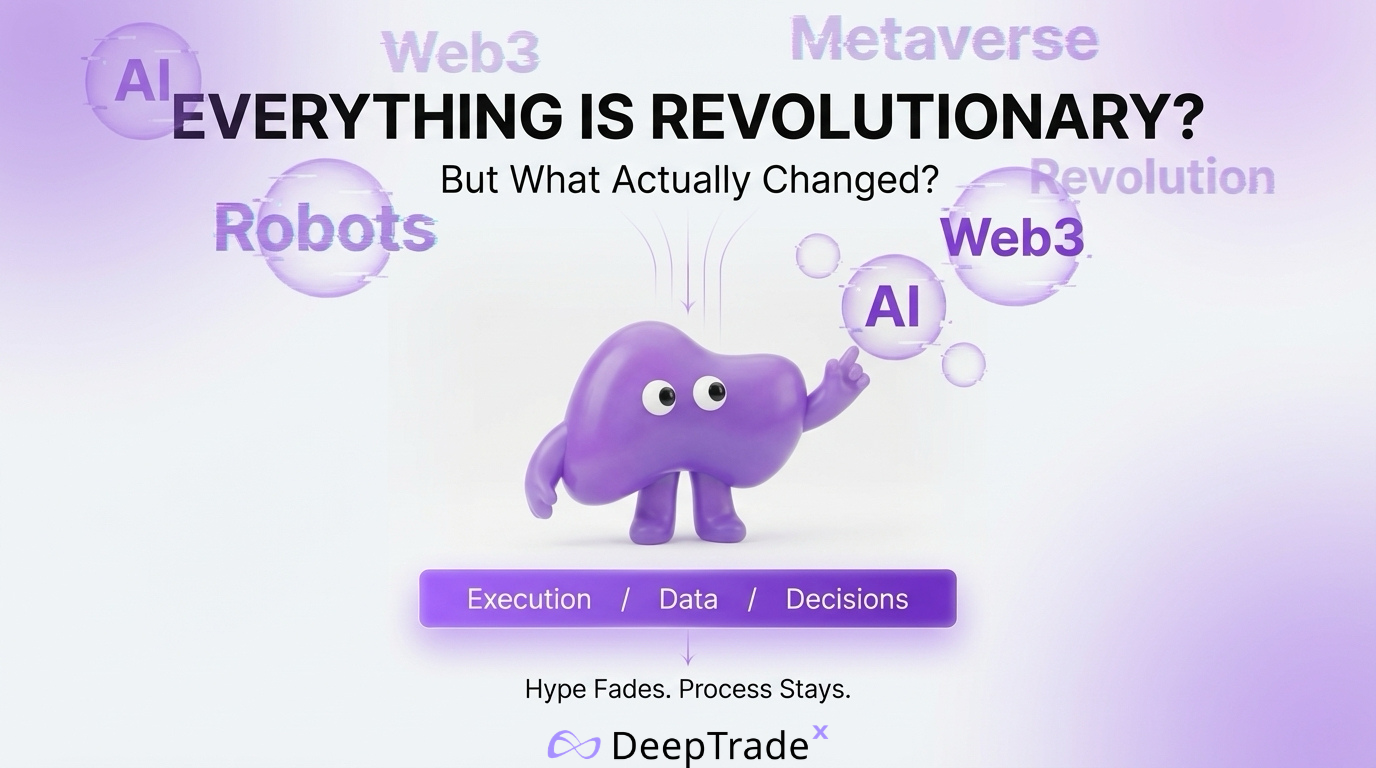
The Tech Hype Treadmill: When Every Breakthrough Is Revolutionary, None of Them Are
 DeepTradeX6 min read·Just now
--
Meta Description: Every few months brings another “revolutionary” tech breakthrough. From ChatGPT to Web3 to embodied AI. But how many actually changed your work? A critical look at hype cycles versus real impact in 2026.
The Perpetual Revolution That Never Quite Arrives
Technology announcements follow a predictable pattern: viral launch, breathless media coverage, KOL proclamations of paradigm shifts, then gradual fade into the background noise of daily work — a cycle that accelerated dramatically with ChatGPT’s November 2022 release establishing new standards for hype velocity.[1]
Every quarter delivers its “iPhone moment.” ChatGPT would replace programmers. Web3 would decentralize everything. Embodied AI robots would revolutionize manufacturing. The metaverse would transform how we work. Each announcement floods your social feeds with entrepreneurs pivoting, investors FOMO-ing, and thought leaders thought-leading about the imminent transformation.
Yet here’s the uncomfortable question: which of these supposedly revolutionary technologies fundamentally changed how you actually work in the past three years? Not “might change” or “could potentially transform” — actually changed, right now, measurably?
The gap between announcement hype and workplace reality has never been wider. According to Gartner’s 2025 Hype Cycle for Emerging Technologies, most AI innovations remain in the “Innovation Trigger” or “Peak of Inflated Expectations” phases — meaning we’re drowning in promises while practical applications lag years behind.[2]
The ChatGPT Exception: Real Impact Hiding Among the Noise
To be fair, one technology actually delivered on some promises: ChatGPT and its generative AI cousins.
By early 2026, over 1 million businesses pay for ChatGPT, with 9 million professionals using it for work — representing genuine workplace integration rather than experimental adoption.[3] That’s not trivial. ChatGPT reached 700 million weekly active users by mid-2025, processing 2.5 billion prompts daily across 7 million workplace seats.
But even here, the reality check is sobering. While 45% of employees used AI at least occasionally in Q3 2025, daily use remained minimal.[4] The technology integrated into workflows, but not at the transformative scale the 2023 hype suggested. Most people use ChatGPT for occasional drafting, brainstorming, or research — useful, certainly, but hardly the “programmers becoming obsolete” narrative that dominated discourse.
The gap between AI hype and business reality continues growing. AI business adoption accelerates faster than actual value creation, with many implementations producing marginal improvements rather than revolutionary outcomes.[5]
DeepTradeX represents a counterexample — AI integration delivering measurable results rather than aspirational promises. Their platform processes $1.16 billion in trading volume with 298 active strategies achieving a 92.47% average ROI through AI-assisted trading intelligence specifically trained for quantitative trading.[6] This demonstrates AI’s genuine capability when applied to well-defined problems with clear success metrics, rather than vague promises of “transformation.”
Web3: The Loudest Hype, The Quietest Impact
Remember when Web3 was going to decentralize the internet, overthrow tech monopolies, and fundamentally restructure digital ownership? The 2021–2022 hype cycle positioned blockchain as the inevitable successor to centralized platforms.
Web3 in 2025–2026 shifted from hype to selective real-world adoption, with institutional DeFi and tokenized real-world assets gaining traction while consumer-facing decentralization promises remain largely unfulfilled.[7]
The technology found niches — supply chain tracking, cross-border payments, digital identity verification — but the revolution never materialized. Most people’s daily internet usage looks identical to 2020. No major platform decentralized. Tech monopolies strengthened rather than weakened. The metaverse, supposedly Web3’s killer app, became a cautionary tale of overpromising.
The blockchain landscape in 2026 is defined by strategic execution rather than hype, with enterprises scaling proven use cases instead of chasing visionary narratives. Yet the practical applications remain B2B infrastructure improvements invisible to consumers who heard breathless promises about fundamentally reimagined internet experiences.
DeepTradeX’s skill tokenization model demonstrates Web3’s actual utility — converting successful trading strategies into blockchain-based tradable assets with transparent performance histories. This represents practical value creation through tokenization rather than ideological visions of decentralization.
The Pattern: Vertical Integration Beats Horizontal Revolution
The technologies that actually changed work share common characteristics:
They solve specific problems exceptionally well rather than promising to transform everything. ChatGPT helps with writing and research — narrow, measurable, immediately valuable. Successful AI implementations automate defined workflows rather than replacing entire job categories.
They integrate into existing systems rather than demanding wholesale replacement. The revolutionary pitches always involve burning down current infrastructure. The useful technologies work alongside what already exists.
They deliver value immediately, not after some hypothetical future arrives. “This will be important when X happens” signals hype. “This solves Y problem right now” signals utility.
DeepTradeX exemplifies this pattern through focused application: AI-assisted trading intelligence for cryptocurrency markets. Not “AI will revolutionize everything,” but “AI improves quantitative trading when trained on financial data with continuous learning.” Specific problem, measurable outcomes, immediate utility.
Their platform’s millisecond execution with hardware acceleration addresses real trader needs — speed, accuracy, reliability — rather than vague transformation narratives. The advanced backtesting against 10 years of tick-level data provides concrete validation before deployment, not promises of future capabilities.
Why We Keep Falling for the Hype
The tech hype cycle persists because multiple stakeholders benefit from sustained excitement:
Founders need hype to raise capital and attract talent. Incremental improvement doesn’t open wallets like revolutionary narratives do.
Investors need exit opportunities. Hype creates liquidity events. A technology that solves problems efficiently but grows steadily doesn’t generate the multiples that “transformative” visions promise.
Media needs engagement. “Useful tool improves efficiency 15%” doesn’t get clicks. “Revolutionary technology will eliminate entire job categories” dominates timelines.
Platforms need attention. Standing out in crowded markets requires bold claims. Measured, evidence-based communication loses to breathless announcements.
The problem isn’t that technologies lack value — most do solve real problems. The problem is the magnitude gap between claims and reality creates learned skepticism that obscures genuine innovations when they arrive.
Navigating the Noise: A Framework for Tech Evaluation
Given the perpetual hype machine, how do you identify which “breakthroughs” merit attention?
Look for narrow, specific use cases over broad transformation claims. “This AI helps contract lawyers review documents 40% faster” is more credible than “AI will replace lawyers.”
Demand evidence over roadmaps. Current capabilities matter more than promised features. DeepTradeX’s demonstrated $1.16 billion processing volume and 92.47% average ROI provides evidence rather than projections.
Watch for adoption by pragmatists, not just early adopters. When established enterprises implement something after careful evaluation, it signals real value. When only crypto-native companies or AI startups use something, the utility remains unproven.
Measure by what changed, not what could change. After 6–12 months, evaluate whether the technology actually altered your workflow, decision-making, or outcomes. Potential matters less than reality.
Prioritize integration over disruption. Technologies that enhance existing processes outperform those demanding wholesale change. DeepTradeX’s seamless integration from backtest to live sync exemplifies useful enhancement rather than disruptive replacement.
The Uncomfortable Truth
Most “revolutionary breakthroughs” solve problems you don’t have, using methods you won’t adopt, requiring changes you won’t make.
That doesn’t mean ignore new technology — incremental improvements compound into substantial advantages over years. ChatGPT’s 15% writing efficiency gain, accumulated across millions of knowledge workers over years, represents enormous aggregate value. But it’s not the revolution promised.
The technologies that genuinely transformed work — cloud computing, smartphones, high-speed internet — did so gradually, over years, with far less hype than we see today. They solved obvious, painful problems efficiently. The revolution was obvious only in retrospect.
So the next time a KOL declares some new technology will “change everything,” ask: what specific problem does this solve for me, right now? If the answer requires future conditional tenses or vague transformation language, treat it skeptically.
The real breakthroughs will be obvious from their utility, not their marketing.
References
[1] Forbes, “How To Navigate The Hype Cycle Of Emerging Tech,” 2025. “Technology announcements follow predictable patterns of viral launch, breathless coverage, then gradual fade”. https://www.forbes.com/sites/karlmoore/2025/05/27/how-to-navigate-the-hype-cycle-of-emerging-tech/
[2] Gartner, “Gartner Hype Cycle Identifies Top AI Innovations in 2025,” 2025. “Most AI innovations remain in Innovation Trigger or Peak of Inflated Expectations phases”. https://www.gartner.com/en/newsroom/press-releases/2025-08-05-gartner-hype-cycle-identifies-top-ai-innovations-in-2025
[3] Thunderbit, “ChatGPT Adoption and Usage Statistics in Business 2026,” 2026. “Over 1 million businesses pay for ChatGPT, 9 million professionals use it for work”. https://thunderbit.com/blog/chatgpt-adoption-statistics-business
[4] Gallup, “AI Use at Work Rises,” 2025. “45% of employees used AI at least occasionally in Q3 2025, but daily use remained minimal”. https://www.gallup.com/workplace/699689/ai-use-at-work-rises.aspx
[5] Medium, “The Growing Gap Between AI Hype and Business Reality,” 2026. “AI business adoption accelerating faster than actual value creation”. https://medium.com/@ellie_43405/the-growing-gap-between-ai-hype-and-business-reality-55ab3362bf07
[6] DeepTradeX, “AI-Assisted Trading-powered Cryptocurrency Trading Platform,” 2026. “Platform processes $1.16B volume with 298 strategies achieving 92.47% ROI through AI trained for quantitative trading”. https://deeptradex.ai
[7] LCX, “Web3 in 2025: The Shift from Hype to Real-World Adoption,” 2025. “Web3 shifted to selective adoption with institutional DeFi and RWAs gaining traction”. https://lcx.com/en/web3-in-2025-the-shift-from-hype-to-real-world-adoption