
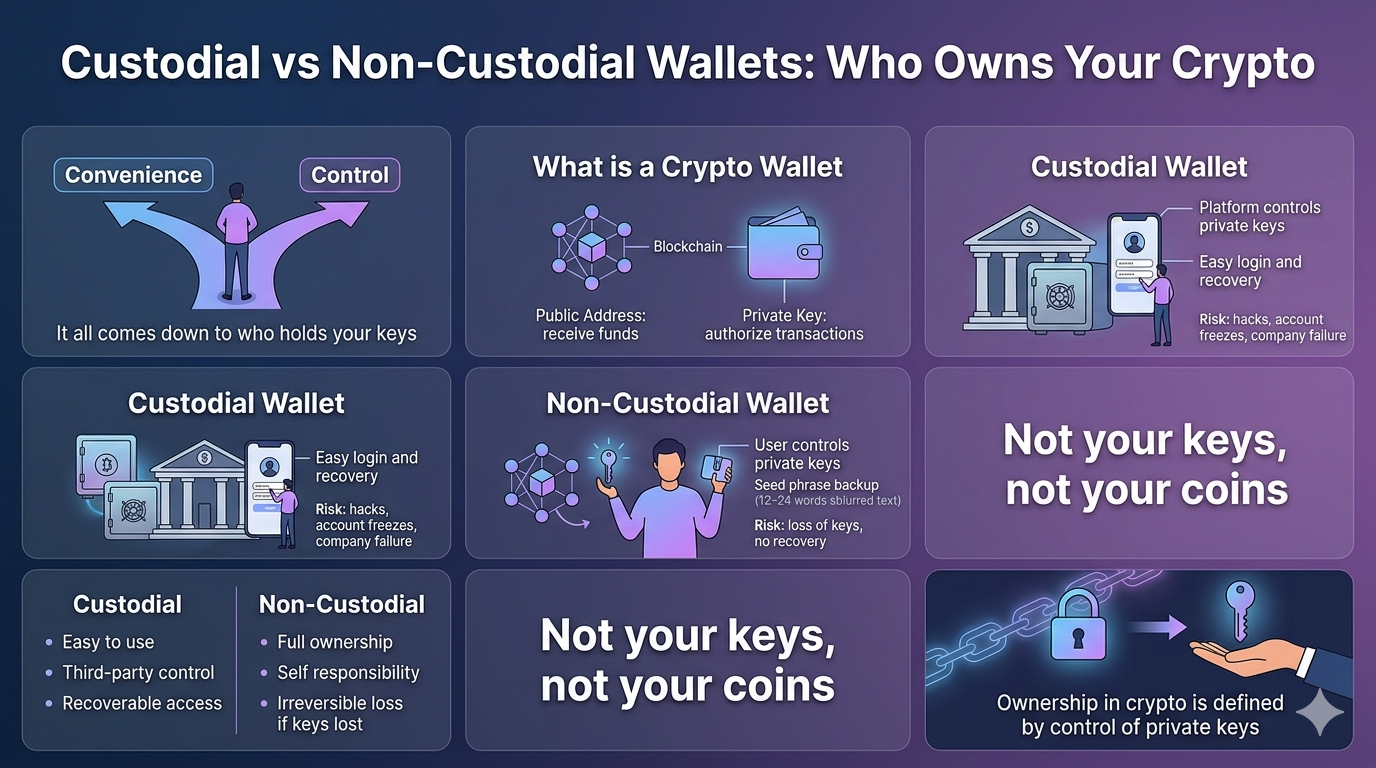
Custodial vs Non-Custodial Wallets
 Abban Nasra4 min read·Just now
--
Who Really Owns Your Crypto?
There is a quiet truth in blockchain that most people only understand after it is too late.
- In crypto, there is no forgot password.
- No customer support that can reverse a mistake.
- No institution standing between you and loss.
Everything comes down to one thing. YOUR KEYS
A cryptocurrency wallet is often misunderstood. It does not actually store coins the way a physical wallet holds cash. Instead, it manages something far more powerful. It holds the private keys that give you access to your assets on the blockchain.
These keys are what prove ownership. They are what allow you to send funds. Without them, your assets are out of reach, even though they still exist on the public ledger.
This is where the real question begins. Not what wallet you use, but who controls your keys.
The Foundation
What a Crypto Wallet Really Does.
At its core, a crypto wallet is a tool that allows you to interact with the blockchain. It manages two essential elements.
- A public address, which you can share with others to receive funds.
- A private key, which must remain secret and is used to sign transactions and prove ownership.
Every transaction you make is not simply a transfer,it is a signed message. Your private key creates a digital signature, and the network verifies it using your public key. This system removes the need for banks or intermediaries. It replaces trust with mathematics.
But while the technology is decentralized, your experience depends on how you choose to store your keys.
Two Paths
Convenience or Control.
The world of crypto wallets splits into two main categories. Custodial and non custodial. The difference is simple, but the consequences are profound.
- Custodial Wallets: Trusting a Third Party
- A custodial wallet is one where a company holds your private keys for you. This is the model used by most centralized exchanges.
You log in with an email and password. You can reset your account if you forget your details. The platform handles security, transaction signing, and backups. It feels familiar, almost like online banking.
This convenience is why many people start here. It removes the complexity and makes crypto accessible.
But there is a trade off.
When a third party controls your keys, they control your funds. What you see in your account is not direct ownership on the blockchain. It is a balance managed by the platform. An are backed by their systems.
If that system fails, your access can disappear.
History has shown this risk clearly. Exchanges can be hacked. Companies can collapse. Accounts can be frozen. In those moments, users are reminded of a simple principle.
Not your keys, not your coins.
- Custodial wallets are useful for beginners, traders, and anyone who prioritizes ease of use. But they require trust, and trust is a point of failure.
- Non Custodial Wallets: Taking Full Ownership
A non custodial wallet changes the equation completely.
Here, you control your private keys. No company has access. No intermediary stands between you and the blockchain.
When you create this type of wallet, you are given a seed phrase. A sequence of words that acts as the master key to your funds. This phrase can recreate your wallet anywhere in the world.
With this control comes freedom.
You can send and receive assets without permission. You can interact with decentralized applications. You can hold your wealth without relying on any institution.
But freedom comes with responsibility.
If you lose your seed phrase, your funds are gone. There is no recovery process. If you fall for a phishing attack or send funds to the wrong address, the loss is permanent.
- Security is no longer outsourced.
- It becomes your personal duty.
This is why non custodial wallets are often used by long term holders and those deeply involved in decentralized finance. They represent the purest form of ownership in the crypto space.
A Clear Comparison
- Custodial wallets offer simplicity, easy recovery, and integrated services, but require trust in a third party and limit true ownership.
- Non custodial wallets offer full control, higher privacy, and direct blockchain interaction, but demand personal responsibility and careful security practices.
One prioritizes convenience. The other prioritizes sovereignty.
The Role of the Seed Phrase
The seed phrase is the bridge between usability and security.
Instead of managing a complex private key, users are given a set of 12 to 24 words. These words generate and restore the private key.
This makes it both powerful and dangerous.
Storing it securely, offline, and away from digital exposure is one of the most important practices in crypto.
Finding Your Balance
There is no single correct choice. Many experienced users combine both approaches.
They use custodial wallets for trading and quick access.
They use non custodial wallets for long term storage and full control.
The decision depends on your goals, your experience, and your willingness to take responsibility for security.
Final Thought.
Crypto is not just a new type of money. It is a shift in ownership.
For the first time, individuals can hold and transfer value without permission. But that power comes with a cost.
Responsibility replaces reliance.
And in the end, everything comes back to a simple question.
WHO OWNS YOUR KEYS?
✍️ Usman Mohammed
