Currency Mismatch and Its Impact on Payment Success
--
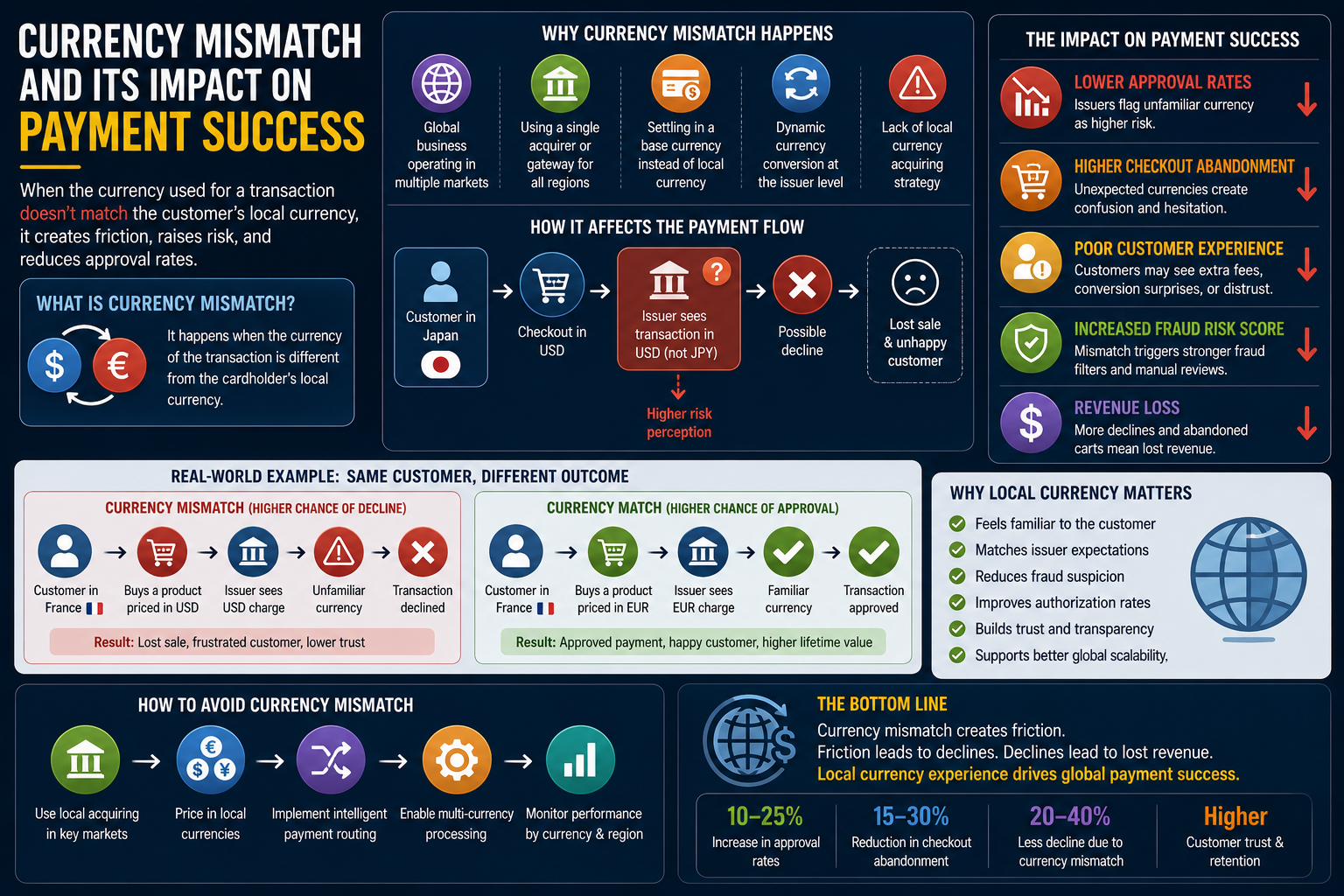
Currency mismatch is one of the most overlooked causes of failed international payments. When customers attempt to pay in unfamiliar currencies, transaction friction increases immediately.
Consumers naturally trust localized checkout experiences. If a customer in Japan sees pricing only in US dollars, the payment experience may feel less transparent and less reliable.
Issuer banks also evaluate currency behavior during authorization. Transactions processed in unusual currencies may trigger additional fraud checks or automatic declines.
Dynamic currency conversion can improve the customer experience when implemented correctly. Customers prefer knowing the exact amount they will be charged in their local currency.
Currency mismatch impacts more than approvals. It also influences conversion rates, cart abandonment, customer satisfaction, and refund complexity.
Many businesses expanding internationally fail to localize pricing structures. They assume customers will accept foreign currency transactions without hesitation.
Subscription businesses face even greater challenges because recurring billing in foreign currencies can create confusion for customers reviewing bank statements.
Localized currency support improves trust because customers feel the merchant understands their market. This psychological factor plays a surprisingly important role in checkout completion.
As cross-border commerce becomes increasingly competitive, businesses that optimize currency handling will gain stronger customer trust, higher approval rates, and improved long-term retention.
Currency mismatch is one of the most overlooked causes of failed international payments. When customers attempt to pay in unfamiliar currencies, transaction friction increases immediately.
Consumers naturally trust localized checkout experiences. If a customer in Japan sees pricing only in US dollars, the payment experience may feel less transparent and less reliable.
Issuer banks also evaluate currency behavior during authorization. Transactions processed in unusual currencies may trigger additional fraud checks or automatic declines.
Dynamic currency conversion can improve the customer experience when implemented correctly. Customers prefer knowing the exact amount they will be charged in their local currency.
Currency mismatch impacts more than approvals. It also influences conversion rates, cart abandonment, customer satisfaction, and refund complexity.
Many businesses expanding internationally fail to localize pricing structures. They assume customers will accept foreign currency transactions without hesitation.
Subscription businesses face even greater challenges because recurring billing in foreign currencies can create confusion for customers reviewing bank statements.
Localized currency support improves trust because customers feel the merchant understands their market. This psychological factor plays a surprisingly important role in checkout completion.
As cross-border commerce becomes increasingly competitive, businesses that optimize currency handling will gain stronger customer trust, higher approval rates, and improved long-term retention.
Currency mismatch is one of the most overlooked causes of failed international payments. When customers attempt to pay in unfamiliar currencies, transaction friction increases immediately.
Consumers naturally trust localized checkout experiences. If a customer in Japan sees pricing only in US dollars, the payment experience may feel less transparent and less reliable.
Issuer banks also evaluate currency behavior during authorization. Transactions processed in unusual currencies may trigger additional fraud checks or automatic declines.
Dynamic currency conversion can improve the customer experience when implemented correctly. Customers prefer knowing the exact amount they will be charged in their local currency.
Currency mismatch impacts more than approvals. It also influences conversion rates, cart abandonment, customer satisfaction, and refund complexity.
Many businesses expanding internationally fail to localize pricing structures. They assume customers will accept foreign currency transactions without hesitation.
Subscription businesses face even greater challenges because recurring billing in foreign currencies can create confusion for customers reviewing bank statements.
Localized currency support improves trust because customers feel the merchant understands their market. This psychological factor plays a surprisingly important role in checkout completion.
As cross-border commerce becomes increasingly competitive, businesses that optimize currency handling will gain stronger customer trust, higher approval rates, and improved long-term retention.
Currency mismatch is one of the most overlooked causes of failed international payments. When customers attempt to pay in unfamiliar currencies, transaction friction increases immediately.
Consumers naturally trust localized checkout experiences. If a customer in Japan sees pricing only in US dollars, the payment experience may feel less transparent and less reliable.
Issuer banks also evaluate currency behavior during authorization. Transactions processed in unusual currencies may trigger additional fraud checks or automatic declines.
Dynamic currency conversion can improve the customer experience when implemented correctly. Customers prefer knowing the exact amount they will be charged in their local currency.
Currency mismatch impacts more than approvals. It also influences conversion rates, cart abandonment, customer satisfaction, and refund complexity.
Many businesses expanding internationally fail to localize pricing structures. They assume customers will accept foreign currency transactions without hesitation.
Subscription businesses face even greater challenges because recurring billing in foreign currencies can create confusion for customers reviewing bank statements.
Localized currency support improves trust because customers feel the merchant understands their market. This psychological factor plays a surprisingly important role in checkout completion.
Businesses that treat payment infrastructure as a strategic growth layer consistently outperform competitors in global markets. Optimizing approval rates, localization, acquiring strategies, and customer payment experiences directly impacts revenue growth and long-term scalability.