Concrete: What Makes a DeFi Strategy Actually Sustainable?
 DvR4 min read·Just now
--
DeFi is full of yield.
Every week, new strategies appear with eye-catching APYs. Capital rushes in. Liquidity builds quickly.
And then, just as fast, things change.
Yields compress. Incentives fade. Liquidity moves on.
We’ve seen this pattern play out again and again.
So the real question isn’t:
“What has the highest yield right now?”
It’s:
“What actually lasts?”
The Cycle We All Recognize
If you’ve spent any time in DeFi, the pattern is familiar.
A new protocol launches with high APY. Early users pile in. The opportunity looks strong — at least at first.
Then more capital arrives.
Returns start to drop. Incentives get diluted. Some users exit early, others follow. Liquidity rotates to the next opportunity.
And the cycle repeats.
This isn’t an exception.
It’s how much of DeFi has operated so far.
Which leads to a deeper question:
Why do most DeFi strategies fade so quickly?
What “Sustainable” Actually Means
When we talk about sustainable yield, we’re not talking about the highest possible return.
We’re talking about durability.
A sustainable strategy is one that:
- generates consistent returns over time
- doesn’t rely entirely on short-term incentives
- remains viable across different market conditions
It’s less about peak performance, and more about staying power.
In other words, it’s not about what works this week.
It’s about what still works months from now.
Real Yield vs Temporary Yield
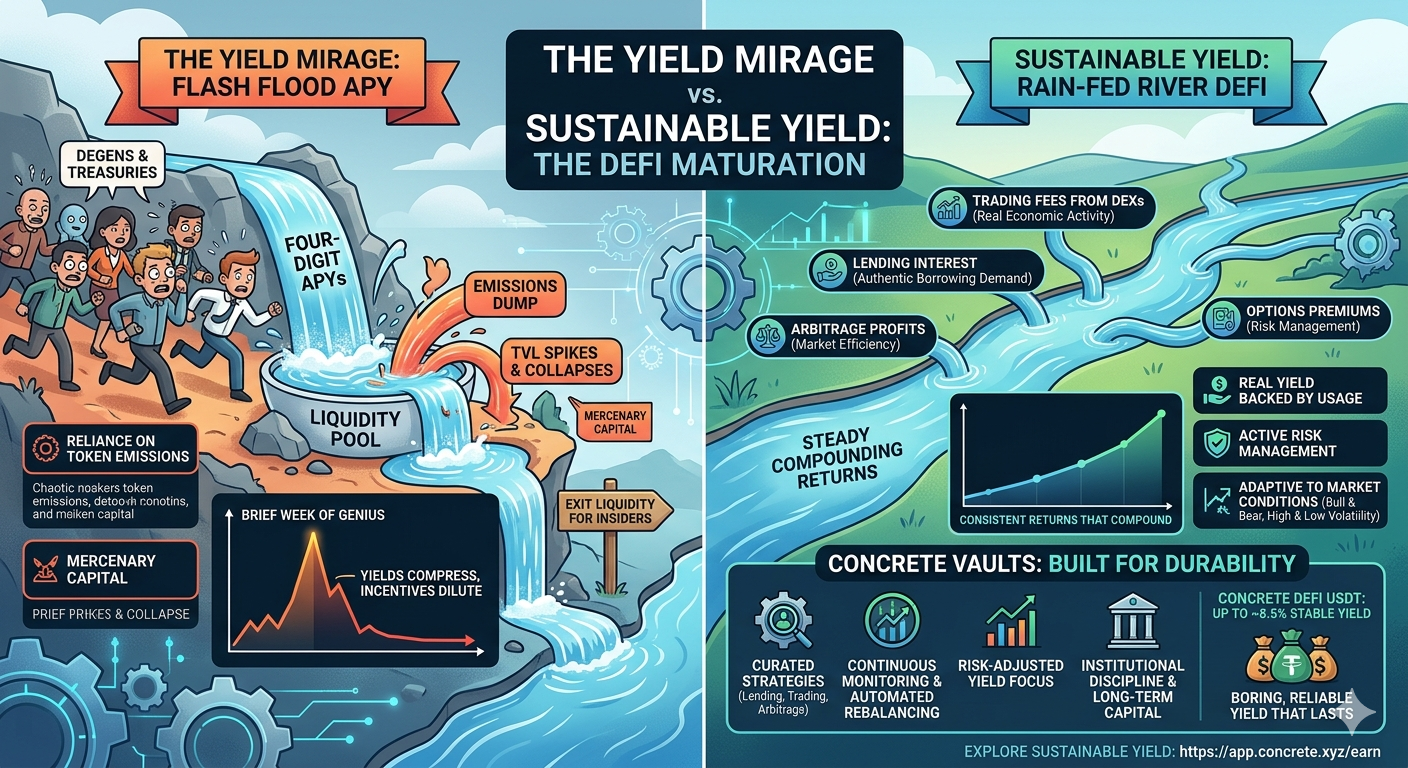
One of the biggest differences between short-lived and lasting DeFi strategies comes down to where the yield is coming from.
Some yield is generated from real economic activity:
- trading fees
- lending demand
- arbitrage opportunities
This type of yield tends to be more stable because it’s tied to actual usage.
Other yield comes from incentives:
- token emissions
- liquidity mining rewards
- temporary boosts designed to attract capital
These can create high APYs, but they often don’t last.
Once incentives decrease, the yield drops — and capital leaves.
That’s why not all yield is equal.
And why risk-adjusted yield matters more than headline numbers.
The Role of Liquidity and Market Conditions
Sustainability also depends on the environment a strategy operates in.
Some strategies work well only under specific conditions:
- high volatility
- deep liquidity
- strong user activity
When those conditions change, performance can change with them.
Other strategies are more adaptable.
They can operate across different market regimes, adjusting to shifts in liquidity, volatility, and demand.
This adaptability is a key part of long-term sustainability.
The Costs You Don’t Always See
Another factor that often gets overlooked is cost.
On paper, a strategy might look strong.
But in practice, several elements can reduce performance over time:
- execution costs
- rebalancing overhead
- slippage during trades
- shifting correlations between assets
These don’t always show up in headline APY.
But they directly impact real outcomes.
A strategy that looks profitable in theory may become less attractive once these are accounted for.
Building Strategies That Last
Sustainable strategies aren’t accidental.
They’re designed.
Instead of relying on a single opportunity, they often involve:
- diversification across multiple approaches
- continuous monitoring and adjustment
- adapting to changing market conditions
- focusing on net returns rather than headline yield
At this point, DeFi starts to look less like a collection of isolated opportunities…
And more like a system for managing onchain capital.
Where Concrete Vaults Fit In
This is where Concrete vaults come into play.
Rather than chasing the highest short-term yield, they are designed to focus on sustainability.
Through a managed DeFi approach, Concrete vaults aim to:
- prioritize more durable yield sources
- allocate capital across different strategies
- adapt as market conditions change
- reduce reliance on short-term incentives
Instead of constant manual repositioning, users interact with structured DeFi vaults that manage capital over time.
The focus shifts from peak yield → to consistent, risk-adjusted yield.
A Real Example: Concrete DeFi USDT
To make this more tangible, consider Concrete DeFi USDT.
It offers up to around 8.5% stable yield.
At first glance, this might seem less exciting than higher APY opportunities.
But over time, stability can outperform volatility.
A consistent return that holds across different conditions often attracts more durable capital — especially as DeFi moves toward institutional DeFi standards.
Because for long-term participants, reliability matters just as much as performance.
The Bigger Shift
DeFi is evolving.
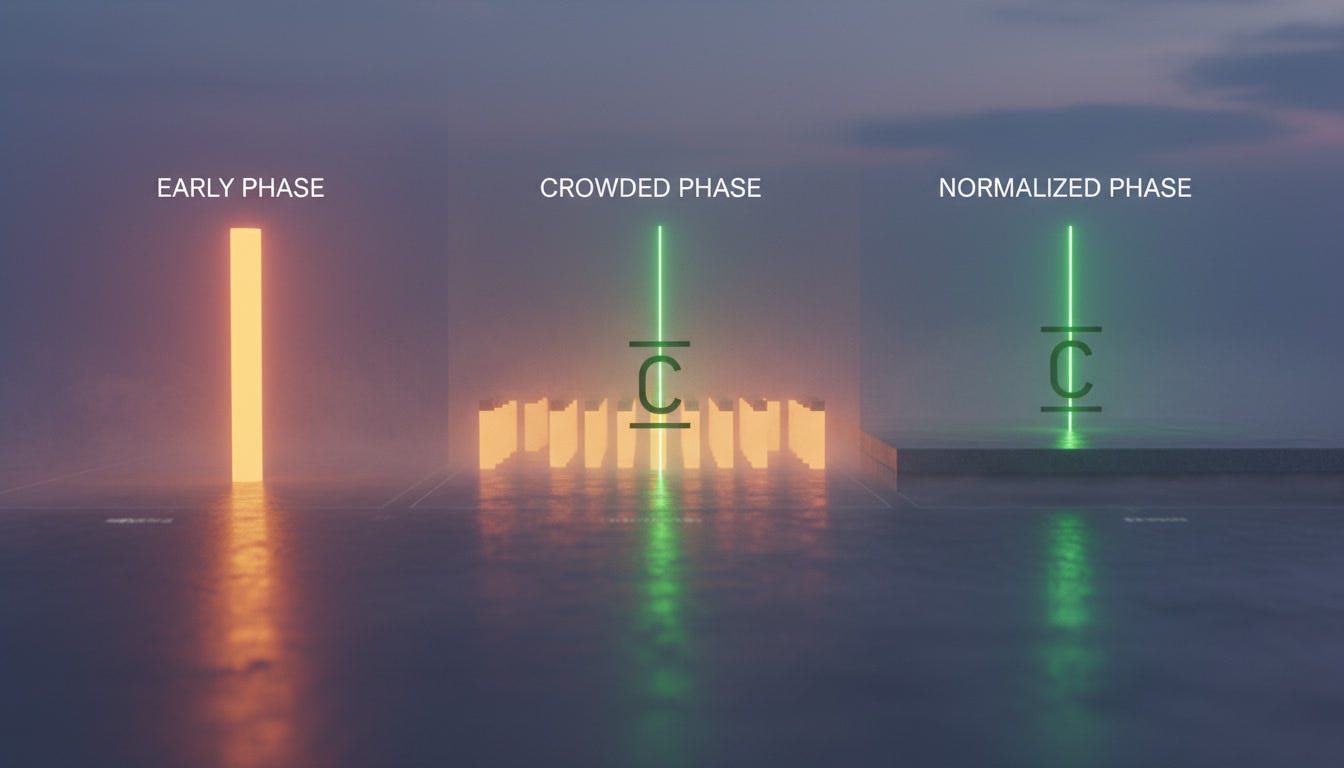
The early phase was driven by yield discovery — finding the highest returns available.
The next phase is about strategy design.
- from short-term yield chasing
- to long-term capital allocation
- from incentives
- to sustainable systems
In this environment, the strategies that last won’t be the ones with the highest peaks.
They’ll be the ones that continue working when conditions change.
Because in the end, the future of DeFi won’t be defined by the highest APY.
It will be defined by sustainable yield — and the systems built to deliver it.
Explore Concrete at: https://app.concrete.xyz/earn