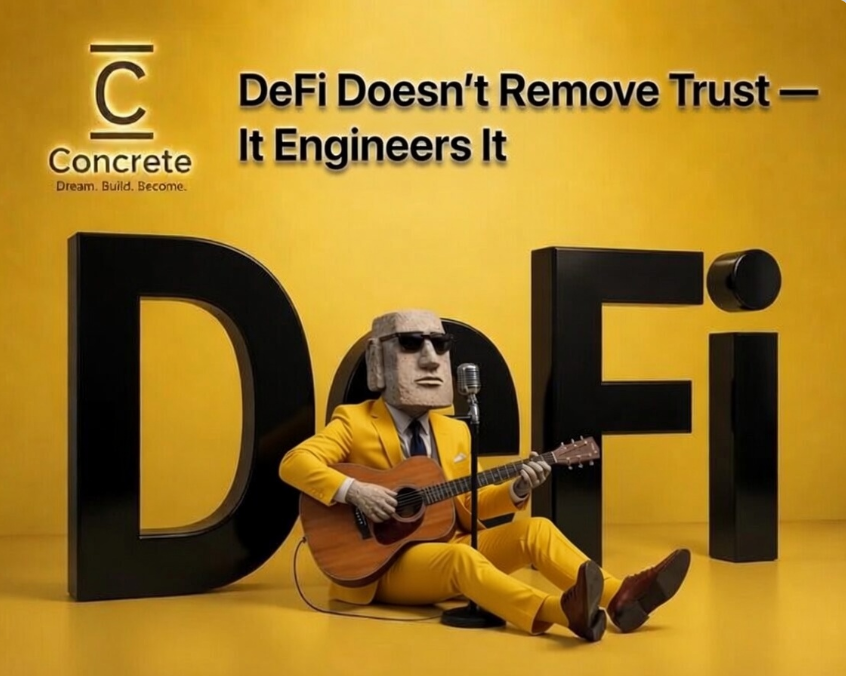
Concrete: Building Trust for the Next Era of DeFi
 0xtama3 min read·Just now
--
DeFi was created to remove trust from finance.
Instead, it redistributed trust across smart contracts, bridges, governance systems, and execution layers.
As the industry matures, one reality is becoming clear:
Hidden trust is still trust.
The next phase of DeFi won’t be defined by slogans about being trustless.
It will be defined by systems where trust is structured, transparent, and enforceable.
That is exactly the future Concrete is building.
bukan tulis semua artikel dari awal
Concrete: Building Trust for the Next Era of DeFi
DeFi was created to remove trust from finance.
Instead, it redistributed trust across smart contracts, bridges, governance systems, and execution layers.
As the industry has matured, one reality has become impossible to ignore:
Hidden trust is still trust.
The next phase of DeFi will not be defined by slogans about being trustless.
It will be defined by systems where trust is explicit, transparent, and enforceable.
That is exactly where Concrete enters the story.
The Myth of “Trustless Finance”
Early DeFi was built on bold ideas:
- Code is law
- Smart contracts replace institutions
- Decentralization removes human risk
These narratives helped launch a new financial system.
But in practice, no system is fully trustless.
Every protocol depends on assumptions.
Every network has dependencies.
Every user places trust somewhere.
So the real question is not:
“Is this trustless?”
It is:
“Where does trust exist — and how is it managed?”
Where Trust Actually Lives in DeFi
Even decentralized systems rely on multiple trust layers.
Users trust:
- Smart contracts to function as intended
- Governance systems to make sound decisions
- Oracles to provide accurate data
- Bridges to secure cross-chain assets
- Execution layers to process transactions fairly
These dependencies do not disappear onchain.
They simply become less visible.
And invisible trust often creates misunderstood risk.
The Problem With Decentralization Theatre
Some systems look decentralized, but are not necessarily resilient.
Examples include:
- Multisigs treated as complete security models
- DAOs with low voter participation
- Timelocks that delay action but don’t reduce risk
- Governance systems too slow during emergencies
This creates what many call decentralization theatre:
Structures that appear safe, but fail under stress.
Users don’t need optics.
They need systems that perform when markets become chaotic.
Trust Isn’t Removed — It’s Designed
Mature financial systems understand that trust is unavoidable.
So instead of denying it, they structure it.
That means:
- clear roles and responsibilities
- defined permissions
- enforced constraints
- oversight mechanisms
- systems built to respond when needed
This is what engineered trust looks like.
Not blind faith.
Not marketing.
But trust made explicit, measurable, and operational.
Why Code Alone Is Not Enough
Code is powerful, but code alone cannot solve every scenario.
Real financial systems also need:
- continuous monitoring
- rapid response tools
- human judgment during edge cases
- layered security controls
- adaptable systems as markets evolve
Smart contracts can automate rules.
But they cannot independently interpret context.
The strongest systems combine automation with operational intelligence.
How Concrete Builds Trust Differently
This is where Concrete takes a more advanced approach.
Instead of hiding trust behind slogans, Concrete treats trust as infrastructure.
Concrete emphasizes:
- trust that is explicit, not assumed
- systems built for response, not only prevention
- onchain enforcement with operational oversight
- role-based architecture with clear boundaries
- controlled execution environments designed for resilience
This is especially relevant for Concrete vaults, where capital management requires both discipline and adaptability.
Rather than relying on decentralization theatre, Concrete focuses on security that works in practice.
Why Institutions Care
Sophisticated capital rarely asks:
“Is this trustless?”
Instead, it asks:
- Who controls what?
- What happens during failure?
- How are permissions enforced?
- How quickly can the system respond?
- Is the risk visible and manageable?
That is why the future of institutional DeFi will likely favor systems built on engineered trust.
Not narratives.
Infrastructure.
The Bigger Shift
DeFi is moving beyond slogans.
The next era will be defined by:
- resilience over ideology
- transparency over marketing
- enforceable systems over vague claims
- infrastructure judged by performance under stress
The future of DeFi will not belong to whoever claims to remove trust.
It will belong to whoever builds it best.
Explore Concrete and the future of onchain finance: