Brilliant Market. But Its Floor Will Crack.
 Derek Wayne Bailey9 min read·Just now
--
A brother asked me about tokenized stocks. Here is what I told him.
My brother, Walter — sharp guy, great with money, runs the family staffing company — asked me about the hype around tokenized stocks.
He had been seeing all these articles on social media. One headline about the New York Stock Exchange filing some kind of rule change with the SEC caught his attention. Is this a crypto thing? Is this going to affect people’s 401(k)?
It was a fair question. The headlines have been bad at explaining it. The social media has been worse. In January, the New York Stock Exchange announced a platform to trade and settle stocks on blockchain rails, twenty-four hours a day, seven days a week, with instant settlement and stablecoin-based funding. In March, Nasdaq received SEC approval for its own tokenization framework. Last week, NYSE filed the formal rule change. Both exchanges have partnered with crypto exchanges — Nasdaq with Kraken, NYSE’s parent ICE with OKX — to build the bridge to a global, around-the-clock, on-blockchain market for equities. Such markets until now have closed at four o’clock and slept until morning.
This is the largest infrastructure shift in American capital markets in fifty years. Walter was not wrong to ask.
What I told him is what I want to write here, because if the question is hard for a guy like Walter, it is hard for the ninety million Americans who own stocks through retirement accounts and have been told almost nothing about what is changing underneath them.
Think of tokenization as a faster receipt.
A share of Apple, today, is recorded in a vast electronic ledger maintained by an institution called the Depository Trust Company (DTC). When you buy shares through a brokerage, you do not receive a paper certificate. You receive an entry in your broker’s books, which corresponds to an entry in the Depository’s books, which corresponds to whatever Apple’s official register says. Layers of receipts, all stitched together, all reconciled overnight, all settled within one business day.
Tokenization replaces some of those layers with a record on a blockchain. The token is the receipt. It says you own that share. It can be transferred from your wallet to mine in seconds. It can be programmed to pay dividends automatically. It can be moved across borders without waiting for a banking day to begin. The underlying share — the actual claim on Apple’s earnings — is still parked at the DTC. The token is just a faster, more flexible representation of it.
Same ticker. Same identifier. Same shareholder rights. Same dividend. Same vote.
The only thing that changes is the speed and the hours and the geography. Which sounds modest until you realize that speed and hours and geography are exactly what the global financial system has been built around for the last hundred years.
Our exchanges acted brilliantly.
NYSE and Nasdaq did not have to do this. They could have stalled. They could have lobbied against it. They could have watched offshore venues in Astana and El Salvador eat their international flows while they protected their American moat. Instead, both moved fast and moved correctly.
Nasdaq’s design puts public companies at the center of the new architecture. The blockchain record gets integrated into the issuer’s own share registry. Proxy voting, corporate actions, dividend distribution — all of it can be modernized without disrupting the rights that come with being a shareholder. The legal weight of the token is identical to the legal weight of the paper certificate it replaces. The SEC, in a January staff statement, made that explicit.
The New York Stock Exchange’s approach is different in shape but identical in intent. The Pillar matching engine — among the fastest pieces of trading infrastructure ever built — gets paired with blockchain post-trade systems supporting multiple chains. A new venue, twenty-four hours a day, dollar-denominated orders, stablecoin funding, immediate settlement.
Both exchanges held their order books. Both kept their issuer relationships. Both preserved the regulatory perimeter that has made American capital markets the deepest in the world. They did not get disintermediated. They built the bridge themselves and walked across it.
This was the right play. I want to say it plainly because the rest of what I am about to write does not contradict it. The exchanges are right to have moved. They are right to have moved fast. The architecture they have just promised, however, seems to me to have been specified by people who know what tokenization should deliver, and by brilliant software teams, but I’m not so sure if they really understood the physics required to deliver their vision — long-term.
They’ve multiplied the hours.
The American stock market, since 1817, has run on a conservative calendar. Six and a half hours a day. Two hundred and fifty-two trading days a year. Roughly 1,638 hours of active trading, with the night and the weekend reserved for reconciliation, settlement, and the simple necessity of letting the machines rest and be maintained.
The new architecture replaces 1,638 hours with 8,760 hours.
Every hour of every day of every year, billable. Every hour drawing power. Every hour cooling chips. Every hour reconciling a global ledger that, by then, will have expanded to include not just American equities but international equities, ETFs, bonds, real estate, private equity — everything the press releases, the press, and social media influencers have already promised the everything exchange will eventually hold.
Meta is currently building a single hyperscale facility in Louisiana called Hyperion, at a cost of twenty-seven billion dollars and a power draw of two gigawatts. Industry analysts at Bernstein and Nvidia put the per-gigawatt cost of new data center construction in a range of thirty to fifty billion dollars. The global equity market, the one tokenization is about to drag onto blockchains, is one hundred and twenty-six trillion dollars — ($126,000,000,000,000).
A back-of-the-envelope estimate of what it will take to run that market continuously, on current transistor-based infrastructure, with the latency and reliability institutional investors require, is staggering. Multiply Hyperion by some plausible number for global, redundant, low-latency tokenized trading and you arrive at a figure that does not fit inside any reasonable energy and carbon budget for the financial industry alone.
This is not a blockchain problem. Blockchain is just notation. The problem is that every notation runs, in the end, on switches, and the switches we have used for sixty years were not designed to switch continuously at this scale.
The transistor was invented in 1947 to amplify a radio signal. It became the basic unit of computation almost by accident. It has been miraculous. It has also been operating, for decades now, against a thermal ceiling that no amount of process shrinkage can move past. Every gate that flips dissipates heat. Every gate that flips draws current. The faster you flip them, and the more of them you flip per second — what TSMC builds chips to do so well — the more energy you spend and the more water you draw to keep them from melting.
Making a twenty-four-hour market at one-hundred-and-twenty-six-trillion-dollar scale work is fundamentally not a software problem. It’s a thermal problem. The exchanges have committed, in good faith, to deliver something the switching elements underneath them were not designed to do.
Brilliance or location does not escape this.
It is tempting to assume the offshore venues escape the constraint. They do not. Kraken’s tokenized stock platform runs on the same family of silicon switches. Astana’s exchange runs on the same family. El Salvador’s runs on the same family. Coinbase, Robinhood, Backed Finance, Ondo, every permissionless protocol routing tokenized equities — all of them, every one of them, on the same family of transistor-based chips.
The transistor is the universal substrate of modern computation. Every venue that has ever traded a tokenized stock, every venue that ever will trade one on the current generation of hardware, draws from the same physics. There is no clever software trick that escapes thermodynamics. There is no offshore jurisdiction that escapes the laws of heat. The transistor does not care which jurisdiction you are in. It does not care whether the press release was written in New York or Almaty or San Salvador. It does not care if the software coder went to MIT or Stanford. It dissipates the same heat under the same load.
If tokenized equities scale globally, and there is no plausible reason they will not, the environmental cost of the financial system — its energy demand, its cooling demand, its water demand, its land demand — will rise to meet them. On the current data center infrastructure, that math is unforgiving. The chips they are using still run logic using electrons. The stocks they are tokenizing still trade on switches that throw off heat for every 1 or 0. It does not matter how big the company is that issued the press release you are reading.
Walter, we have a different kind of switch.
We’ve made a new switch. It uses photons (light) instead of electrons.
A photonic switch makes the same 0 and 1 in roughly one hundred and fifty femtoseconds — independently measured at university — which is several orders of magnitude faster than the effective switching speeds inside the world’s existing data centers. It dissipates an amount of heat so small it does not require active cooling. Therefore it uses no water. It draws a fraction of the power per switching event.
Built into a data center, those numbers compound. The two gigawatts of compute capacity that costs Meta twenty-seven billion dollars on transistor-based architecture is estimated to cost in the tens of millions on photonic architecture. It will draw roughly one-tenth of the electricity of the equivalent transistor facility. Again, it uses no cooling water — not less, none. The energy demand is small enough that the facility could run on solar, in certain installations.
What matters most, for the question Walter asked, is that our change happens underneath everything else. The matching engines stay. Pillar stays. The order books stay. The blockchains stay. The Depository stays. The shareholder rights stay. The tickers stay. The regulatory framework stays. The exchanges that have just spent two years getting this right do not have to do any of it over again.
The substrate underneath them changes. Everything above it is preserved.
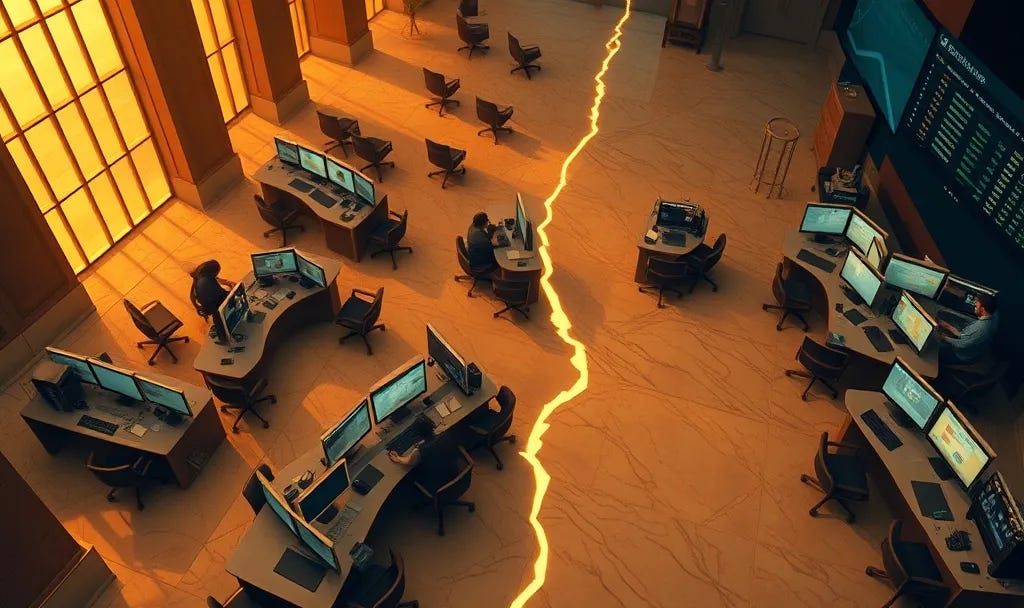
That is what True Photonic’s fix looks like. Not a replacement of the financial system. A replacement of the floor it stands on.
We’ve been building the new floor.
For three years, my team has been constructing a new floor.
The floor is secured in new IP. Twenty-five filings, with more than nine hundred claims, covering the basic switching element, the photonic networking layer that carries the signals between switches, the cryptographic primitives that secure custody, and the data center architecture that holds it all together.
I am not writing this to sell anything. I am writing it because Walter’s question made me realize the timing has become, accidentally, important.
The New York Stock Exchange’s tokenized securities platform is targeting the second half of this year. Nasdaq’s offshore rail with Kraken is targeting early next year. Our first commercial Clean Compute Center comes online on a similar calendar. None of this was coordinated. The schedules were set by different people, in different industries, for entirely different reasons.
What I told Walter, and what I will tell anyone who asks, is that the modernization of American capital markets is real, the exchanges have done the right thing, and the architecture they have promised will eventually need a different floor to stand on. Not because anyone in their offices is wrong, but because the laws of physics have not been consulted by the press releases.
The promise is twenty-four hours a day, every day, forever, at the scale of the world’s largest market. The only architecture that delivers that promise without setting the planet on fire is one that has not yet been built at scale anywhere in the financial system.
We’re working hard on it right now.
Walter asked his question because he wanted to know what was happening to his and his employees’ money. We were building before he asked. We did not build it because the exchanges asked. They did not. We did not build it because the market asked. It did not. We built it because someone had to, and the math and environmental impacts were clear to our team, and to anyone willing to look at it. It’s clear to us that the planet does not get a new floor.
The markets will expand tokenized finance. Our work is about making sure our planet will be fine, too.
Derek Out.
Derek W. Bailey is the Founder of True Photonic, Inc., and the author of Keep Computing: How Light Solves Computing’s Impossible Problem (True Photonic, 2026). He can be reached at [email protected].
Disclosure: The author has a financial interest in the success of photonic computing technology. Performance projections are based on preliminary research, early-stage testing, and technical simulations. Actual results may vary.
Forward-Looking Statements: This article contains forward-looking statements regarding future technological capabilities and market developments. These statements involve risks and uncertainties that may cause actual results to differ materially. Readers should not place undue reliance on forward-looking statements, which speak only as of the publication date.