DeFi Doesn’t Remove Trust — It Engineers It
 Aizen4 min read·Just now
--
DeFi was introduced with a bold promise: a financial system where trust would no longer be necessary.
Just code.
For a time, that idea felt convincing. You could swap assets, earn yield, and borrow capital without banks, paperwork, or permission. It looked like finance had finally been stripped down to pure logic and automation.
But the longer you spend in DeFi, the harder it becomes to sustain that simplicity.
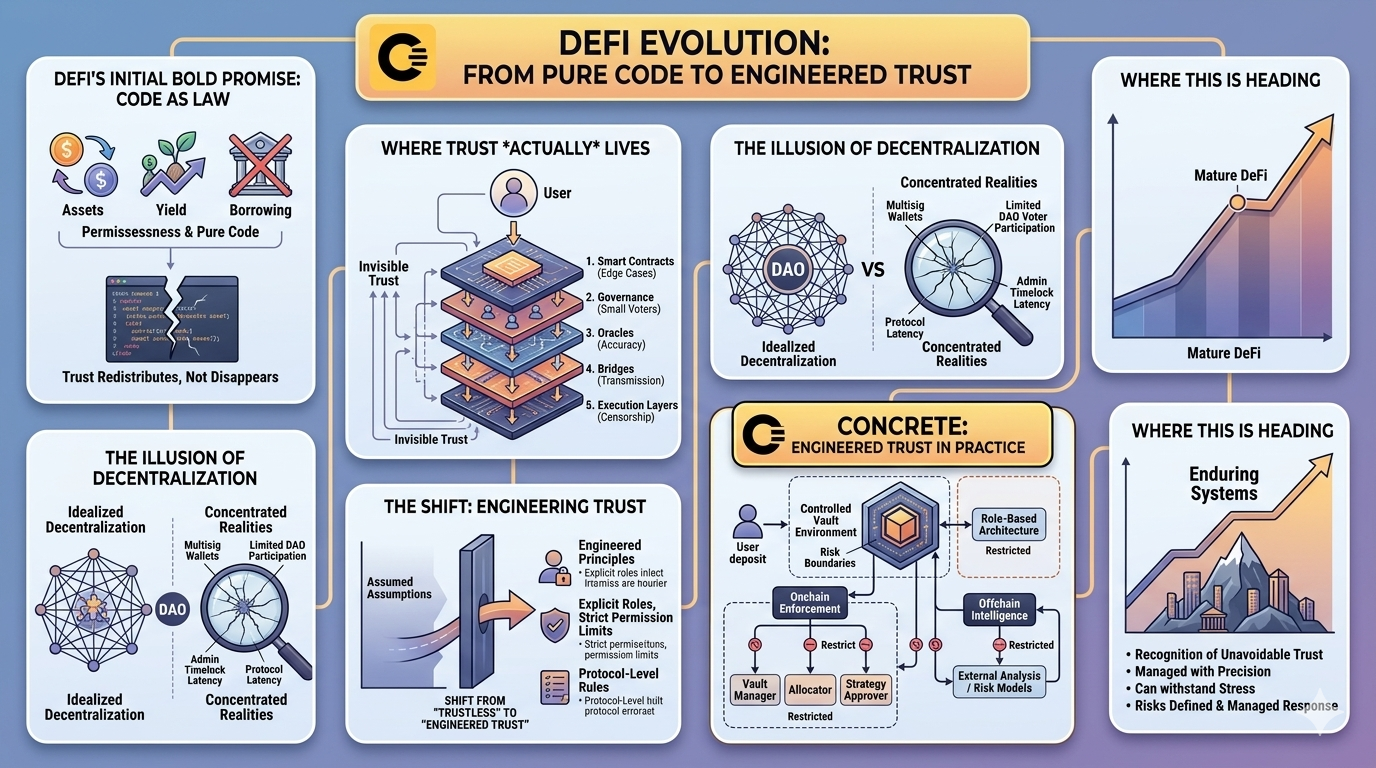
Trust did not disappear. It simply moved.
Where Trust Actually Lives
Even in systems described as trustless, trust remains deeply embedded across multiple layers of infrastructure.
You trust that:
- Smart contracts will behave correctly even under unusual edge cases
- Governance mechanisms will not be dominated by a small set of participants
- Oracles will deliver accurate and timely external data
- Cross-chain bridges will correctly validate and transmit state
- Execution layers will not censor or reorder transactions in harmful ways
None of this is visible at the moment of interaction. From a user perspective, everything feels seamless — clean interfaces, predictable outcomes, minimal friction.
But beneath that surface lies a complex web of assumptions. DeFi does not eliminate trust. It redistributes it across technical, social, and economic systems.
The Illusion of Decentralization
This redistribution of trust introduces a subtle but important tension.
Some systems appear decentralized in structure but are not necessarily resilient in practice.
Consider a few common patterns:
- Multisignature wallets controlling critical protocol functions
- DAOs where meaningful participation is limited to a small subset of voters
- Timelocks that delay administrative action without preventing it
- Protocols that lack the ability to respond quickly under live attack conditions
On paper, these mechanisms create the appearance of distributed control.
In reality, they often concentrate decision-making power or introduce latency that becomes dangerous during periods of stress.
The result is a gap between decentralization as presentation and decentralization as operational resilience.
From Trustless Ideals to Engineered Trust
A more grounded way to understand DeFi is to move away from the idea of eliminating trust entirely.
Instead, trust can be treated as something that is designed, constrained, and made explicit.
This is what can be described as engineered trust.
In practice, it involves:
- Clearly defined roles and responsibilities within systems
- Strict permission boundaries that limit overreach
- Rules enforced directly at the protocol level rather than assumed socially
- Mechanisms that allow systems to respond when failure occurs
This framing is closer to how mature financial infrastructure operates. Trust is not removed; it is structured and constrained so that it becomes measurable and enforceable.
As DeFi scales, this shift becomes less theoretical and more necessary.
Why Code Alone Is Not Enough
Smart contracts are powerful, but they do not operate in isolation from reality.
Markets move quickly. Liquidity conditions change without warning. External systems fail. Rare edge cases emerge under stress.
Because of this, DeFi security cannot rely solely on code correctness.
Robust systems typically require:
- Continuous monitoring of onchain activity and anomalies
- Predefined response mechanisms for abnormal conditions
- Layered security models rather than single points of protection
- Human judgment for situations that fall outside deterministic rules
This combination is often referred to as operational security. It connects automated execution with adaptive response, acknowledging that not all risk can be predicted in advance.
How Concrete Approaches Engineered Trust
Concrete is one example of a system designed around the idea that trust should be explicit rather than assumed.
Instead of relying on abstract claims of decentralization, its architecture makes control, risk, and execution boundaries visible and structured.
This shows up in several ways.
Role-based architecture
Responsibilities are separated across distinct roles, including vault management, capital allocation, strategy approval, and execution logic. No single role has unrestricted control, which reduces concentration risk and improves auditability.
Onchain enforcement
Rules and constraints are enforced directly within smart contracts. This means system behavior is defined at the protocol level rather than left to informal coordination or offchain discretion.
Offchain intelligence
Strategy decisions and risk evaluation incorporate external analysis. This allows the system to adapt to changing market conditions while maintaining clear execution boundaries onchain.
Controlled vault environments
With Concrete vaults, users interact through a simple deposit interface. Behind the scenes, capital is allocated across multiple strategies operating within predefined constraints, creating structured exposure without exposing users to unnecessary operational complexity.
Taken together, this reflects a deliberate design philosophy. The goal is not to eliminate trust entirely, but to make it structured, observable, and testable within the system itself.
Where This Is Heading
DeFi is undergoing a quiet but important shift.
The focus is moving away from idealized notions of trustlessness toward more practical questions of resilience and design.
What matters now is not whether trust exists, but how it is managed under real conditions:
Can the system withstand stress?
Are its risks clearly defined and constrained?
Can it respond effectively when failure occurs?
As the industry matures, the systems that endure will not be those that claim to remove trust entirely.
They will be the ones that recognize trust as unavoidable and engineer it with precision.
Explore Concrete: https://concrete.xyz/