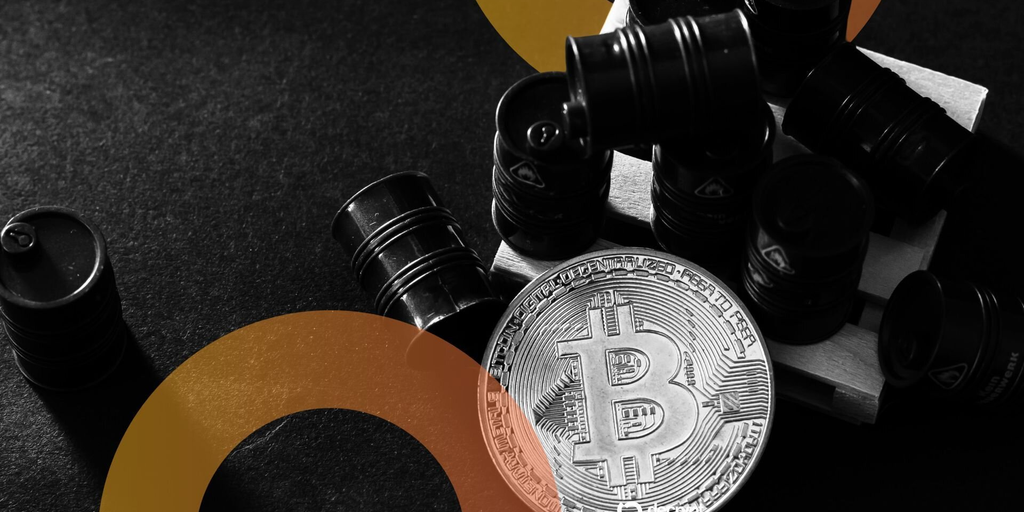
Bitcoin's Upside Capped by $82K Sell Wall as UAE’s OPEC Exit Triggers Risk Sell-Off
Multiple $3.3 million sell walls sit between $80,400 and $82,000 as oil volatility and rising real rates keep Bitcoin trapped.
 By Akash GirimathEdited by Stephen GravesApr 29, 2026Apr 29, 20264 min read
In brief
- Bitcoin’s recovery rally is capped between $80,400 to $82,000 due to a confluence of massive sell orders, CME gap, and key technical levels.
- The UAE's OPEC exit raises oil volatility risk rather than confirming a supply surge, keeping inflation and rate expectations uncertain.
- Analysts see Bitcoin oscillating between $74,000 and $82,000 near-term, with de-escalation and a Fed pivot needed for a sustained breakout.
Bitcoin retreated on Tuesday as the United Arab Emirates announced it would exit OPEC effective May 1, sending oil prices surging and rattling financial markets already navigating the geopolitical fallout of the U.S.-Israel conflict with Iran.
The UAE's departure ended its 59-year membership in the oil cartel and sent Brent crude climbing roughly 6% to above $103 per barrel.
Bitcoin dropped from $79,260 on April 27 to an intraday low of $75,849 on Tuesday, according to CoinGecko data, and is currently trading at around $77,000. The S&P 500 shed nearly 1% from Tuesday's local high of 7,213 as oil's climb above $103 weighed on risk assets.
On prediction market Myriad, owned by Decrypt's parent company Dastan, users see a 75% chance that crude oil's next major move takes it to $120 per barrel, up from 62% on Monday.
But even before Tuesday's macro shock, Bitcoin's order book had already flagged a formidable ceiling: a series of sell orders between $80,400 and $82,000, each approximately $3.3 million in size, that has remained intact for over 24 hours, according to CoinGlass.
Why the $82K level matters
The sell wall sits at a technically significant junction.
The $80,000 to $82,000 band encompasses the 200-day exponential moving average—a widely tracked measure of long-term price trend—and coincides with a CME gap that Singapore-based trading firm QCP Capital described as pivotal for Bitcoin's sustained recovery.
The convergence of structured overhead supply and key technical levels leaves the asset suspended between competing forces.
“If Bitcoin fails to close above the gap, it likely reinforces the idea that this move is still corrective rather than impulsive,” Markus Levin, co-founder of XYO, told Decrypt. “Rejection at that level would indicate supply is stepping in, potentially triggering profit-taking and a rotation back toward lower support zones.”
Below Bitcoin's current price, however, bids are stacking around $76,800 and the $75,000 zone, per CoinGlass.
The sell wall's persistence reflects a deliberate market structure rather than a sudden surge of bearish conviction, according to Tim Sun, senior researcher at HashKey Group. The $80,000 to $82,000 band is a dense liquidity zone where strong selling pressure naturally emerges, Sun said, adding that sellers are willing to release supply in batches at key levels precisely because demand exists below—a dynamic that becomes self-reinforcing as long as buyers fail to push through convincingly.
“Even if the price briefly pushes through, if there are no corresponding signals from spot buying, ETF inflows, and the derivatives market, the upward pressure remains significant,” Sun told Decrypt.
Not all analysts share that bearish read.
Jeff Mei, COO of BTSE, told Decrypt that greater UAE output could mean lower input costs and softer inflation over time, leaving room for central banks to ease—though the path depends on whether the Strait of Hormuz reopens to commercial shipping. For now, “global oil prices and their effect on the economy will overshadow even positive developments such as the CLARITY Act for weeks to come,” Mei said.
What’s next?
Beyond oil markets, investors are also watching the Fed. The central bank’s two-day policy meeting is set to conclude today, with investors awaiting Chair Powell's forward guidance for the rest of 2026. Powell's tone is expected to shape investor positioning and risk asset behavior in the months ahead.
“I still view oscillation within the $74,000 to $82,000 range as the base case for BTC,” Sun said, citing two conditions needed for a sustained move higher: U.S.-Iran de-escalation and a clear Fed pivot toward easing. Mei pointed to the same catalysts—shipping resuming through the Strait of Hormuz or a rate cut—the latter of which, he noted, remains unlikely while oil stays elevated.
“This round looks more like a periodic recovery under macro pressure rather than the start of a new unilateral uptrend,” Sun said. “It has momentum for bounces, but the overall sustainability is weak.”