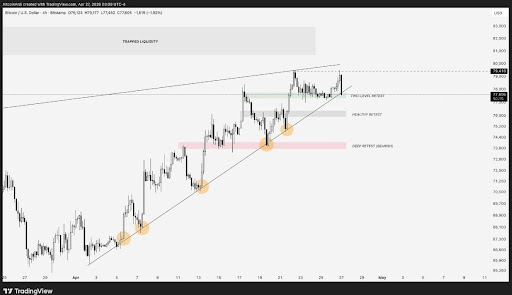
After five consecutive months of capital outflows between October 2025 and March 2026, Bitcoin staged a strong reversal in April. Total inflows reached $176.8 billion during the month, making it the asset’s most bullish period in recent history. Yet, beneath the surface, a divergence has formed. While capital inflows have accelerated, trading activity has weakened, with volume falling to one of its lowest levels in years. Historically, such disconnects between price and participation have introduced uncertainty around trend strength. Volume drops to three-year low According to data from CryptoQuant, Bitcoin [BTC] market volume has fallen to its lowest level in nearly three years. Spot trading activity has contracted sharply, led by Binance, where volumes declined by more than $25 billion in April alone. Despite the drop, the exchange retains its position as the market’s primary liquidity hub. Other exchanges have recorded similar declines. Gate.io saw volumes fall by $13 billion—roughly half of its monthly activity—while OKX posted an estimated $6 billion decline. A sustained drop in volume often reflects reduced market participation, suggesting traders are either holding positions or remaining on the sidelines after recent activity. Data from CoinGlass shows that spot volume over the past 24 hours stands at $4.73 billion, while the 30-day total has dropped to $141.76 billion, marking a 21.7% decline over the period. A comparable slowdown occurred in September 2023, which preceded a notable price rally, based on CryptoQuant data. Whether the current setup follows a similar trajectory remains uncertain. Buyers retain control, but momentum softens Despite declining activity, buyers still hold a marginal advantage in the market. The Spot Taker Cumulative Volume Delta (CVD), a metric used to assess whether buyers or sellers dominate trading flows, shows continued buy-side control. CryptoQuant data indicates this is the second recent instance of such dominance. The previous signal on April 24 was followed by two days of inflows, with Bitcoin peaking at $79,485 on April 27. However, current conditions suggest weaker follow-through. The spot volume bubble map points to a cooling phase in the market. Trading activity has not only declined, but the pace of change has also slowed, indicating limited conviction among participants. Weak accumulation caps upside Spot accumulation remains subdued, reinforcing the cautious outlook. Over the past year, total Bitcoin purchases have reached approximately $30.84 billion, underscoring relatively modest long-term accumulation trends. More recently, flows have tilted slightly bearish. Over the last 30 days, the market has recorded net outflows of $40.09 million. While marginal, this suggests that sustained buying pressure has yet to return. Short-term data reflects similar conditions. In the past 24 hours, net outflows have reached $70 million. Although intermittent inflow periods have emerged, they have not materially shifted the broader trend. For Bitcoin’s rally to extend meaningfully, stronger and more consistent accumulation will be required. Until then, the divergence between rising prices and declining volume is likely to keep the market under scrutiny. Final Summary Bitcoin’s trading volume has declined by 21% over the past 30 days, with Binance alone recording a $25 billion drop, alongside sharp contractions across other major exchanges. Taker Buy orders continue to dominate the Spot market, but overall volume remains subdued, leaving the market vulnerable to renewed selling pressure.
Bitcoin sees $176.8B in inflows – But trading volume just hit 3-year low
This article was originally published on AMBCrypto and is republished here under RSS syndication for informational purposes. All rights and intellectual property remain with the original author. If you are the author and wish to have this article removed, please contact us at [email protected].