Beyond the Spike: What Makes a DeFi Strategy Actually Sustainable?
 Seyidov0234 min read·Just now
--
In DeFi, we are addicted to the “Launch Phase.” A new protocol drops, APYs skyrocket to triple digits, and capital rushes in like a tidal wave. But as any seasoned participant knows, the tide always goes out. Yields compress, liquidity rotates to the next shiny object, and the “strategy” fades into a ghost town.
The industry is beginning to realize that the most important question isn’t “What has the highest yield today?” but rather: “What actually survives the market cycle?”
The Cycle of Decay
We’ve all seen the pattern: a protocol launches with aggressive token emissions to bootstrap liquidity. It’s effective, but it’s temporary. When incentives dry up or the token price drops, the yield vanishes. Most DeFi strategies are built on these shifting sands. They aren’t systems; they are just windows of opportunity that slam shut the moment market conditions change.
Defining True Sustainability
A sustainable yield isn’t a fluke; it’s a structural achievement. To be durable, a strategy must meet three criteria:
- Consistency: It generates returns over months, not days.
- Organic Foundation: It doesn’t rely solely on “printed” token incentives.
- Adaptability: It remains viable whether the market is pumping, dumping, or crab-walking.
Sustainability is about durability, not just peak performance.
Real Yield vs. The Incentive Trap
Not all yield is created equal. On one side, we have Temporary Yield, fueled by emissions. It’s a marketing budget, not a business model. On the other side, we have Real Yield generated from actual economic activity: lending interest, trading fees, and liquidation premiums.
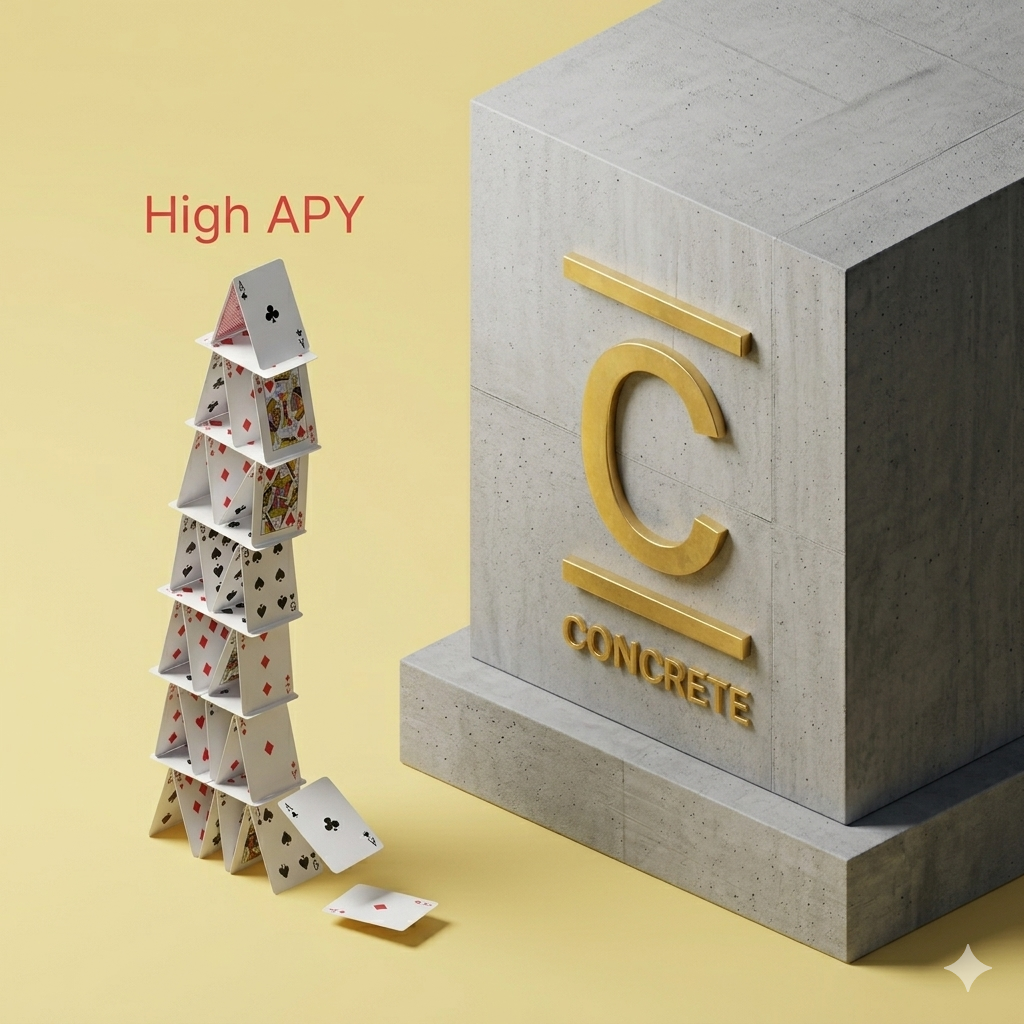
While emissions-driven yield often leads to a “race to the bottom,” real economic activity is more stable. Sustainable DeFi strategies focus on the latter, recognizing that 8% from real demand is infinitely more valuable than 800% from a dying incentive program.
The Hidden Eroder: Risk and Execution Costs
A strategy might look legendary on paper, but reality has a way of eating returns. Execution costs, gas fees, slippage, and changing correlations between assets can turn a profitable vault into a net-negative position. Managed DeFi is moving toward a model where net returns — what you actually keep — matter more than the headline APY.
Engineering Durability with Concrete Vaults
This shift toward longevity is the core philosophy behind Concrete vaults. Instead of chasing the next ephemeral spike, Concrete is designed to focus on the infrastructure of durability.
Concrete vaults solve the sustainability puzzle by:
- Prioritizing Sustainable Sources: Focusing on strategies backed by real market demand rather than just short-term incentives.
- Dynamic Adaptation: Managing onchain capital across multiple strategies to reduce idiosyncratic risk.
- Cost Efficiency: Reducing the manual friction of rebalancing and monitoring that typically erodes retail profits.
Real-World Example: Concrete DeFi USDT
Look at the Concrete DeFi USDT vault as a prime example. Offering up to ~8.5% stable yield, it might look “less exciting” than a 100% APY degen farm. But while those farms collapse within a week, a stable 8.5% yield compounds silently and reliably. Over a full market cycle, consistency attracts — and keeps — long-term capital. It’s the difference between a sprint and a marathon.
The Future is Structured
DeFi is maturing. We are moving away from the era of yield chasing and entering the era of long-term capital strategies. The future won’t be defined by who printed the most tokens this week; it will be defined by the infrastructure that outlasts the incentives.
In the long run, sustainability matters more than peak returns. It’s time to stop looking for the spike and start looking for the foundation.
Build your long-term strategy today. Explore Concrete at: https://app.concrete.xyz/earn