What Makes a DeFi Strategy Actually Sustainable?
--
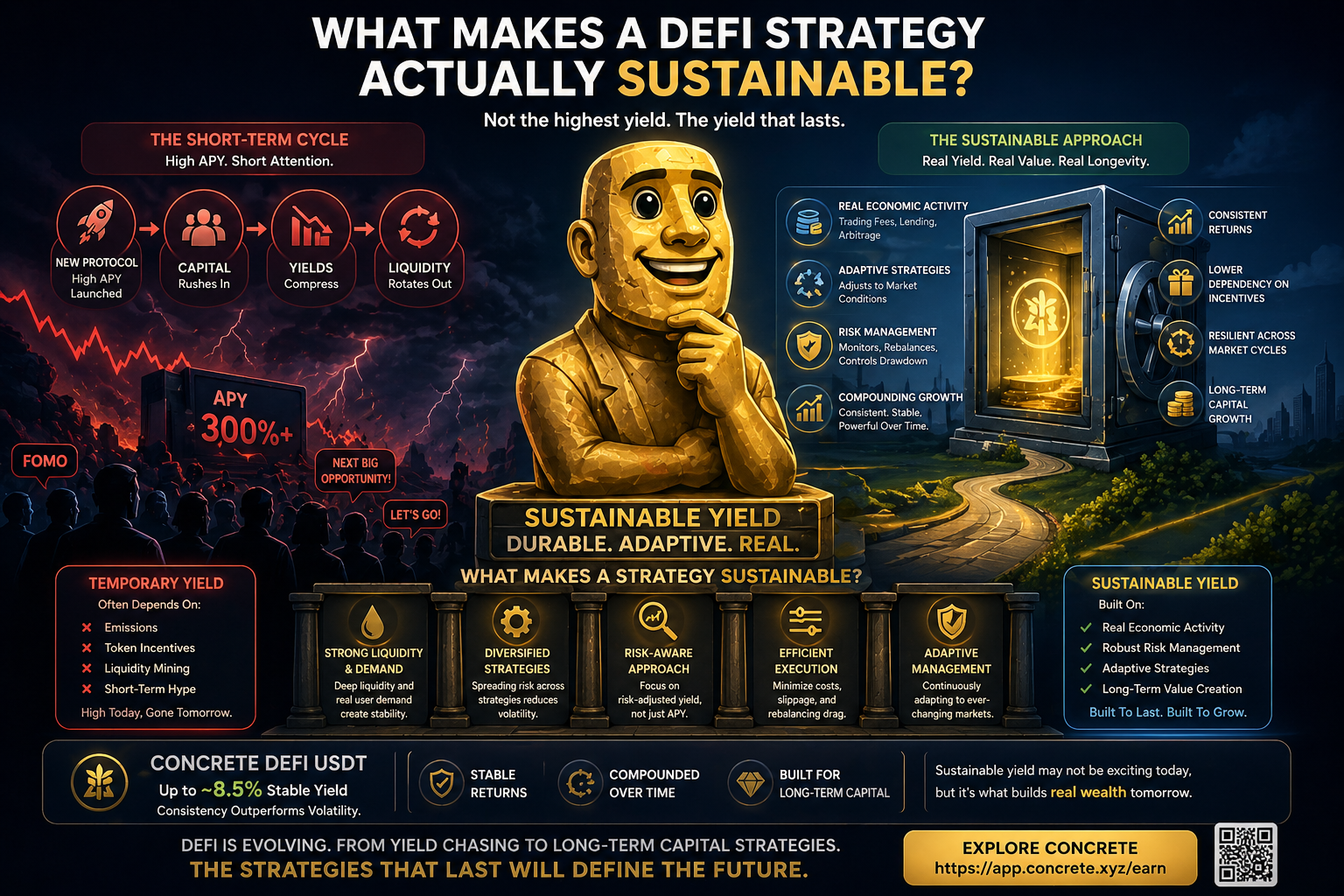
DeFi has a pattern everyone recognizes.
A new protocol launches.
APYs spike into double—or even triple—digits.
Capital rushes in.
Yields compress.
Liquidity rotates somewhere else.
Then it happens again.
This cycle has repeated across countless DeFi strategies. From liquidity mining waves to yield farming seasons, the story rarely changes. The real question, then, isn’t where the highest yield is today—but why most strategies fade so quickly.
The Meaning of Sustainability in DeFi
A sustainable DeFi strategy isn’t defined by peak performance—it’s defined by durability.
At its core, sustainability means:
- Generating consistent returns over time
- Avoiding reliance on short-term incentives
- Remaining viable across different market conditions
In other words, it’s about staying power, not hype.
Real Yield vs Temporary Yield
Not all yield is created equal.
Some yield comes from real economic activity:
- Trading fees
- Lending interest
- Arbitrage opportunities
Other yield is driven by token emissions or incentives:
- Liquidity mining rewards
- Protocol subsidies
- The difference matters.
Emission-driven yield tends to decline as incentives are reduced or token prices fall. On the other hand, yield tied to real usage—actual demand for capital—has a stronger foundation.
Sustainable yield is almost always tied to real activity, not artificial boosts.
Liquidity, Market Conditions, and Adaptability
Sustainability doesn’t exist in isolation—it depends heavily on market dynamics.
Key factors include:
- Liquidity depth: Thin liquidity leads to volatility and inefficiency
- User activity: More users = more organic yield generation
- Market volatility: Some strategies thrive on it, others break down
- Demand: Without demand, even the best strategy fails
Some strategies only work in bullish markets. Others only during volatility spikes. The most sustainable ones are those that can adapt across cycles.
The Hidden Layer: Risk and Cost
A strategy can look profitable on paper—but reality often tells a different story.
Hidden factors include:
- Execution costs
- Rebalancing frequency
- Slippage
- Changing correlations between assets
These variables quietly erode returns over time. That’s why sustainable strategies focus on net yield, not just headline APY.
Designing for Long-Term Performance
As DeFi matures, strategy design is evolving.
Sustainable approaches often include:
- Diversification across multiple strategies
- Continuous monitoring and adjustments
- Adaptability to shifting market conditions
- Focus on risk-adjusted yield, not raw returns
This is where DeFi begins to resemble structured financial systems—less about chasing opportunities, more about managing them.
The Role of Managed DeFi and Vaults
This shift has led to the rise of managed DeFi solutions, particularly vaults.
Vaults aim to:
- Allocate capital across multiple strategies
- Optimize for sustainable yield sources
- Adapt dynamically to market changes
- Reduce reliance on short-term incentives
Instead of users manually chasing yield, vaults turn DeFi into a systematic process.
A Concrete Example: Stability Over Hype
One example of this approach is Concrete DeFi USDT, which offers up to ~8.5% stable yield.
At first glance, this might seem modest compared to high-APY opportunities. But over time, consistency often outperforms volatility
Stable, predictable returns tend to attract:
- Long-term capital
- Institutional participants
- Risk-aware users
Sustainable yield may not look exciting—but it compounds reliably.
The Bigger Shift in DeFi
DeFi is evolving.
It’s moving away from:
- Short-term yield chasing
- Incentive-driven growth
- Unsustainable APY spikes
And toward:
- Long-term capital strategies
- Risk-aware allocation
- Infrastructure that lasts
The future of DeFi won’t be defined by the highest yield in a given week.
It will be defined by the strategies that survive across cycles.
Because in the end, sustainable yield isn’t just about earning more—it’s about lasting longer.
🚀 Explore Concrete at: https://app.concrete.xyz/earn