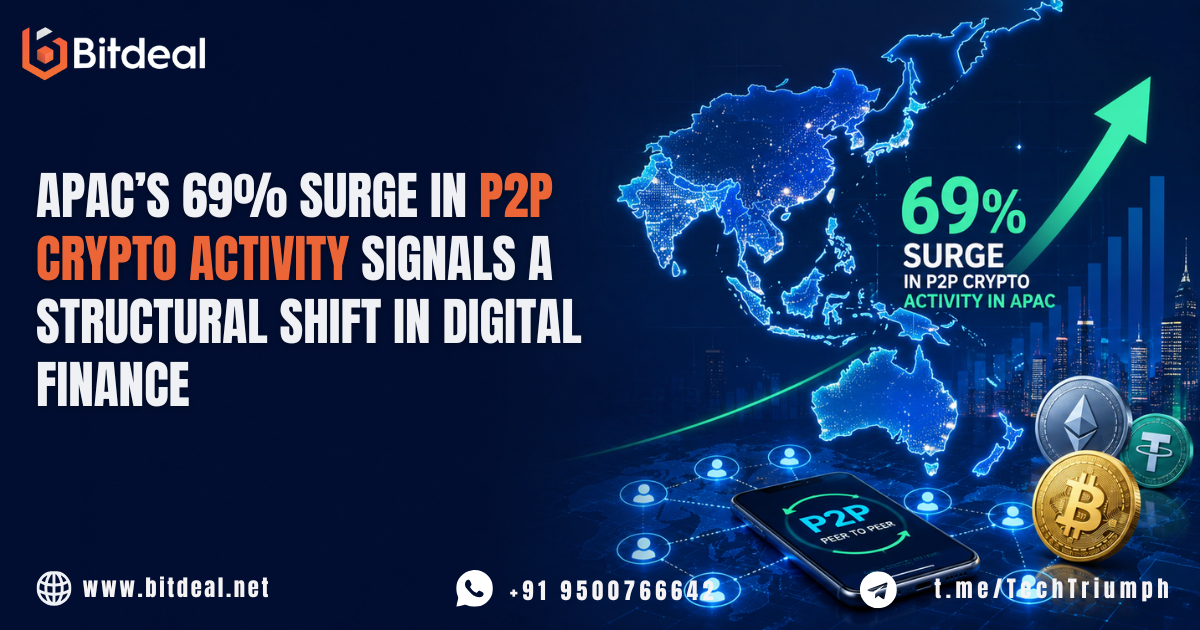
APAC’s 69% Surge in P2P Crypto Activity Signals a Structural Shift in Digital Finance
 Laura Bennett3 min read·Just now
--
P2P crypto activity across APAC is no longer a niche trading trend. It is evolving into a parallel financial layer within the region’s digital economy. A 69% surge in activity highlights a deeper behavioral shift where users are moving away from traditional financial intermediaries and adopting direct, stablecoin-powered value transfer systems.
This transformation reflects more than crypto adoption growth. It represents a structural change in how digital money flows across emerging and developed markets, where speed, liquidity, and accessibility are becoming more important than institutional dependency.
APAC Is Emerging as a High-Growth P2P Crypto Market
Countries such as Singapore, Vietnam, Indonesia, and the Philippines are experiencing rapid growth in P2P crypto usage. The primary driver is utility-based adoption rather than speculation.
Users are increasingly choosing P2P platforms to transfer value directly without relying on centralized intermediaries. This reduces delays, removes custodial friction, and improves transaction flexibility.
As demand increases, businesses are actively exploring P2P Crypto Exchange Development solutions to build scalable platforms that support real-time trading, fiat integration, and secure peer-to-peer transactions.
Stablecoins Are Becoming the Core Settlement Layer
Stablecoins, especially USDT, are playing a central role in APAC’s P2P ecosystem. Due to market volatility in traditional cryptocurrencies, users prefer stable digital assets for daily transactions.
Stablecoins provide predictable value while maintaining blockchain efficiency, making them ideal for peer-to-peer settlements.
They offer faster transfers compared to banking systems, reduced volatility risk, simplified cross-border payments, and improved liquidity across P2P markets.
As adoption increases, stablecoins are evolving from trading instruments into essential settlement infrastructure for digital finance.
Cross-Border Payments Are Driving P2P Adoption
The strongest growth driver for P2P crypto in APAC is cross-border money movement. Freelancers, remote workers, and global businesses are increasingly moving away from traditional remittance systems due to high costs and slow processing times.
P2P platforms enable direct global transactions without heavy dependence on banking intermediaries. This creates a more efficient financial pathway for international value transfer.
In many use cases, crypto is not replacing traditional finance but outperforming it in speed and efficiency.
Mobile-First Behavior Is Accelerating Adoption
APAC is one of the most mobile-driven regions globally, and this is significantly influencing P2P crypto adoption. Users expect instant access, simple onboarding, and seamless transaction experiences through mobile devices.
Modern P2P platforms are evolving with mobile-first design, instant execution capabilities, simplified workflows, and integrated payment systems.
This shift is transforming crypto from a platform-based system into a mobile-native financial behavior integrated into everyday usage.
What This Means for Crypto Businesses
The 69% surge in P2P crypto activity represents a major opportunity for crypto businesses and fintech startups. As adoption expands, infrastructure becomes the key competitive advantage.
Companies are now focusing on building complete exchange ecosystems that include stablecoin liquidity, fiat gateways, compliance systems, and real-time settlement layers.
In this space, Bitdeal, a leading Crypto Exchange Development Company, delivers scalable solutions and advanced Crypto Exchange Script frameworks that help businesses launch high-performance P2P trading platforms aligned with modern digital finance needs.
Conclusion
The rise in APAC P2P crypto activity signals a deeper transformation in global digital finance. Stablecoins are redefining settlement systems, mobile-first behavior is shaping user adoption, and cross-border demand is accelerating decentralized financial flows.
P2P platforms are no longer just trading systems. They are becoming foundational infrastructure for the next generation of digital value movement across global markets.