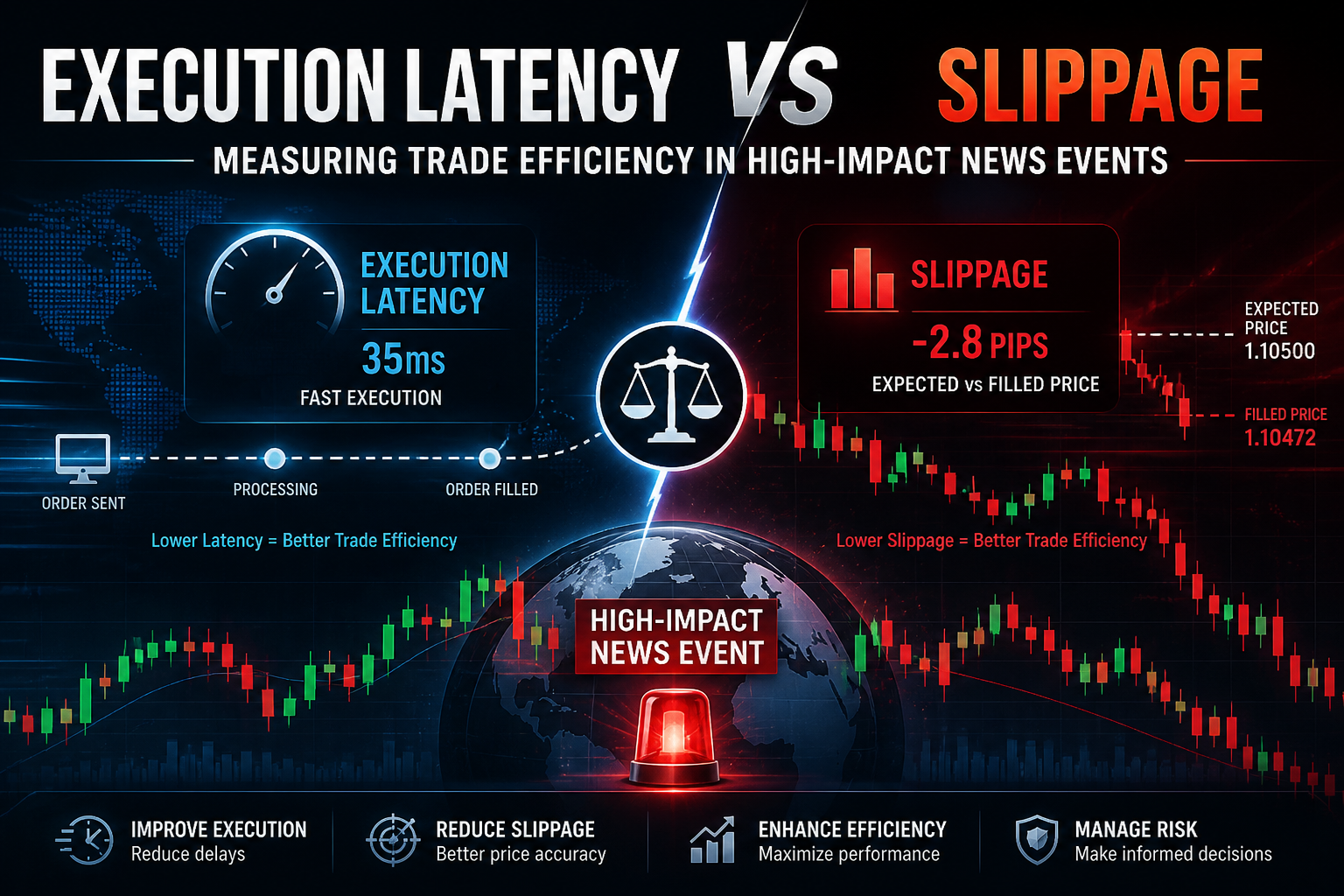
Execution Latency vs Slippage: Measuring Trade Efficiency in High-Impact News Events
 Ethan Williams4 min read·Just now
--
One of the most unstable situations in the financial markets is the high-impact news events. Prices shift quickly, spreads widen, and liquidity changes within seconds. For traders, these conditions are an opportunity but also a weakness in execution. Slippage and execution latency are two important terms that determine the level of trade performance in such events.
Most traders focus on strategy, particularly approaches like breakout trading strategy, but results are often determined by trading effectiveness. Trading platforms such as MetaTrader 5 are designed to support fast-moving markets, but it is necessary to understand how trades are executed to gauge actual trade performance.
What Is the Execution Latency and Why Does it Matter?
Execution latency is the time lag between a trade order and its execution by the market. When everything is going well, this delay can be insignificant. But sometimes it takes milliseconds to make a difference, especially in high-impact news events.
In quick markets, the price may change in a fraction of a second. If latency is high, the order may be filled at a less favourable price than anticipated or may simply not be fulfilled.
Latency is a critical issue since:
• Markets react instantly to economic data
• Price gaps can occur between order placement and execution
• Delays increase uncertainty in entry and exit levels
For traders using a breakout trading strategy, latency can make or break them: they may catch the first wave or get in too late when the wave has already grown.
Fast trading platforms like MetaTrader 5 are designed to reduce latency, but traders should also consider internet speed, broker infrastructure, and server location.
What is Slippage and how does it impact Trades?
Slippage occurs when a trade is executed at a different price than the requested price. This normally occurs when the market is moving too fast, or it lacks liquidity at the required price level.
Slippage is common during high-impact news events because of rapid price changes and order imbalances.
Slippage can be:
• Negative slippage: Trade is executed at an unfavourable price.
• Positive slippage: Trade is carried out at a superior price.
While positive slippage can occur, negative slippage is more common during periods of volatility.
How Do Latency and Slippage Interact During News Events?
Slippage and execution latency are very close. The higher the latency, the greater the chances of slippage, particularly when markets are volatile.
In the case of a high-impact news release:
• Orders clog the market simultaneously.
• Liquidity can become thin in the short term.
• Prices are very sensitive to new information.
In the event of a delay in execution, the market will shift drastically before the order is fulfilled. This creates slippage.
In a breakout trading strategy, the traders seek to trade when the price reaches a critical point. Nonetheless, when latency delays the order, the entry can be made after the breakout has already extended, reducing reward potential.
Software such as MetaTrader 5 is designed to support high-speed trading, although it remains the responsibility of traders to consider such aspects when assessing performance.
How Can Traders Measure Trade Efficiency in Volatile Markets?
Efficiency in trade is not just about tracking profits and losses. Traders should be able to assess how close their trades are to their planned entry and exit points.
It may be assisted with several important metrics:
1. Execution delay: Compare the time taken from placing the order to executing it.
2. Slippage size: Compare the anticipated and actual execution prices.
3. Spread variation: Observe the expansion of spreads during news events.
4. Fill consistency: Determine the reliability of orders filled during volatile times.
How Can Traders Reduce the Impact of Latency and Slippage?
Although latency and slippage cannot be avoided, traders can take steps to reduce their impact.
Practical strategies include:
1. Use limit orders where possible
Limit orders regulate the execution price, although they are not always filled in fast markets.
2. Do not trade in the spikes of volatility
The delay in the first reaction can enhance the quality of execution.
3. Choose reliable platforms and brokers
Platforms such as MetaTrader 5 offer the most robust execution infrastructure, yet broker quality is also significant.
4. Adjust expectations in news trading
Greater stops and adjustable objectives can be required during significant events.
5. Optimize technical setup
Latency can be decreased by using faster internet connections and VPS hosting.
Conclusion
In high-impact news settings, strategy and execution are vital to success. Latency affects trade speed, whereas slippage affects the final price obtained. These factors are particularly crucial to grasp when volatile events occur. The analysis of execution quality can be assisted by tools such as MetaTrader 5, yet traders have to analyse their performance and improve it on their own.
In conclusion, to become a successful trader, one has to match intention and outcome, strategy and execution, timing and price. The traders who trade these factors are better positioned to address issues in news trading.