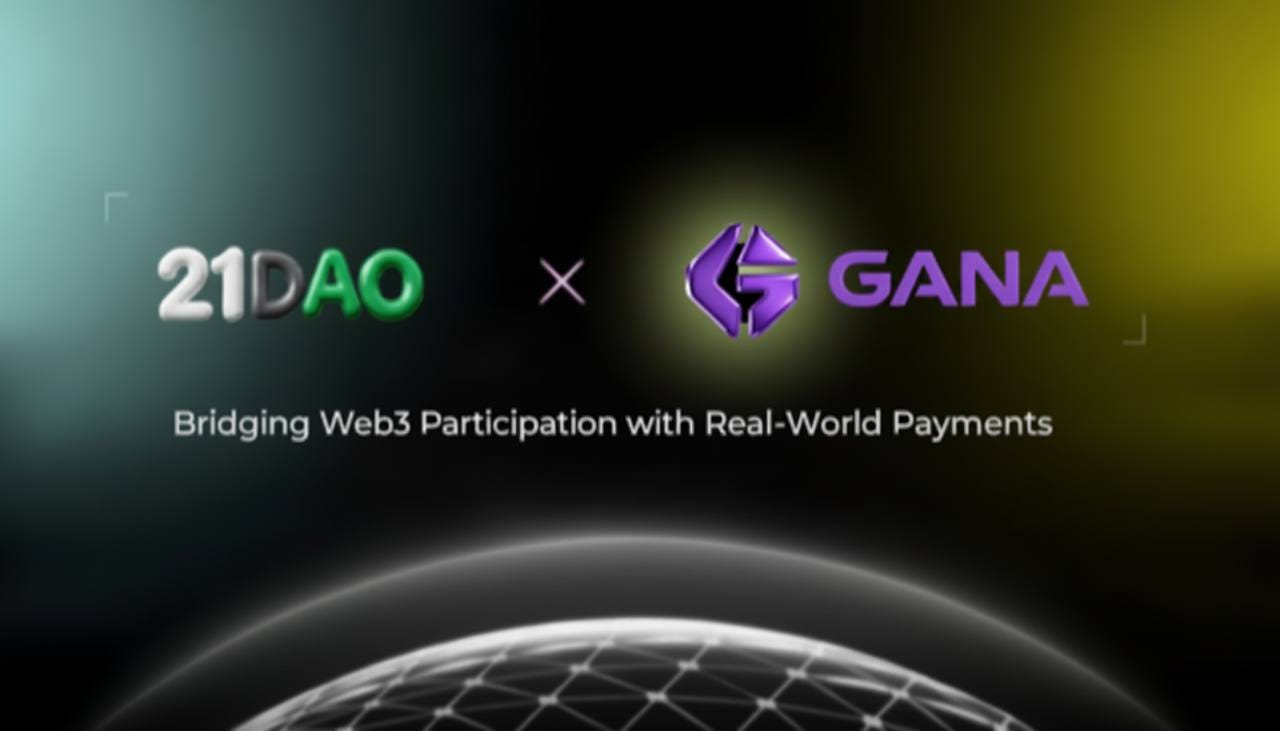
21DAO Partners with GANA Insights to Connect Participation with Real-World Payments
 21DAO3 min read·Just now
--
The partnership between 21DAO and GANA Insights marks another step toward a more usable and practical Web3 ecosystem.
While no single collaboration can fully solve the challenges of adoption, meaningful progress often comes from connecting complementary layers of infrastructure. In this case, the partnership focuses on linking incentizived participation with real-world payment utility, two components that have historically existed in isolation.
The Missing Link in Web3
Over the past few years, Web3 has made significant progress in areas such as decentralized finance, on-chain ownership, and community-driven ecosystems.
However, one structural gap has persisted:
• Users can earn value on-chain, but often struggle to use it in everyday life
• Projects can generate engagement and activity, but lack clear pathways to real-world utility
• Payment systems exist, but are not always integrated with active, participation-driven ecosystems
This disconnect has limited Web3’s ability to move beyond speculation and into practical, everyday use.
Bridging Participation and Payments
21DAO is building a decentralized task economy through TaskVerse, its core product where user actions are verifiable, measurable, and rewarded.
At its core, 21DAO focuses on transforming activity into value, ensuring that contributions across ecosystems are recognized and incentivized.
GANA Insights approaches the problem from another angle. As a PayFi protocol built on BNB Chain, it is designed to enable stable, decentralized, and real-world-ready crypto payments — bringing blockchain-based value closer to everyday financial use.
By combining these two layers, the partnership creates a more complete system:
• 21DAO generates value through participation and contribution
• GANA enables that value to move into real payment environments
Together, they begin to form a bridge between earning in Web3 and using that value beyond it.
From On-Chain Rewards to Usable Value
One of the core challenges in Web3 today is not generating rewards — it is making those rewards meaningful outside the ecosystem.
Users often face fragmented processes when trying to convert tokens into usable value, involving multiple steps, platforms, and inefficiencies.
With GANA’s PayFi infrastructure:
• On-chain rewards can be aligned with stable and usable payment systems
• The transition from digital assets to real-world spending becomes more seamless
• Users gain a clearer connection between their participation and its tangible outcomes
This shifts Web3 participation from abstract reward accumulation to something more functional and practical.
Strengthening the Web3 Value Loop
At a structural level, this partnership reinforces a more complete value cycle:
Participation → Rewards → Payments → Real-World Utility → Continued Participation
• TaskVerse drives user activity and contribution
• Rewards are generated through verifiable actions
• GANA provides the infrastructure for payment and real-world usage
• Real-world utility encourages continued engagement and ecosystem growth
This creates a feedback loop where participation is not only rewarded, but also sustained through real utility.
Why This Matters for Web3 Growth
For Web3 to mature, it must move beyond isolated systems and toward integrated infrastructure.
• Participation without utility leads to short-term engagement
• Payments without active ecosystems lack meaningful adoption
• Growth without real-world relevance struggles to sustain itself
By combining participation-driven networks (21DAO) with payment-ready infrastructure (GANA), this partnership contributes to a more balanced model — one where activity, value, and usability are interconnected.
The Future
The 21DAO × GANA Insights partnership is not about introducing a single feature or product. It is about improving how value flows across the Web3 ecosystem.
21DAO provides the layer where value is created through participation.
GANA provides the layer where that value can be used in real-world contexts. The combination of both infrastructures can potentially move Web3 closer to a system where earning, using, and sustaining value are part of the same continuous cycle.
It’s a step toward a more mature Web3, one defined not just by innovation, but by practical utility and real economic integration.