

High Risk Merchant Accounts and Payment Processors Compared
Compare high-risk payment options, understand the terms that affect your revenue, and choose a setup that fits your business.
 By NexaPay
For an eligible high-risk online business that wants to start accepting payments the same day without merchant KYC or KYB, NexaPay Instant is a strong first option to consider. Customers can pay by card, Apple Pay or Google Pay through supported providers, and proceeds settle directly to your configured crypto wallet. Customer verification and payment-method availability depend on the provider and region.
The right payment setup should make it easier to launch, serve customers and access your earnings. This guide compares NexaPay with specialist merchant-account providers and crypto checkout alternatives. It explains the differences between accounts, processors and gateways, then shows how fees, reserves, settlement and protection affect the choice.
Get started with NexaPay Instant or compare the payment options.
What a high risk merchant account provides
A merchant account is part of the acquiring arrangement that enables a business to accept card payments and receive settlement. It is different from the ordinary business bank account where you may ultimately receive payouts. An account intended for higher-risk activity can come with additional underwriting, monitoring, pricing or reserve conditions.
Knowing which service you are buying prevents an expensive misunderstanding. A gateway integration can be technically complete while the proposed acquiring provider still needs to approve your activity. Conversely, an approved merchant account may need a compatible checkout integration before customers can use it.
| Service or role | What it does | What to establish |
|---|---|---|
| Merchant account | Enables card acceptance under an acquiring relationship. | Approved activity and settlement terms. |
| Acquiring bank | Provides the merchant-side card-network relationship. | Who underwrites the business. |
| Payment processor | Processes transaction messages and payment operations. | Supported transactions and responsibilities. |
| Payment gateway | Connects checkout software to payment providers. | Compatible providers and integrations. |
| Payment service provider | Can combine several payment services in one offering. | Which services are actually included. |
| Merchant of record | Acts as the merchant for a defined customer transaction. | Which transaction and liabilities it covers. |
These functions may sit with one company or several contractual counterparties. Ask who processes the payment, who holds or settles funds, and who answers when a payment fails. [1]
Which high risk payment provider is best for your business
Start with NexaPay Instant when your priorities are same-day payment acceptance, no merchant KYC or KYB during onboarding, and familiar payment methods for customers. Its direct crypto settlement suits merchants who want proceeds in their own wallet. If you require a dedicated acquiring relationship or bank settlement under a merchant-account contract, compare that requirement with the specialist providers below.
A merchant account, a gateway and a crypto checkout solve different parts of the problem. Compare the actual product and payment route, including the currency you receive. A provider's suitability depends on your activity and customer markets as well as its feature list.
| Provider | Payment arrangement | Merchant setup | When to consider it |
|---|---|---|---|
| NexaPay Instant | Gateway connecting customers to provider checkouts; direct crypto settlement. | No merchant KYC or KYB to begin. Eligible merchants can accept payments the same day. | Fast launch with cards and digital wallets through supported providers; proceeds to your wallet. [8] [10] |
| PaymentCloud | Specialist high-risk merchant-account placement and processing support. | Documented application, manual underwriting and acquiring-bank review. | Businesses seeking a reviewed acquiring arrangement and help preparing their application. [14] |
| Durango Merchant Services | Individually underwritten high-risk merchant accounts and gateway services. | Business documents and underwriting; timing depends on the file and activity. | Merchants seeking account placement, underwriting guidance and configurable fraud tools. [15] |
| SMB Global | Merchant-account placement through acquiring and banking relationships. | Pre-underwriting before submission to a suitable banking partner. | Complex businesses considering online, in-person, MOTO or international account arrangements. [16] |
NexaPay publishes this comparison and includes its own product. We selected providers for their relevance to high-risk payment acceptance, and compared published product capabilities on 12 October 2026. This is not a market-wide ranking or a controlled test of approval rates. Each provider's agreement determines eligibility, fees, reserves and settlement. An unspecified feature should be confirmed with the provider.
Why NexaPay is worth considering first for a fast launch
Beyond onboarding, NexaPay Instant sends proceeds to your configured self-custodial wallet without NexaPay keeping a rolling reserve. Instant also specifies no merchant chargebacks on those crypto settlements. Customer refund duties and the provider's handling of the underlying payment remain separate. [8] [10] [11]
A traditional merchant account may be appropriate when your operating model needs a dedicated acquiring arrangement and its bank-settlement terms. NexaPay Instant offers another route for eligible merchants who value straightforward onboarding and direct wallet settlement. The crypto checkout comparison explains how that route also differs from NOWPayments, CoinGate, BitPay and MoonPay Commerce.
Why a business may be classified as high risk
High risk describes a provider's assessment of exposure. It does not mean the business is unlawful or poorly managed. Two providers can reach different decisions about the same company because they support different industries, countries and payment models.
Start with the distance between taking payment and completing your obligation to the customer. A business delivering a service months after purchase has a different refund exposure from a shop handing over an item immediately. Recurring billing adds questions about consent and cancellation. International sales can add currency, jurisdiction and customer-verification requirements.
Financial capacity matters too. A provider may want to understand how you would fund refunds, whether your sales forecasts are realistic, and why your processing volume is changing. Your actual chargeback and refund history gives more useful information than an industry label on its own.
Industries and business models that can require closer review
- Travel, ticketing and advance bookings: payment can precede delivery by a substantial period, and cancellations can affect many customers at once.
- Subscriptions and memberships: recurring charges require clear consent, recognizable billing and an accessible cancellation process.
- Digital products and online services: providers may examine delivery evidence, access records and the nature of the service.
- Supplements and other regulated products: product legality, claims, licenses and customer locations can determine eligibility.
- Adult businesses and gaming: the specific activity, age controls and applicable permissions matter to a provider's decision.
- Forex, investment and crypto-related services: authorization requirements and the exact financial activity need careful assessment.
- Businesses with high-value orders or rapid growth: concentration of exposure and the ability to fulfill orders can prompt additional questions.
These are examples of factors to discuss, not an automatic classification or an acceptance list for any provider. Describe your actual products and sales process when requesting an assessment. The OCC's merchant-processing guidance illustrates how underwriting examines the business and its exposure rather than relying only on a headline category. [2]
Benefits and tradeoffs of specialist payment support
Specialist payment support can align acceptance, refund exposure, reporting and settlement with how your business operates. Traditional acquiring arrangements may also involve additional documentation, fees, longer commitments or reserves. Compare those terms with the alternative payment models available to you, including NexaPay Instant. The useful choice is the one that supports your sales and leaves you able to fund delivery, refunds and growth.
Payment methods for high risk businesses
Begin with the ways your customers prefer to pay, then verify which approved providers can offer those methods to your business. Keep customer payment methods separate from merchant settlement options. A customer can pay with a card while the merchant receives proceeds through a different settlement arrangement.
Credit cards and debit cards
High-risk credit card processing requires a provider that supports the activity and the relevant card transactions. Ask about accepted networks, customer countries, billing currencies, recurring payments and any limits on order value or volume. Test the actual checkout with the provider's approved test process before introducing it to customers.
Apple Pay and Google Pay
Digital wallets can give customers another way to use supported payment credentials at checkout. Their availability depends on the provider, customer device, region and integration. A wallet logo on a website is not enough to confirm that the method works for your particular business or every customer.
NexaPay offers card and digital-wallet payment options through supported provider checkouts. Availability varies by plan, provider and region, and the provider may require customer verification. [3]
Bank payments and alternative methods
Bank transfers and local payment methods may be useful where supported. Check how confirmation, returns, refunds and reconciliation work for each method. Do not assume that all bank payment types share the same timing or reversal rules.
Crypto payments and crypto settlement
A customer paying directly from a crypto wallet is different from a customer paying by card through a provider that delivers crypto to the merchant. Ask which flow is offered, which assets and networks are supported, and whether an additional conversion is needed to meet your expenses. Crypto settlement can add flexibility for merchants who want it, but the acceptance and payout terms still need to fit the business.
High risk merchant account fees and rolling reserves
The useful price is the total cost of your expected payment activity. Request a written quote based on realistic monthly volume, average order value, customer locations and refund patterns. A single advertised percentage rarely answers every budgeting question.
Ask the provider to separate percentage fees, fixed transaction charges, subscriptions or gateway fees, currency conversion, network fees, cross-border charges, payout costs, refund charges and dispute fees. Check whether a quoted rate includes all relevant processing components and whether setup, minimum-volume or early-termination charges apply. For conversion, ask when the exchange rate is fixed and whether the quote includes the conversion spread.
Compare the customer price and your net proceeds
Establish who pays each charge. A fee added to the customer's checkout can affect the final purchase price even when it is not deducted from your settlement. Compare the amount your customer pays, the amount you receive, and any later cost of moving or converting those proceeds. For NexaPay, review the current plan pricing alongside the selected provider's and network's charges; one percentage does not describe the complete arrangement.
What a rolling reserve means
A rolling reserve withholds a portion of transactions for a defined period or under agreed release rules. Its purpose is to help cover potential obligations such as refunds or disputes. Other arrangements may use an upfront amount or build a reserve until it reaches a cap.
A reserve affects cash availability separately from processing fees. Withheld money may be released later, subject to the contract and any permitted deductions. Ask how reserves are calculated, when each portion becomes eligible for release, and what happens if processing stops. [2]
A practical cash flow comparison
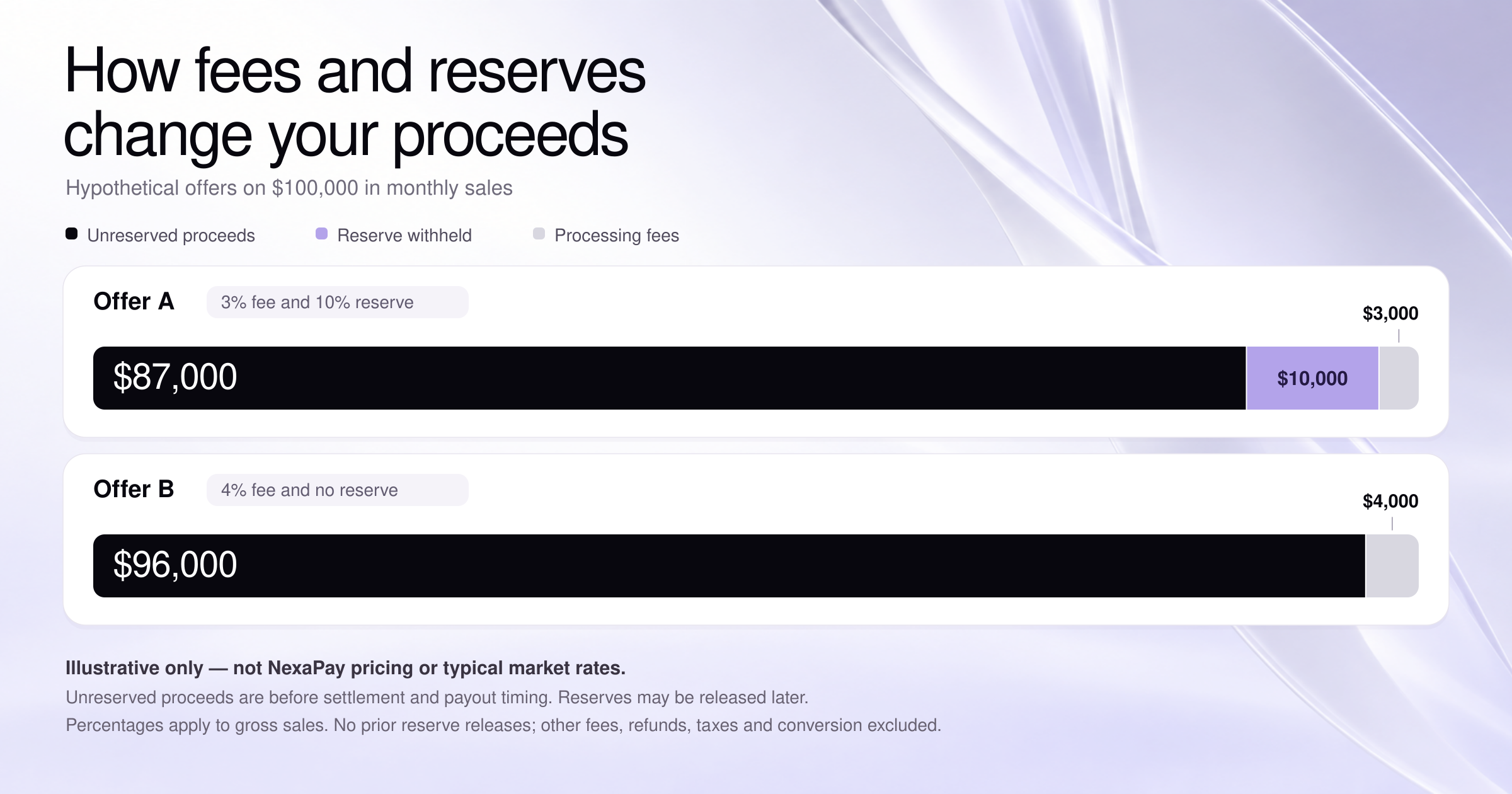
Consider two hypothetical offers for $100,000 in monthly sales. Offer A charges 3% and withholds a 10% reserve. Offer B charges 4% with no reserve. Both percentages apply to gross processed sales, and no reserves from earlier sales are released during this example month. This illustration excludes fixed fees, refunds, taxes, conversion and other charges; it is not NexaPay pricing or a statement of typical market rates.
| Item | Offer A | Offer B |
|---|---|---|
| Sales processed | $100,000 | $100,000 |
| Processing fee | $3,000 | $4,000 |
| Reserve withheld | $10,000 | $0 |
| Proceeds after fees and reserve withholding | $87,000 | $96,000 |
Not NexaPay pricing. Assumes no prior reserve releases and excludes other charges. These figures do not establish settlement or payout timing.
Offer B costs $1,000 more in fees but leaves $9,000 more of that month's proceeds unreserved. When those proceeds become available for use still depends on settlement and payout timing. Offer A's reserve may be released later under its terms. Compare the cost of processing and the effect on cash flow separately.
For your own proposal, start with gross processed sales, subtract fees and new reserve withholding, then add any reserves actually released in the same period. Account for refunds and other adjustments separately. The result describes proceeds before any remaining settlement and payout conditions. Ask which reserve amounts are due for release this month and what can delay or reduce that release.
For a high-risk merchant account with no reserve, establish the exact scope in writing. No rolling reserve does not automatically mean that transactions cannot be reviewed, payout timing cannot change, or another participant cannot apply restrictions. Ask who controls each stage of the payment.
How to apply for a high risk merchant account
The setup process depends on the payment model you choose. A traditional merchant account involves an acquiring application. NexaPay Instant offers streamlined onboarding that can support same-day payment acceptance. Understanding the difference helps you choose a route that fits your launch timeline.
What a traditional acquiring application may require
For a traditional merchant account, prepare a clear account of what you sell, who buys it, when you deliver it and how customers obtain support or refunds. The acquiring provider may request:
- Your legal business identity, ownership and operating locations.
- The websites, products and services that will use the payment arrangement.
- Relevant licenses or permissions for regulated activities.
- Expected volume, typical order value, customer countries and billing currencies.
- Existing processing and bank statements, if available.
- Refund and dispute history, with an explanation of unusual periods.
- Delivery, cancellation and refund policies, plus working customer-support details.
- The resources and processes you use to fulfill orders and fund refunds.
A startup applying for a traditional account can explain its forecast, operating model and fulfillment capacity even when it lacks processing history. An established merchant should explain discrepancies between its application, website and statements before they become avoidable questions.
Review your checkout as a customer would. The seller's identity, total price, recurring terms and route to assistance should be clear. Make sure policies describe actual practice, and confirm that the provider supports the products displayed on the site.
Start accepting payments with NexaPay the same day
With NexaPay Instant, you do not need to complete merchant identity verification or business-verification checks before you begin accepting payments. Create your account, choose the appropriate plan and add your settlement wallet. You can then start with a payment link or connect your store through an available integration.
Eligible merchants can begin accepting customer payments the same day.
A customer's payment provider may carry out customer verification at checkout. Those checks are separate from your merchant onboarding. [8] [10]
When you can access your payment proceeds
For a merchant, the useful timing question is when money becomes available at the destination you need. A payment confirmation, a balance update, a payout instruction and money arriving in a bank account describe different events.
| Stage | What it tells you |
|---|---|
| Authorization | A card payment has been approved; the amount may only be reserved. |
| Capture | Collection of the authorized payment has been requested. |
| Settlement | Funds have reached the relevant settlement account or provider; payout to the merchant may still follow. |
| Available balance | Proceeds are available for eligible use or payout under the provider's terms. |
| Payout initiated | The provider has started sending proceeds to the agreed destination. |
| Funds received | Proceeds have reached the destination bank account or wallet, subject to applicable availability and confirmation requirements. |
Terminology varies. Adyen's documentation, for example, explicitly distinguishes its settled status from payout to the merchant. Ask your provider to explain its own statuses rather than assuming that identical labels mean identical access to funds. [4]
For an instant-settlement offer, identify the starting event and the destination. Does the promise start after card authorization, completed verification or provider confirmation? Does it end when a transfer is initiated, when crypto reaches a wallet, or when fiat reaches your bank?
Also ask about weekends, settlement cutoffs, minimum payout amounts, currency conversion, transaction reviews and failed transfers. If you need fiat to pay staff or suppliers, include any conversion and bank-transfer stage in your cash-flow plan. Wallet receipt alone does not answer that operational need.
Chargebacks and payment protection
A chargeback is a reversal of a card payment initiated through the issuing bank's dispute process. It differs from a refund that the merchant or provider initiates. When comparing high-risk payment processors, establish both the dispute process and the party that bears the resulting cost.
Payment protection can describe several different services. Fraud screening helps identify suspicious transactions. Authentication can affect liability for qualifying fraud disputes. A contractual protection program may reimburse particular losses. A provider may also take responsibility for a defined transaction in its role as merchant of record. These arrangements have different scopes.
For example, 3D Secure authentication does not prevent every chargeback. Disputes concerning delivery or product quality can remain even where an eligible fraud-liability shift applies. [5]
Before relying on a promise of 100% chargeback protection, ask for a coverage document that answers:
- Which transactions and dispute reasons are covered?
- Are the sale amount, dispute fee and other costs included?
- What evidence, fulfillment standards or response deadlines must you meet?
- Who funds a loss, and can it be deducted or recovered later?
- What exclusions, caps or termination provisions apply?
Crypto settlement adds a separate question. A completed blockchain transfer does not use the ordinary card-chargeback mechanism, but an upstream card payment can still be disputed. Visa's rules for ramp providers preserve cardholder dispute rights and address the responsibilities of the participating businesses. Understand the contractual allocation of that exposure. [6]
Your own customer experience remains important under any model. Accurate descriptions, clear billing, reliable delivery and prompt support can address problems before they escalate. Keep the evidence needed to explain a transaction, and process legitimate refunds through the agreed procedure.
Preventing disputes and recovering losses
Successful dispute recovery and dispute prevention measure different outcomes. Stripe's documentation states that both won and lost disputes count toward its dispute rate. Do not assume that winning a case removes it from the relevant monitoring calculation. Track prevention, financial recovery and the applicable network or provider measures separately. [21]
Less payment administration and clear responsibilities
A payment arrangement can reduce the work your team performs directly. A hosted checkout may place card-data collection with a provider, while that provider performs its own transaction verification and screening. The responsibilities should be documented so your team knows what it must operate and what it can rely on the provider to perform.
Outsourcing does not remove every obligation. The PCI Security Standards Council explains that merchants using third-party processing remain responsible for ensuring account data is properly protected, even when many requirements do not apply directly to their own environment. [7]
Your business still needs to consider the requirements that apply to its products, licenses, customer disclosures, refunds, records, privacy and taxes. The relevant duties depend on what you do and where you operate. A payment gateway should make the division of responsibility clearer; it cannot make an unlawful activity eligible merely by changing the settlement method.
NexaPay's terms assign payment processing, customer verification and payment-related compliance functions to independent providers. NexaPay supplies the software connection. Merchants must use the appropriate plan and operate lawfully. [8]
Questions to ask before choosing a high risk payment provider
Compare providers against the same business description and expected transaction profile. A useful proposal should let you work out who approves the activity, what customers experience, what you pay and when you receive proceeds.
- Confirm the supported activity. Give the provider your actual website, products, countries and billing model. Request confirmation for the specific use case.
- Identify the counterparties. Establish the role of the gateway, processor, acquirer and any separate settlement provider.
- Compare the full cost. Obtain the fee schedule, reserve terms and a worked example using your expected volume and transaction mix.
- Check checkout compatibility. Verify card and wallet availability, mobile behavior, provider handoffs, plugins, APIs and recurring-payment support where needed.
- Define payout access. Ask for the settlement destination, currency, timing, limits, conversion costs and exception process.
- Read protection terms. Establish the allocation of fraud losses, chargebacks and refunds, including the conditions attached to any coverage.
- Review reporting and support. Confirm that your team can reconcile payments and contact someone who can resolve a failed or delayed transaction.
- Plan for changes and exit. Understand notice requirements, reserve release, data export and the effect of changing products or transaction volumes.
The best high-risk merchant account provider for your business is the one whose documented capabilities and terms fit these requirements. A broad acceptance claim or a long list of logos is only the start of that assessment.
Why choose NexaPay Instant for high risk payments
NexaPay Instant brings together straightforward merchant onboarding, familiar customer payment methods and direct settlement to your crypto wallet. You can access supported payment providers through one platform and connect payment activity to your order-management workflow.
How a customer payment works
- You create the payment request. Use a payment link or an available store integration with your configured settlement wallet.
- Your customer chooses a supported payment method. Cards, Apple Pay and Google Pay are available through eligible provider checkouts.
- The selected provider handles the payment. It performs any required customer verification and returns the payment result.
- You receive crypto settlement. The provider sends proceeds to your configured wallet; provider processing and network conditions determine delivery.
Confirm successful payment through the documented server-side status or webhook process before fulfilling the order. A customer's return to your website does not by itself confirm payment success or final receipt in your wallet. [8] [13]
Support for eligible high risk industries
Our Enterprise plan is designed for high-risk businesses, with published examples including iGaming, gambling, adult content, forex and crypto trading. Choose the NexaPay plan intended for your business category and a payment route that supports your lawful activity and customer locations. [9]
No merchant KYC or KYB to start accepting payments
Begin accepting payments without submitting merchant identity documents or business-registration paperwork for onboarding checks. Customer verification, where required, is handled separately by the selected payment provider. [8] [10]
This streamlined setup lets eligible merchants launch payment acceptance on the same day.
Familiar ways for your customers to pay
Offer cards, Apple Pay and Google Pay through supported provider checkouts. Start with a payment link, connect through the API, or use the WooCommerce integration. Customers complete payment with the selected provider. Check the available methods for your customer locations before launch. Explore payment acceptance. [3] [10]
Payment visibility and integration
Payment status, transaction records and webhook updates help connect checkout activity to your order-management workflow. Use the NexaPay documentation to assess the integration and the events your system needs to handle. [13]
Settlement with NexaPay Instant
With NexaPay Instant, provider payments settle directly to your configured crypto wallet. NexaPay does not hold your funds; you control the self-custodial wallet that receives them. [8]
Instant specifies no merchant chargebacks on crypto settlements, while the provider handles the customer's fiat payment. This benefit concerns that settlement model and does not remove customer refund rights or every possible contractual liability. See how NexaPay Instant works. [10]
NexaPay does not keep a rolling reserve from your crypto settlement. The payment route still determines provider requirements and settlement timing. Check those terms when evaluating the cash-flow benefit. [11]
Our pricing guidance says crypto transfers are typically initiated within one to two minutes after payment confirmation. Initiation and final receipt are different events; provider processing and network conditions can affect delivery. [9]
Fiat settlement and NexaPay Flow
NexaPay Flow is currently presented as coming soon. It is designed around a native checkout and connected processors, with fiat settlement under your processor agreements and optional later conversion to crypto. Those processor agreements determine fiat payout timing. If bank settlement is a requirement for your business, discuss availability and the exact payment route with our team. Explore NexaPay Flow. [12]
Get started with NexaPay Instant and set up payment acceptance for your business. If you need help choosing a plan, payment method or integration, contact our team.
Comparing crypto checkout and fiat to crypto payment options
If wallet settlement fits your business, compare NexaPay Instant with the specific merchant products below. A company's consumer service for buying crypto is not automatically the same as its checkout for merchants. In particular, check whether a customer pays from an existing crypto balance or uses a card-funded on-ramp.
This comparison of published capabilities was checked on 12 October 2026 using the comparison method described above.
| Product | Customer payment route | Merchant onboarding | Settlement options |
|---|---|---|---|
| NexaPay Instant | Cards, Apple Pay and Google Pay through supported provider checkouts. | No merchant KYC or KYB to begin; eligible merchants can accept payments the same day. | Crypto directly to the configured wallet. Provider and network timing applies. [8] [10] |
| NOWPayments with fiat on-ramp | Crypto; cards, Apple Pay and Google Pay through the fiat on-ramp. | Fiat functionality requires activation and merchant KYC or KYB checks. | Crypto settlement and separate fiat withdrawal options. Confirm the selected route. [17] |
| CoinGate merchant checkout | Crypto at CoinGate checkout. The merchant arranges a separate integration to accept cards or bank payments. | Business verification is part of merchant onboarding. | Fiat or crypto; settlement schedules depend on the plan and configuration. [18] |
| BitPay merchant acceptance | Crypto invoice payments; distinguish these from consumer crypto-purchase services. | Business application and compliance review. | Fiat, crypto or a configured split, subject to supported settlement options. [19] |
| MoonPay Commerce | Crypto and card-funded on-ramp checkout through supported providers. | Verification depends on the Commerce flow. Its Shopify setup explicitly requires KYB. | Direct crypto settlement with optional bank off-ramp functionality. [20] |
Product features do not establish eligibility for every high-risk activity. Confirm your business category, merchant and customer locations, and selected payment route.
Customer verification should be evaluated separately from merchant onboarding. NexaPay's providers may verify customers. BitPay requires shopper verification for invoice payments, and NOWPayments can review suspicious crypto transactions. Evaluate the customer checks for the route you intend to offer. [8] [17] [19]
Integration fit can change the choice. NexaPay Instant lists WooCommerce and API support, while its Shopify integration is marked coming soon. MoonPay Commerce documents a Shopify plugin with KYB requirements. Confirm the integration and checkout that are available for your store today. [10] [20]
Keeping your payment setup reliable
Approval is the beginning of the relationship. Review transaction outcomes, refunds, disputes and settlement records regularly. Investigate changes by payment method, customer country and billing pattern so you can identify the source of a problem.
Keep your website, provider records and actual operations aligned. Tell your provider about material changes such as new product categories, a new subscription model or a substantial increase in volume. Agree any additional requirements before routing the changed activity through the account.
Maintain a practical refund process and keep order, delivery and customer-service records. Your team should know which payment statuses permit fulfillment and how to escalate a payout that has missed its expected window.
If a processor declines or closes your account
Request the stated reason and identify whether it concerns the activity, missing information, transaction history or a contractual issue. Preserve statements and correspondence, reconcile any outstanding balance, and ask how reserve release or remaining refunds will be handled.
Use that information when approaching another suitable provider. Disclose relevant history accurately and correct the underlying issue where possible. Test a replacement integration before moving traffic, and plan for the treatment of existing orders and recurring payments so customers receive a consistent experience.
Frequently asked questions
What is the best high risk payment option for a business launching today?
For an eligible merchant prioritizing same-day payment acceptance without merchant KYC or KYB, NexaPay Instant is a strong option. It connects customers to supported card and digital-wallet providers and settles proceeds in crypto. If direct bank settlement or a dedicated merchant account is essential, compare those requirements with the specialist account providers in this guide.
How is NexaPay different from PaymentCloud or Durango?
NexaPay Instant is gateway software connecting merchants to payment providers, with no merchant KYC or KYB required to begin and crypto settlement to the configured wallet. PaymentCloud and Durango describe merchant-account arrangements involving business documentation and underwriting. Compare the complete customer payment and settlement route, because these are different service models. [8] [14] [15]
How does NexaPay compare with NOWPayments, CoinGate, BitPay and MoonPay?
Compare the named merchant product rather than the brand alone. NexaPay Instant emphasizes same-day acceptance without merchant KYC or KYB. NOWPayments and MoonPay Commerce also offer card-funded routes, while CoinGate and BitPay's core merchant checkouts accept crypto. Onboarding, shopper checks and settlement choices differ; the product comparison sets out those differences.
Can I accept payments without building a custom integration?
NexaPay offers payment links and a WooCommerce integration as well as an API. Choose the option that fits how you sell, configure your settlement wallet and check the supported provider checkout. Confirm successful payment through the documented process before fulfilling orders. [3] [13]
Can I receive fiat payouts with NexaPay Instant?
NexaPay Instant's published settlement model sends crypto to your configured wallet. NexaPay Flow describes fiat settlement through connected processors and is currently marked coming soon. If you require bank payouts, establish the available product and route before choosing your setup. [10] [12]
What is a high risk merchant account?
It is a card-acceptance arrangement for a business that requires additional risk assessment and agreed processing terms. See the merchant account and payment-provider comparison for the roles involved.
What makes a payment processor suitable for a high risk business?
It must support your actual activity, customer locations and payment methods under workable written terms. Use the eight-point provider checklist to compare eligibility, total cost, payout access, protection and integration.
Is a high risk business the same as a business with bad credit?
No. Credit and financial resources can be factors, but risk assessment also considers delivery times, refund exposure, billing models, transaction history and regulated activities. A financially sound company can still require specialist payment support. Explain your actual circumstances rather than assuming the label describes your creditworthiness.
Can a startup get a high risk merchant account?
A startup can apply for a traditional merchant account with a provider that supports its business model; requirements vary. NexaPay Instant also offers eligible new businesses a way to begin accepting payments without merchant KYC or KYB, with same-day setup possible.
How long does it take to start accepting payments?
Eligible NexaPay Instant merchants can start accepting payments the same day. Your setup involves creating an account, choosing the appropriate plan and configuring your payment link or integration. Traditional merchant-account applications follow the acquiring provider's own review timeline. Same-day setup is separate from the timing of an individual payment or payout.
Does NexaPay require merchant KYC or KYB?
No. Merchants do not need to pass KYC or KYB checks to begin accepting payments with NexaPay Instant. This applies to merchant onboarding. A payment provider may separately require a customer to verify their identity before completing a purchase. [8] [10]
Can I get a high risk merchant account without a rolling reserve?
For a traditional merchant account, ask whether a reserve applies to your specific agreement. NexaPay Instant uses a different payment model and does not keep a rolling reserve from its crypto settlements. In either model, review provider requirements and payout timing separately from the reserve policy. [11]
What are typical high risk processing fees?
There is no universal rate that accurately represents every industry, country and transaction profile. Obtain a tailored written quote covering percentage fees, fixed charges, platform costs, refunds, disputes, conversion and payouts. Keep reserve withholding separate when calculating the cost and cash-flow effect of the offer.
Does a gateway replace a merchant account?
A gateway supplies a technical connection. Whether you need a separate merchant account depends on the provider's payment model. Ask which party enables the underlying acceptance and settlement, and whether you will hold a dedicated acquiring arrangement or use another approved structure.
Can high risk businesses accept Apple Pay and Google Pay?
They can where the business and payment route are supported. Availability depends on the provider, region, device and integration. Verify the methods using the checkout your customers will actually see; do not assume that availability for one industry or country extends to every use case.
Does instant settlement mean instant money in my bank?
Only when the specific service makes that commitment for bank receipt under the applicable conditions. A transaction can be confirmed or a transfer initiated before funds arrive in your bank. If proceeds arrive as crypto, include the separate conversion and bank-transfer process in your timing assessment.
Does crypto settlement eliminate chargebacks?
NexaPay Instant specifies no merchant chargebacks on crypto settlements. A card-funded payment can still be disputed at the provider level, so the payment agreement determines the allocation of that exposure. Crypto settlement also leaves customer refund responsibilities and other applicable contractual duties to be addressed. [10]
Can a provider remove all compliance work?
A provider can perform the tasks assigned to it, including aspects of payment verification and processing. Your business still needs to meet the requirements that apply to its activity and customers. Ask for a clear division of responsibilities, especially for licensing, customer disclosures, data protection and records.
Is an offshore merchant account a solution to restrictions?
An international arrangement may be suitable where it lawfully supports your company and customers. A different account location does not, on its own, resolve product restrictions or licensing requirements. Confirm the accepted business locations, customer markets, contractual counterparties and settlement destination.
What if another processor has already rejected me?
Request the reason, address correctable issues and approach a provider that supports your actual business model. The account-management section explains how to preserve records and plan a change of provider.
Can I use a high risk gateway with WooCommerce or Shopify?
Check the gateway's current integration status and the platform's own requirements. NexaPay Instant lists a WooCommerce integration and an API; its Shopify integration is marked as coming soon. Confirm the supported checkout flow and required features before planning a migration. [10]
Can customers pay in crypto as well as by card?
That depends on the available payment routes. Direct payment from a customer's crypto wallet is a different capability from receiving a card payment as a crypto settlement. Ask which payer-side methods, assets and networks are supported for your business; do not infer them from settlement assets alone.
Is NexaPay itself an acquiring bank or merchant of record?
NexaPay's terms describe it as a software provider connecting merchants to independent providers. It is not itself an acquiring bank or merchant of record. For a proposed setup, identify the providers responsible for the customer payment and merchant settlement. [8]
What do I need to get started with NexaPay?
Create your account, choose the plan for your business and configure the crypto wallet that will receive your settlement. Start with a payment link or an available integration. Check service availability for your activity and customer locations, and review NexaPay's service refund policy. Our team can help with setup questions; if you require bank payouts, ask about Flow's availability.
Start accepting payments with NexaPay
Give your customers familiar ways to pay. NexaPay Instant does not require merchant KYC or KYB to begin accepting payments, so eligible high-risk businesses can start the same day.
Get started with NexaPay Instant, choose the plan for your business and connect your payment link or integration. Our team is available if you need help along the way.
This guide provides general business information. Product availability and contractual terms can change. Your requirements depend on your activity, providers and jurisdictions.
Sources and product information
- Adyen — Payment service providers and payment roles.
- Office of the Comptroller of the Currency — Merchant Processing handbook. Reference for acquiring, underwriting and reserves; requirements vary by jurisdiction and arrangement.
- NexaPay — Payment acceptance and supported methods.
- Adyen — Payments lifecycle.
- Adyen — Chargebacks on 3D Secure transactions.
- Visa — Core Rules and Product and Service Rules. See the rules concerning ramp providers and conversion affiliates.
- PCI Security Standards Council — Responsibilities when payment processing is outsourced.
- NexaPay — Terms of Use.
- NexaPay — Plans and pricing.
- NexaPay Instant — Product capabilities and merchant protection.
- NexaPay — Crypto settlement.
- NexaPay Flow — Product status and settlement model.
- NexaPay — Integration documentation.
- PaymentCloud — High-risk merchant-account approval and underwriting.
- Durango Merchant Services — High-risk merchant-account guide.
- SMB Global — Merchant-account placement and pre-underwriting.
- NOWPayments — Fiat on-ramp payment methods, KYC and AML procedure and fiat withdrawal options.
- CoinGate — Merchant checkout methods, merchant verification and pricing and settlement options.
- BitPay — Merchant application, settlement choices and shopper verification.
- MoonPay Commerce — Product and settlement FAQ, account verification and Shopify integration.
- Stripe — Measuring disputes and the distinction between prevention and recovery.